







Question: Can anyone help me write the most Efficient in runtime complexity algorithm in detail? The Goal is verifying that whether L is an Euler path
Can anyone help me write the most Efficient in runtime complexity algorithm in detail? 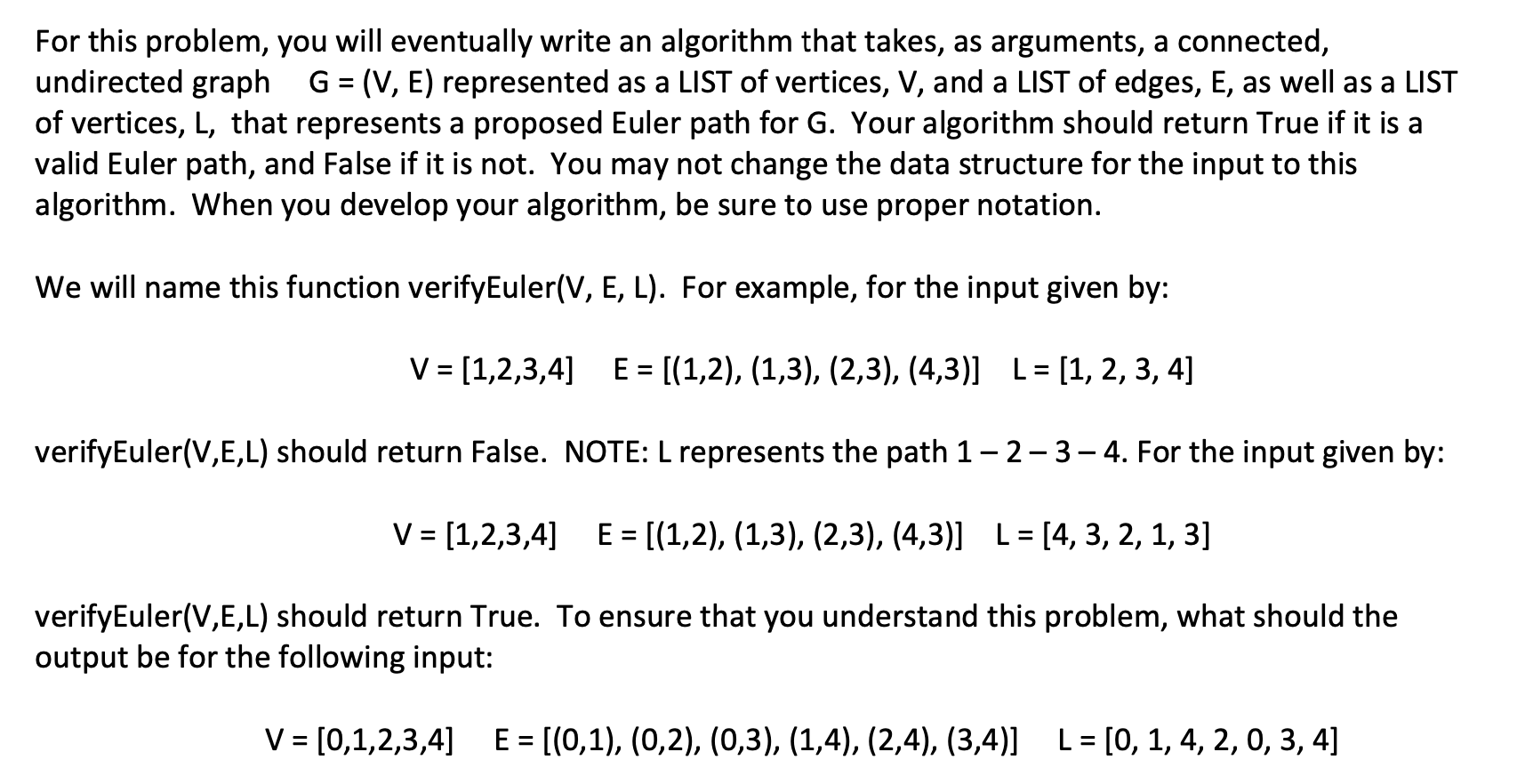
The Goal is verifying that whether L is an Euler path or not. Return True if it is, else return False. (An Euler Path is a path that goes through every edge of a graph exactly once)
For this problem, you will eventually write an algorithm that takes, as arguments, a connected, undirected graph G=(V,E) represented as a LIST of vertices, V, and a LIST of edges, E, as well as a LIST of vertices, L, that represents a proposed Euler path for G. Your algorithm should return True if it is a valid Euler path, and False if it is not. You may not change the data structure for the input to this algorithm. When you develop your algorithm, be sure to use proper notation. We will name this function verifyEuler(V, E, L). For example, for the input given by: V=[1,2,3,4]E=[(1,2),(1,3),(2,3),(4,3)]L=[1,2,3,4] verifyEuler (V,E,L) should return False. NOTE: L represents the path 1234. For the input given by: V=[1,2,3,4]E=[(1,2),(1,3),(2,3),(4,3)]L=[4,3,2,1,3] verifyEuler(V,E,L) should return True. To ensure that you understand this problem, what should the output be for the following input: V=[0,1,2,3,4]E=[(0,1),(0,2),(0,3),(1,4),(2,4),(3,4)]L=[0,1,4,2,0,3,4]
Step by Step Solution
There are 3 Steps involved in it

Get step-by-step solutions from verified subject matter experts
 Study Help