



Question: can anyone help with this question... 5. In the IQ example, X, ~ N(0,100), 0 ~ N(100, 225). Suppose the child took two tests and
can anyone help with this question...
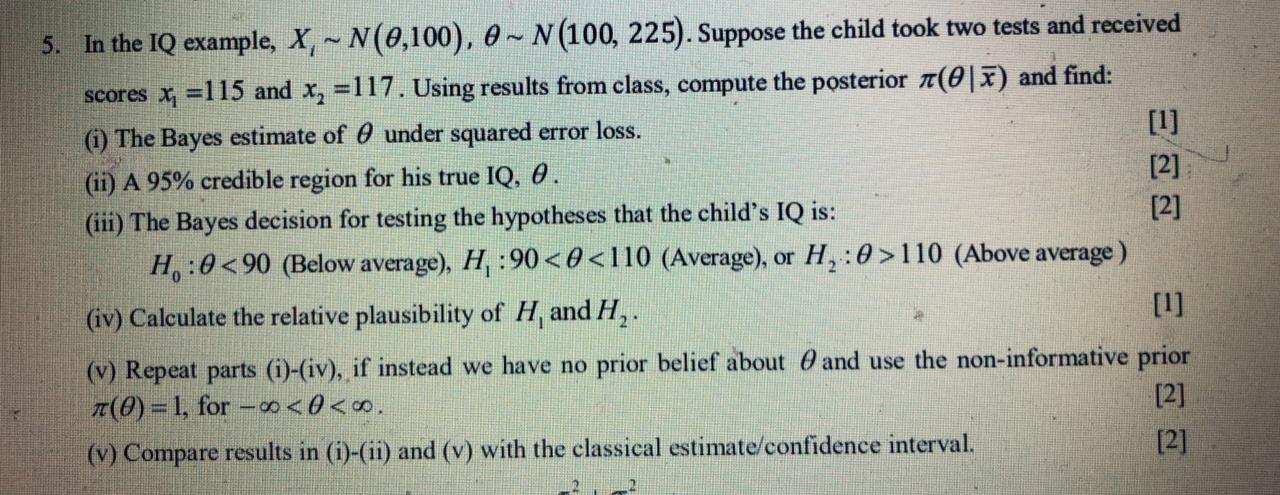
5. In the IQ example, X, ~ N(0,100), 0 ~ N(100, 225). Suppose the child took two tests and received scores x, =115 and x, =117 . Using results from class, compute the posterior 7(0 | x) and find: (i) The Bayes estimate of O under squared error loss. [1] (ii) A 95% credible region for his true IQ, 0. [2] (iii) The Bayes decision for testing the hypotheses that the child's IQ is: [2] H, :0 110 (Above average ) (iv) Calculate the relative plausibility of H, and H . [1] (v) Repeat parts (i)-(iv), if instead we have no prior belief about O and use the non-informative prior TT(0) =1, for -co
Step by Step Solution
There are 3 Steps involved in it
1 Expert Approved Answer
Step: 1 Unlock

Question Has Been Solved by an Expert!
Get step-by-step solutions from verified subject matter experts
Step: 2 Unlock
Step: 3 Unlock