





Question: Can anyone please answer question 6? It looks like really really long, but it's actually really easy--just a lot (but not hard!) to read? 6.
Can anyone please answer question 6? It looks like really really long, but it's actually really easy--just a lot (but not hard!) to read?
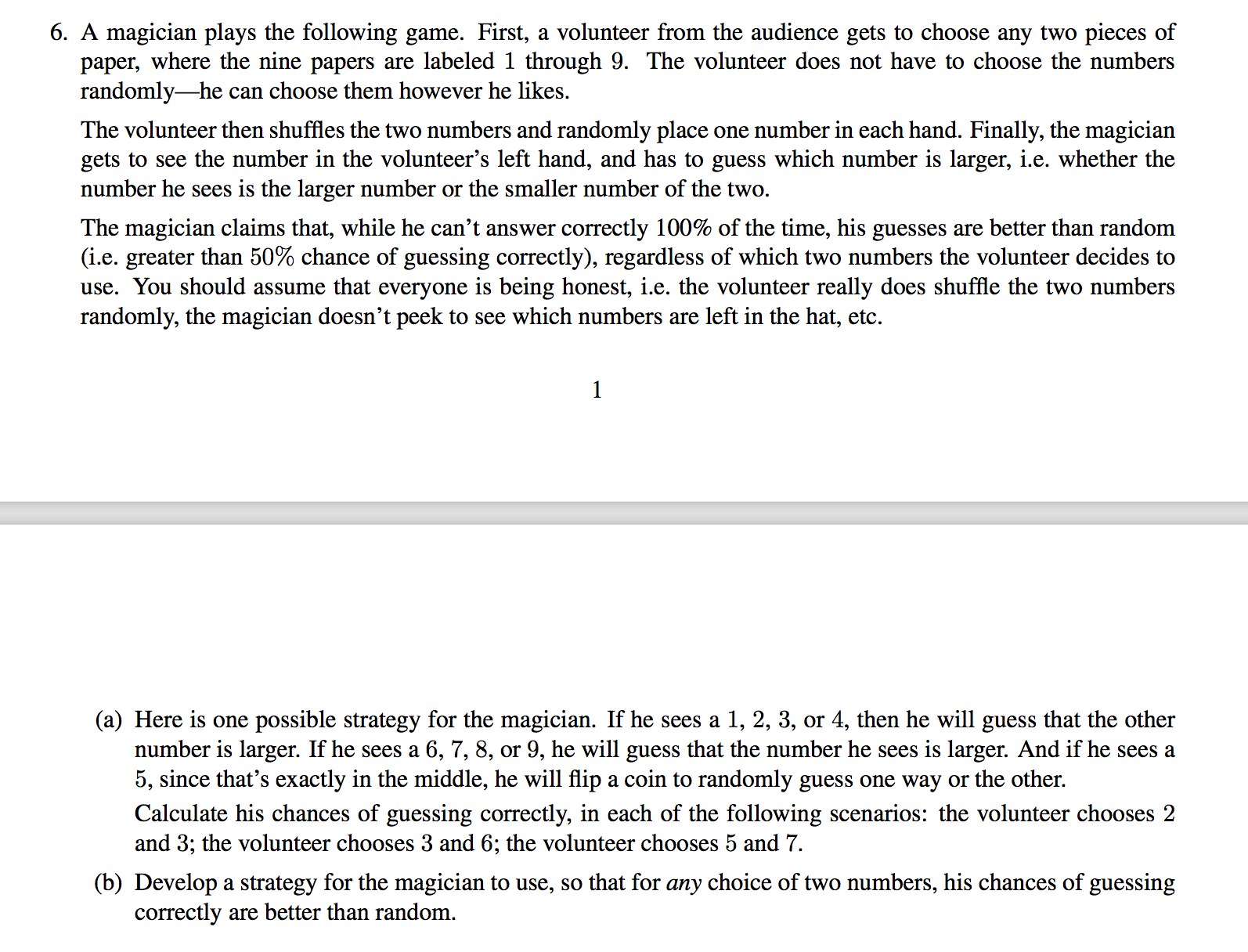
6. A magician plays the following game. First, a volunteer from the audience gets to choose any two pieces of paper, where the nine papers are labeled 1 through 9. The volunteer does not have to choose the numbers randomlyhe can choose them however he likes. The volunteer then shufes the two numbers and randomly place one number in each hand. Finally, the magician gets to see the number in the volunteer's left hand, and has to guess which number is larger, i.e. whether the number he sees is the larger number or the smaller number of the two. The magician claims that, while he can't answer correctly 100% of the time, his guesses are better than random (i.e. greater than 50% chance of guessing correctly), regardless of which two numbers the volunteer decides to use. You should assume that everyone is being honest, i.e. the volunteer really does shufe the two numbers randomly, the magician doesn't peek to see which numbers are left in the hat, etc. (a) Here is one possible strategy for the magician. If he sees a 1, 2, 3, or 4, then he will guess that the other number is larger. If he sees a 6, 7, 8, or 9, he will guess that the number he sees is larger. And if he sees a 5, since that's exactly in the middle, he will ip a coin to randomly guess one way or the other. Calculate his chances of guessing correctly, in each of the following scenarios: the volunteer chooses 2 and 3; the volunteer chooses 3 and 6; the volunteer chooses 5 and 7. (b) Develop a strategy for the magician to use, so that for any choice of two numbers, his chances of guessing correctly are better than random

