







Question: can i get any help with this in SIMIO software or results are fine need solution in simio software results This lab involves developing a
can i get any help with this in SIMIO software or results are fine 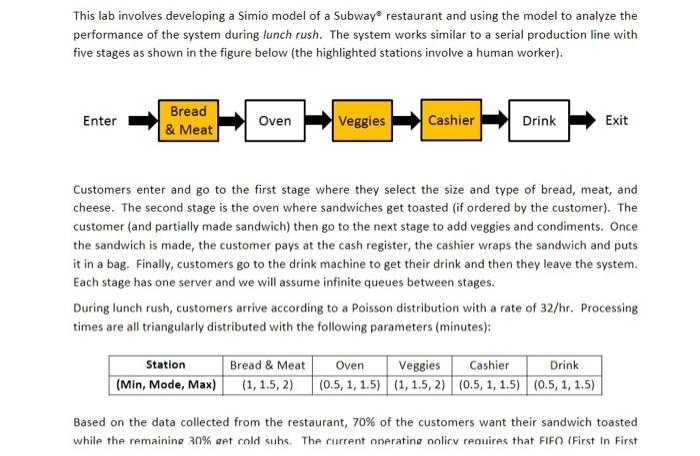
need solution in simio software results 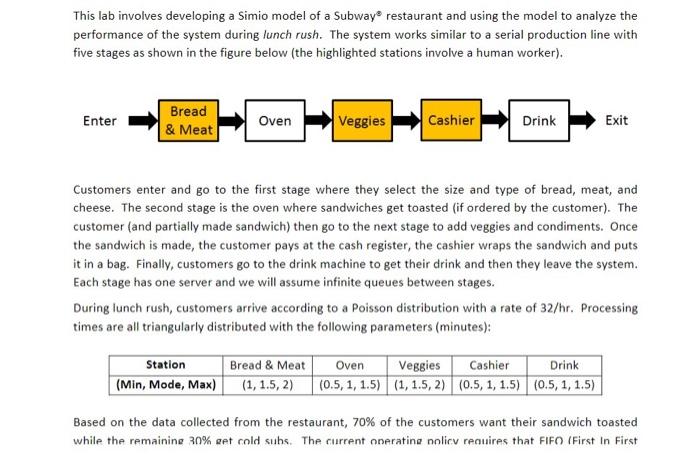
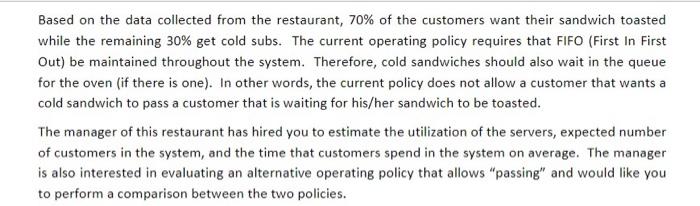
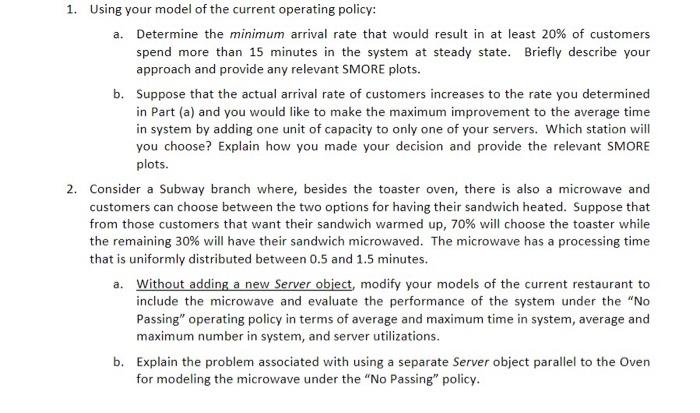
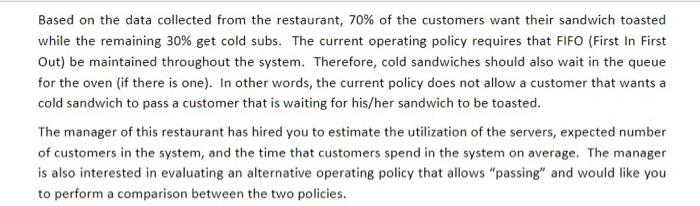
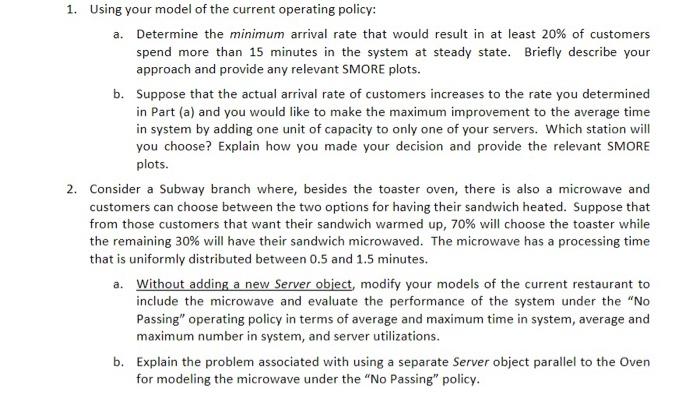
This lab involves developing a Simio model of a Subway restaurant and using the model to analyze the performance of the system during lunch rush. The system works similar to a serial production line with five stages as shown in the figure below (the highlighted stations involve a human worker). Enter Bread & Meat Oven Veggies Cashier Drink Exit Customers enter and go to the first stage where they select the size and type of bread, meat, and cheese. The second stage is the oven where sandwiches get toasted (if ordered by the customer). The customer and partially made sandwich) then go to the next stage to add veggies and condiments. Once the sandwich is made, the customer pays at the cash register, the cashier wraps the sandwich and puts it in a bag. Finally, customers go to the drink machine to get their drink and then they leave the system. Each stage has one server and we will assume infinite queues between stages. During lunch rush, customers arrive according to a Poisson distribution with a rate of 32/hr. Processing times are all triangularly distributed with the following parameters (minutes): Station Bread & Meat Oven Veggies Cashier Drink (Min, Mode, Max) (1,1.5, 2) (0.5, 1, 1.5) (1,1.5, 2) (0.5, 1, 1.5) (0.5, 1, 1.5) Based on the data collected from the restaurant, 70% of the customers want their sandwich toasted while the remainine 30% get cold subs. The current onerating nolicy requires that FIFO (First In First Based on the data collected from the restaurant, 70% of the customers want their sandwich toasted while the remaining 30% get cold subs. The current operating policy requires that FIFO (First In First Out) be maintained throughout the system. Therefore, cold sandwiches should also wait in the queue for the oven (if there is one). In other words, the current policy does not allow a customer that wants a cold sandwich to pass a customer that is waiting for his/her sandwich to be toasted. The manager of this restaurant has hired you to estimate the utilization of the servers, expected number of customers in the system, and the time that customers spend in the system on average. The manager is also interested in evaluating an alternative operating policy that allows "passing" and would like you to perform a comparison between the two policies. 1. Using your model of the current operating policy: a. Determine the minimum arrival rate that would result in at least 20% of customers spend more than 15 minutes in the system at steady state. Briefly describe your approach and provide any relevant SMORE plots. b. Suppose that the actual arrival rate of customers increases to the rate you determined in Part (a) and you would like to make the maximum improvement to the average time in system by adding one unit of capacity to only one of your servers. Which station will you choose? Explain how you made your decision and provide the relevant SMORE plots. 2. Consider a Subway branch where, besides the toaster oven, there is also a microwave and customers can choose between the two options for having their sandwich heated. Suppose that from those customers that want their sandwich warmed up, 70% will choose the toaster while the remaining 30% will have their sandwich microwaved. The microwave has a processing time that is uniformly distributed between 0.5 and 1.5 minutes. a. Without adding a new Server object, modify your models of the current restaurant to include the microwave and evaluate the performance of the system under the "No Passing" operating policy in terms of average and maximum time in system, average and maximum number in system, and server utilizations. b. Explain the problem associated with using a separate Server object parallel to the Oven for modeling the microwave under the "No Passing" policy. This lab involves developing a Simio model of a Subway restaurant and using the model to analyze the performance of the system during lunch rush. The system works similar to a serial production line with five stages as shown in the figure below (the highlighted stations involve a human worker). Enter Bread & Meat Oven Veggies Cashier Drink Exit Customers enter and go to the first stage where they select the size and type of bread, meat, and cheese. The second stage is the oven where sandwiches get toasted (if ordered by the customer). The customer (and partially made sandwich) then go to the next stage to add veggies and condiments. Once the sandwich is made, the customer pays at the cash register, the cashier wraps the sandwich and puts it in a bag. Finally, customers go to the drink machine to get their drink and then they leave the system. Each stage has one server and we will assume infinite queues between stages. During lunch rush, customers arrive according to a Poisson distribution with a rate of 32/hr. Processing times are all triangularly distributed with the following parameters (minutes): Station Bread & Meat Oven Veggies Cashier Drink (Min, Mode, Max) (1,1.5, 2) (0.5, 1, 1.5) (1,1.5, 2) (0.5, 1, 1.5) (0.5, 1, 1.5) Based on the data collected from the restaurant, 70% of the customers want their sandwich toasted while the remainine 30% set cold subs. The current oneratine nolic requires that FIFO (First In First Based on the data collected from the restaurant, 70% of the customers want their sandwich toasted while the remaining 30% get cold subs. The current operating policy requires that FIFO (First In First Out) be maintained throughout the system. Therefore, cold sandwiches should also wait in the queue for the oven (if there is one). In other words, the current policy does not allow a customer that wants a cold sandwich to pass a customer that is waiting for his/her sandwich to be toasted. The manager of this restaurant has hired you to estimate the utilization of the servers, expected number of customers in the system, and the time that customers spend in the system on average. The manager is also interested in evaluating an alternative operating policy that allows "passing" and would like you to perform a comparison between the two policies. 1. Using your model of the current operating policy: a. Determine the minimum arrival rate that would result in at least 20% of customers spend more than 15 minutes in the system at steady state. Briefly describe your approach and provide any relevant SMORE plots. b. Suppose that the actual arrival rate of customers increases to the rate you determined in Part (a) and you would like to make the maximum improvement to the average time in system by adding one unit of capacity to only one of your servers. Which station will you choose? Explain how you made your decision and provide the relevant SMORE plots. 2. Consider a Subway branch where, besides the toaster oven, there is also a microwave and customers can choose between the two options for having their sandwich heated. Suppose that from those customers that want their sandwich warmed up, 70% will choose the toaster while the remaining 30% will have their sandwich microwaved. The microwave has a processing time that is uniformly distributed between 0.5 and 1.5 minutes. a. Without adding a new Server object, modify your models of the current restaurant to include the microwave and evaluate the performance of the system under the "No Passing" operating policy in terms of average and maximum time in system, average and maximum number in system, and server utilizations. b. Explain the problem associated with using a separate Server object parallel to the Oven for modeling the microwave under the "No Passing" policy Step by Step Solution
There are 3 Steps involved in it
1 Expert Approved Answer
Step: 1 Unlock

Question Has Been Solved by an Expert!
Get step-by-step solutions from verified subject matter experts
Step: 2 Unlock
Step: 3 Unlock
 Study Help