







Question: Can I get some help with this problem? Thanks! Problem 1 - Patent rights, research, and product development. Consider a market with an upstream researcher
Can I get some help with this problem? Thanks!
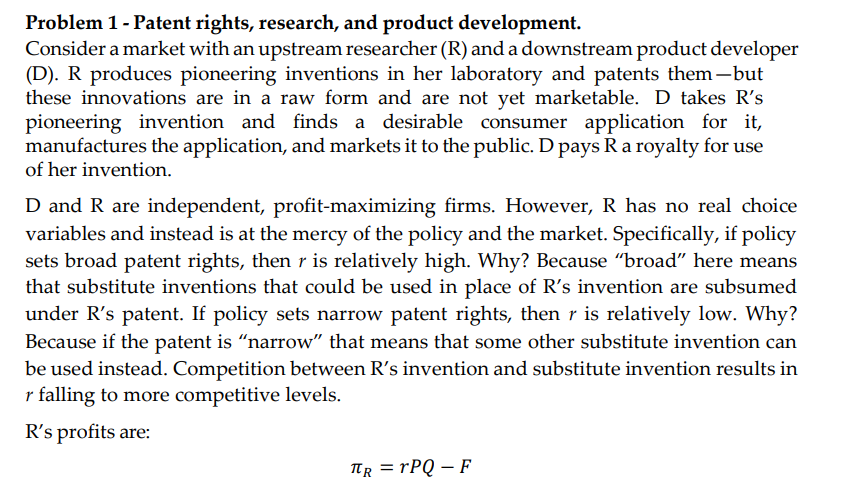
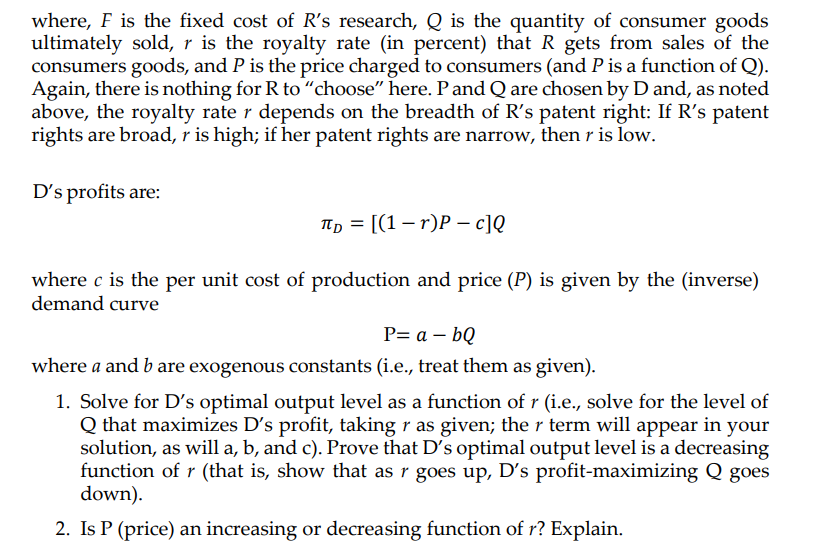
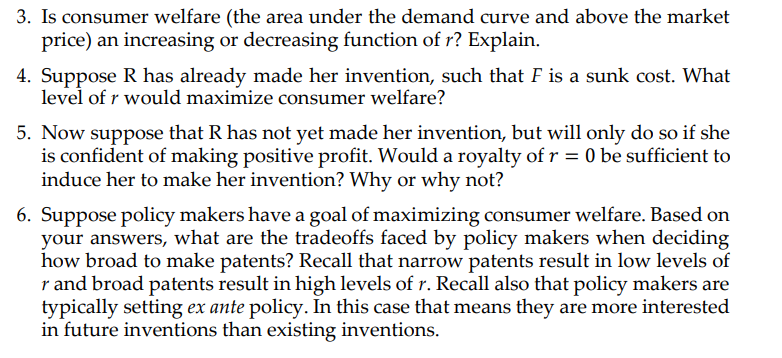
Problem 1 - Patent rights, research, and product development. Consider a market with an upstream researcher {R} and a downstream product deveIOper (D). R produces pioneering inventions in her laboratory and patents them but these innovations are in a raw form and are not yet marketable. D takes R's pioneering invention and finds a desirable consumer application for it, manufactures the application, and markets it to the public. D pays R a royalty for use of her invention. D and R are independent, profitmaximizing firms. However, R has no real choice variables and instead is at the mercy of the policy and the market. Specifically, if policy sets broad patent rights, then r is relatively high. W'hy? Because \"broad" here means that substitute inventions that could be used in place of R's invention are subsumed under R's patent. If policy sets narrow patent rights, then r is relatively low. Why? Because if the patent is \"narrow" that means that some other substitute invention can be used instead. Competition between R's invention and substitute invention results in r falling to more competitive levels. R's profits are: HR = TPQ F where, F is the fixed cost of R's research, Q is the quantity of consumer goods ultimately sold, r is the royalty rate (in percent) that R gets from sales of the consumers goods, and P is the price charged to consumers (and P is a function of Q). Again, there is nothing for R to "choose" here. P and Q are chosen by D and, as noted above, the royalty rate r depends on the breadth of R's patent right: If R's patent rights are broad, r is high; if her patent rights are narrow, then r is low. D's profits are: TID = [(1-r)P - c]Q where c is the per unit cost of production and price (P) is given by the (inverse) demand curve P= a - bQ where a and b are exogenous constants (i.e., treat them as given). 1. Solve for D's optimal output level as a function of r (i.e., solve for the level of Q that maximizes D's profit, taking r as given; the r term will appear in your solution, as will a, b, and c). Prove that D's optimal output level is a decreasing function of r (that is, show that as r goes up, D's profit-maximizing Q goes down). 2. Is P (price) an increasing or decreasing function of r? Explain.. Is consumer welfare {the area under the demand curve and above the market price) an increasing or decreasing function of r? Explain. . Suppose R has already made her invention, such that F is a sunk cost. What level of r would maximize consumer welfare? . Now suppose that R has not yet made her invention, but will only do so if she is confident of making positive profit. Would a royalty of r = I] be sufficient to induce her to make her invention? 'Why or why not? . Suppose policy makers have a goal of maximizing consumer welfare. Based on your answers, what are the tradeoffs faced by policy makers when deciding how broad to make patents? Recall that narrow patents result in low levels of r and broad patents result in high levels of r. Recall also that policy makers are typically setting ex ante policy. In this case that means they are more interested in future inventions than existing inventions
Step by Step Solution
There are 3 Steps involved in it

Get step-by-step solutions from verified subject matter experts
 Study Help