







Question: Can I get the answers for these python programming problems?Exercise 3 The dimer covering problem [ 1 2 points ] A well studied problem in
Can I get the answers for these python programming problems?Exercise The dimer covering problem points
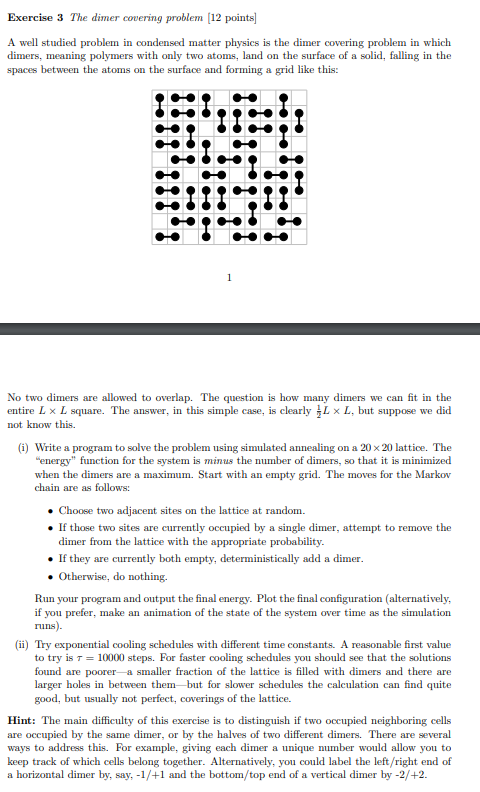
A well studied problem in condensed matter physics is the dimer covering problem in which
dimers, meaning polymers with only two atoms, land on the surface of a solid, falling in the
spaces between the atoms on the surface and forming a grid like this:
No two dimers are allowed to overlap. The question is how many dimers we can fit in the
entire square. The answer, in this simple case, is clearly but suppose we did
not know this.
i Write a program to solve the problem using simulated annealing on a lattice. The
"energy" function for the system is minus the number of dimers, so that it is minimized
when the dimers are a maximum. Start with an empty grid. The moves for the Markov
chain are as follows:
Choose two adjacent sites on the lattice at random.
If those two sites are currently occupied by a single dimer, attempt to remove the
dimer from the lattice with the appropriate probability.
If they are currently both empty, deterministically add a dimer.
Otherwise, do nothing.
Run your program and output the final energy. Plot the final configuration alternatively
if you prefer, make an animation of the state of the system over time as the simulation
runs
ii Try exponential cooling schedules with different time constants. A reasonable first value
to try is steps. For faster cooling schedules you should see that the solutions
found are poorera smaller fraction of the lattice is filled with dimers and there are
larger holes in between thembut for slower schedules the calculation can find quite
good, but usually not perfect, coverings of the lattice.
Hint: The main difficulty of this exercise is to distinguish if two occupied neighboring cells
are occupied by the same dimer, or by the halves of two different dimers. There are several
ways to address this. For example, giving each dimer a unique number would allow you to
keep track of which cells belong together. Alternatively, you could label the leftright end of
a horizontal dimer by say, and the bottomtop end of a vertical dimer by
Step by Step Solution
There are 3 Steps involved in it
1 Expert Approved Answer
Step: 1 Unlock

Question Has Been Solved by an Expert!
Get step-by-step solutions from verified subject matter experts
Step: 2 Unlock
Step: 3 Unlock
 Study Help