







Question: Can I please get help with this assignment. I just want to clarify I'm doing it right. Part 2 Data: Rate of Reaction 360 540
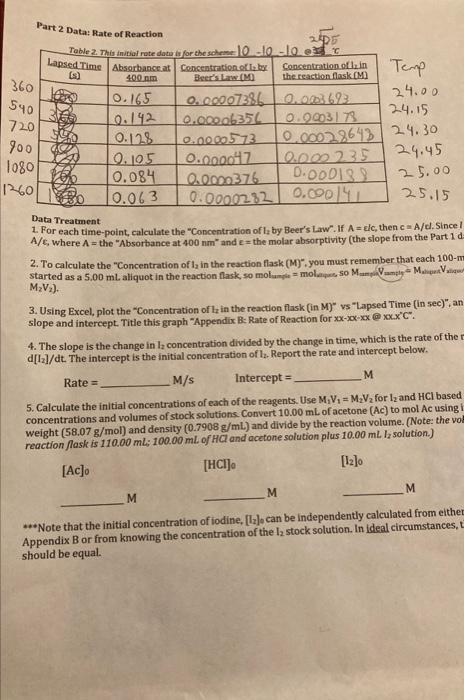
Part 2 Data: Rate of Reaction 360 540 720 900 2105 Table 2. This inatial rate datote for the scheme 100 loc Lapsed Time Absorbance at Concentration of te by Concentration of in Temp 400 m Beer's Law the reaction flask CM 10. 165 0.00007386 0.003693 24.00 0.142 24.15 0.00006354 0.00031 73 2 0.125 0.0000573 0.00022643 24.30 0.105 1080 0.000047 0.000235 24.45 are 0.084 0.0000376 D.00019 25.00 1260 10.063 0.0000232 0.00014 25.15 Data Treatment 1. For each time-point, calculate the "Concentration of I, by Beer's Law". If Aclc then c = A/d. Since! A/c, where A = the "Absorbance at 400 nmand e = the molar absorptivity (the slope from the Part 1d 2. To calculate the "Concentration of lz in the reaction flask (M)", you must remember that each 100-m started as a 5.00 ml. aliquot in the reaction flask, so molungie = mole, So Many Mangaw M2V). 3. Using Excel, plot the "Concentration of hy in the reaction flask (in My" vs "Lapsed Time (in sec)", an slope and intercept. Title this graph "Appendix B: Rate of Reaction for xx-xx-xx @ xxxC 4. The slope is the change in lconcentration divided by the change in time, which is the rate of the d[1/dt. The intercept is the initial concentration of Is. Report the rate and intercept below. Rate = M/s M Intercept = 5. Calculate the initial concentrations of each of the reagents. Use M,V, = M,V2 for lz and HCl based concentrations and volumes of stock solutions. Convert 10.00 mL of acetone (Ac) to mol Ac using i weight (58.07 g/mol) and density (0.7908 g/ml) and divide by the reaction volume. (Note: the vol reaction flask is 110.00 ml: 100.00 mL of HCl and acetone solution plus 10.00 mL l, solution) [AC] [HCI]. [12] M M M ***Note that the initial concentration of iodine, [[z]o can be independently calculated from either Appendix B or from knowing the concentration of the Iz stock solution. In ideal circumstances, should be equal. Part 2 Data: Rate of Reaction 360 540 720 900 2105 Table 2. This inatial rate datote for the scheme 100 loc Lapsed Time Absorbance at Concentration of te by Concentration of in Temp 400 m Beer's Law the reaction flask CM 10. 165 0.00007386 0.003693 24.00 0.142 24.15 0.00006354 0.00031 73 2 0.125 0.0000573 0.00022643 24.30 0.105 1080 0.000047 0.000235 24.45 are 0.084 0.0000376 D.00019 25.00 1260 10.063 0.0000232 0.00014 25.15 Data Treatment 1. For each time-point, calculate the "Concentration of I, by Beer's Law". If Aclc then c = A/d. Since! A/c, where A = the "Absorbance at 400 nmand e = the molar absorptivity (the slope from the Part 1d 2. To calculate the "Concentration of lz in the reaction flask (M)", you must remember that each 100-m started as a 5.00 ml. aliquot in the reaction flask, so molungie = mole, So Many Mangaw M2V). 3. Using Excel, plot the "Concentration of hy in the reaction flask (in My" vs "Lapsed Time (in sec)", an slope and intercept. Title this graph "Appendix B: Rate of Reaction for xx-xx-xx @ xxxC 4. The slope is the change in lconcentration divided by the change in time, which is the rate of the d[1/dt. The intercept is the initial concentration of Is. Report the rate and intercept below. Rate = M/s M Intercept = 5. Calculate the initial concentrations of each of the reagents. Use M,V, = M,V2 for lz and HCl based concentrations and volumes of stock solutions. Convert 10.00 mL of acetone (Ac) to mol Ac using i weight (58.07 g/mol) and density (0.7908 g/ml) and divide by the reaction volume. (Note: the vol reaction flask is 110.00 ml: 100.00 mL of HCl and acetone solution plus 10.00 mL l, solution) [AC] [HCI]. [12] M M M ***Note that the initial concentration of iodine, [[z]o can be independently calculated from either Appendix B or from knowing the concentration of the Iz stock solution. In ideal circumstances, should be equal
Step by Step Solution
There are 3 Steps involved in it

Get step-by-step solutions from verified subject matter experts
 Study Help