



Question: Can i see this step by step please? Couldn't figure this out. Problem P5-8 (similar to) Assuming a 1-year money market account investment at 487
Can i see this step by step please? Couldn't figure this out.
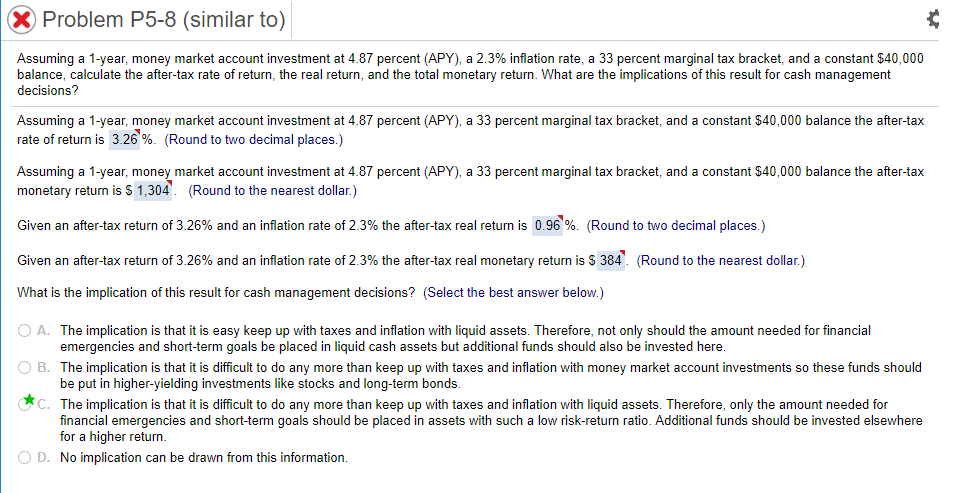
Problem P5-8 (similar to) Assuming a 1-year money market account investment at 487 percent AP a 2.3% infat on rate, a 33 percent marginal tax bracket, and a constant S40000 balance, calculate the after-tax rate of return, the real return, and the total monetary return. What are the implications of this result for cash management decisions? Assuming a 1-year, money market account investment at 4.87 percent (APY), a 33 percent marginal tax bracket, and a constant $40,000 balance the after-tax rate of return is 3.26% (Round to two decimal places) Assuming a 1-year, money market account investment at 4.87 percent (APY), a 33 percent marginal tax bracket, and a constant $40,000 balance the after-tax monetary return is $ 1,304 (Round to the nearest dollar.) Given an after-tax return of 3.26% and an inflation rate of 2.3% the after-tax real retum s D96 %. Round to to decimal places.) Given an after-tax return of 3.26% and an inflation rate of 2.3% the after-tax real monetary return is S 384, (Round to the nearest dollar.) What is the implication of this result for cash management decisions? (Select the best answer below.) A. The implication is that it is easy keep up with taxes and inflation with liquid assets. Therefore, not only should the amount needed for financia B. The implication is that it is difficult to do any more than keep up with taxes and inflation with money market account investments so these funds should C. The implication is that it is difficult to do any more than keep up with taxes and inflation with liquid assets. Therefore, only the amount needed for emergencies and short-term goals be placed in liquid cash assets but additional funds should also be invested here. be put in higher-yielding investments like stocks and long-term bonds financial emergencies and short-term goals should be placed in assets with such a low risk-return ratio. Additional funds should be invested elsewhere for a higher return. D. No implication can be drawn from this information. Problem P5-8 (similar to) Assuming a 1-year money market account investment at 487 percent AP a 2.3% infat on rate, a 33 percent marginal tax bracket, and a constant S40000 balance, calculate the after-tax rate of return, the real return, and the total monetary return. What are the implications of this result for cash management decisions? Assuming a 1-year, money market account investment at 4.87 percent (APY), a 33 percent marginal tax bracket, and a constant $40,000 balance the after-tax rate of return is 3.26% (Round to two decimal places) Assuming a 1-year, money market account investment at 4.87 percent (APY), a 33 percent marginal tax bracket, and a constant $40,000 balance the after-tax monetary return is $ 1,304 (Round to the nearest dollar.) Given an after-tax return of 3.26% and an inflation rate of 2.3% the after-tax real retum s D96 %. Round to to decimal places.) Given an after-tax return of 3.26% and an inflation rate of 2.3% the after-tax real monetary return is S 384, (Round to the nearest dollar.) What is the implication of this result for cash management decisions? (Select the best answer below.) A. The implication is that it is easy keep up with taxes and inflation with liquid assets. Therefore, not only should the amount needed for financia B. The implication is that it is difficult to do any more than keep up with taxes and inflation with money market account investments so these funds should C. The implication is that it is difficult to do any more than keep up with taxes and inflation with liquid assets. Therefore, only the amount needed for emergencies and short-term goals be placed in liquid cash assets but additional funds should also be invested here. be put in higher-yielding investments like stocks and long-term bonds financial emergencies and short-term goals should be placed in assets with such a low risk-return ratio. Additional funds should be invested elsewhere for a higher return. D. No implication can be drawn from this information
Step by Step Solution
There are 3 Steps involved in it

Get step-by-step solutions from verified subject matter experts