Question: Can sickness or disability ever be the basis for a successful claim of frustration of contract? O a. Yes, but only at the point that
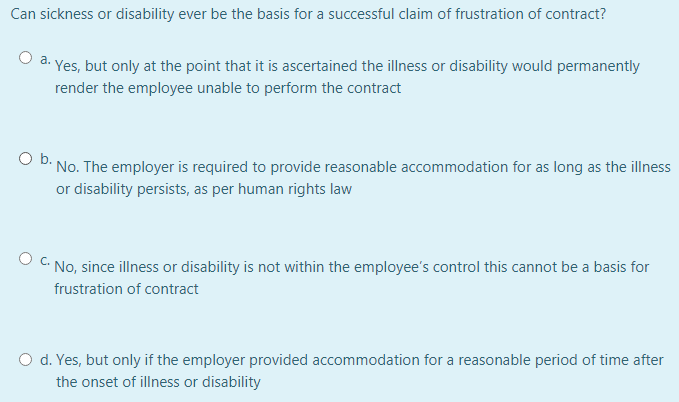
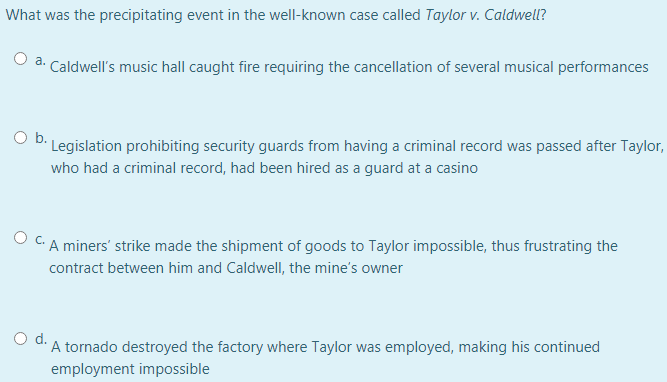
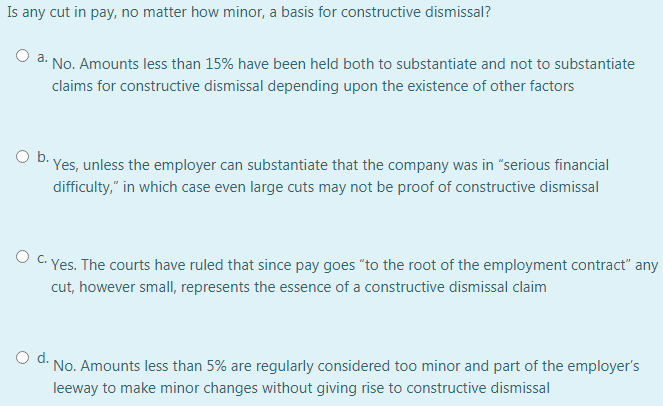
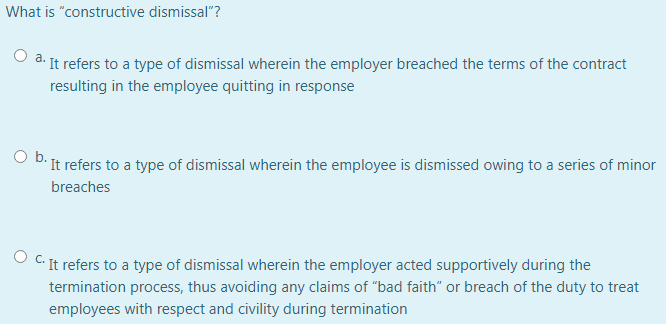
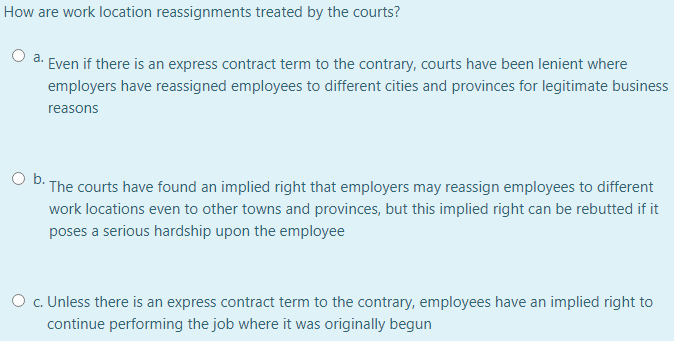
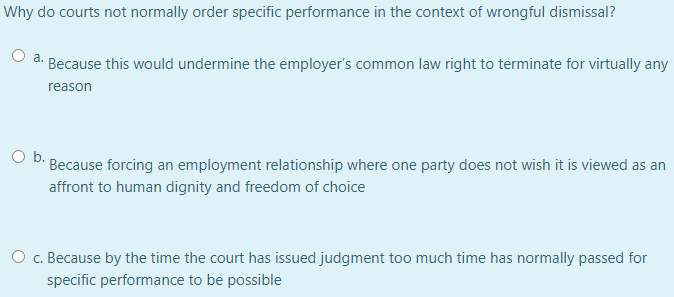
Can sickness or disability ever be the basis for a successful claim of frustration of contract? O a. Yes, but only at the point that it is ascertained the illness or disability would permanently render the employee unable to perform the contract O b. No. The employer is required to provide reasonable accommodation for as long as the illness or disability persists, as per human rights law O C. No, since illness or disability is not within the employee's control this cannot be a basis for frustration of contract O d. Yes, but only if the employer provided accommodation for a reasonable period of time after the onset of illness or disability What was the precipitating event in the well-known case called Taylor v. Caldwell? a. Caldwell's music hall caught fire requiring the cancellation of several musical performances b. Legislation prohibiting security guards from having a criminal record was passed after Taylor, who had a criminal record, had been hired as a guard at a casino C. A miners' strike made the shipment of goods to Taylor impossible, thus frustrating the contract between him and Caldwell, the mine's owner d. 'A tornado destroyed the factory where Taylor was employed, making his continued employment impossible Is any cut in pay, no matter how minor, a basis for constructive dismissal? a. No. Amounts less than 15% have been held both to substantiate and not to substantiate claims for constructive dismissal depending upon the existence of other factors O b. Yes, unless the employer can substantiate that the company was in "serious financial difficulty," in which case even large cuts may not be proof of constructive dismissal O c. Yes. The courts have ruled that since pay goes to the root of the employment contract" any cut, however small, represents the essence of a constructive dismissal claim O d. No. Amounts less than 5% are regularly considered too minor and part of the employer's leeway to make minor changes without giving rise to constructive dismissal What is "constructive dismissal"? a. It refers to a type of dismissal wherein the employer breached the terms of the contract resulting in the employee quitting in response b. 'It refers to a type of dismissal wherein the employee is dismissed owing to a series of minor breaches O C. It refers to a type of dismissal wherein the employer acted supportively during the termination process, thus avoiding any claims of "bad faith" or breach of the duty to treat employees with respect and civility during termination How are work location reassignments treated by the courts? a. Even if there is an express contract term to the contrary, courts have been lenient where employers have reassigned employees to different cities and provinces for legitimate business reasons O b. The courts have found an implied right that employers may reassign employees to different work locations even to other towns and provinces, but this implied right can be rebutted if it poses a serious hardship upon the employee O c. Unless there is an express contract term to the contrary, employees have an implied right to continue performing the job where it was originally begun Why do courts not normally order specific performance in the context of wrongful dismissal? a. Because this would undermine the employer's common law right to terminate for virtually any reason b. Because forcing an employment relationship where one party does not wish it is viewed as an affront to human dignity and freedom of choice c. Because by the time the court has issued judgment too much time has normally passed for specific performance to be possible









 Study Help