



Question: Can someone answer the application of chapter content questions. I need a different perspective! Management in Action Vegan Leather: Earth's Friend or Foe? Clothes wreak
Can someone answer the application of chapter content questions. I need a different perspective! 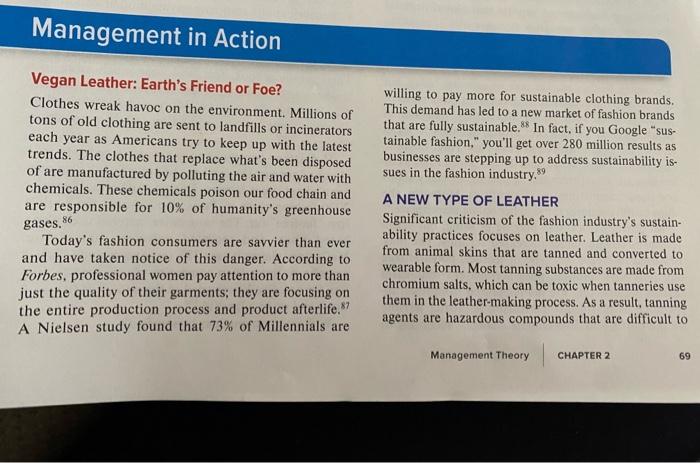
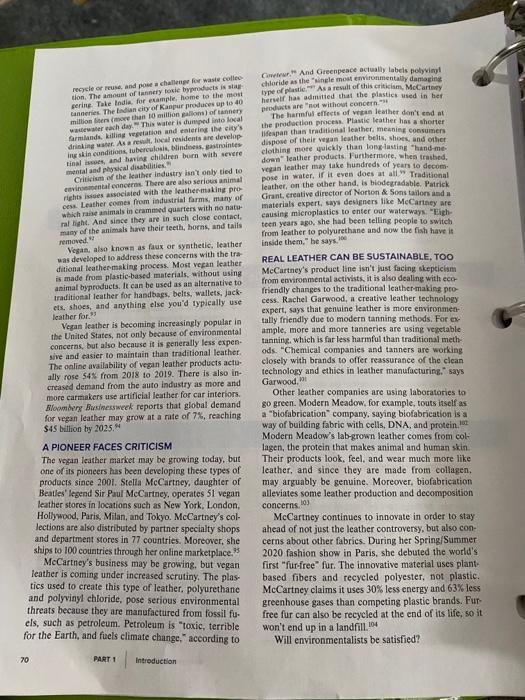
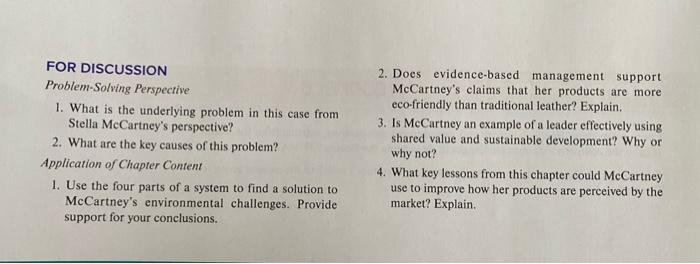
Management in Action Vegan Leather: Earth's Friend or Foe? Clothes wreak havoc on the environment. Millions of tons of old clothing are sent to landfills or incinerators each year as Americans try to keep up with the latest trends. The clothes that replace what's been disposed of are manufactured by polluting the air and water with chemicals. These chemicals poison our food chain and are responsible for 10% of humanity's greenhouse gases.86 Today's fashion consumers are savvier than ever and have taken notice of this danger. According to Forbes, professional women pay attention to more than just the quality of their garments, they are focusing on the entire production process and product afterlife. A Nielsen study found that 73% of Millennials are willing to pay more for sustainable clothing brands. This demand has led to a new market of fashion brands that are fully sustainable. In fact, if you Google "sus- tainable fashion," you'll get over 280 million results as businesses are stepping up to address sustainability is- sues in the fashion industry A NEW TYPE OF LEATHER Significant criticism of the fashion industry's sustain- ability practices focuses on leather. Leather is made from animal skins that are tanned and converted to wearable form. Most tanning substances are made from chromium salts, which can be toxic when tanneries use them in the leather-making process. As a result, tanning agents are hazardous compounds that are difficult to Management Theory CHAPTER 2 69 cycle of reuse and pose a challenge for waste colle tion. The amount of tannery foxie byproducts is a gering. Tale India for example, home to the most camere The Indian city of Kanpur produces up to 40 milliers (more than 10 million pallons) of tannery wastewater day. This water is dumped into focal farmlands Bling vegetation and entering the city's drinking water. As a result, al residents are develop ing skin conditions tuberculosi, tinders, gastrointes TAN, and having children born with severe mental and physical disabilities Criticism of the leather industry isn't only tied to cental concerns. There are also serious animal rights is associated with the leather making pro Des Leather comes from industrial farms, many of which are animals in crammed quarters with no natur ral light. And since they are in such close contact, many of the animals have their teeth, horns, and tails removed Vegan, also known as faux or synthetic, leather was developed to address these concerns with the tra ditional leather making process. Most vegan leather is made from plastic-based materials, without using animal byproducts. It can be used as an alternative to traditional leather for handbags, belts, wallets, jack els, shoes, and anything else you'd typically use leather for Vegan leather is becoming increasingly popular in the United States, not only because of environmental concerns, but also because it is generally less expen- sive and easier to maintain than traditional leather The online availability of vegan leather products actu- ally rose 54% from 2018 to 2019. There is also in creased demand from the auto industry as more and more carmakers use artificial leather for car interiors Blomberg Businessweek reports that global demand for vegan leather may grow at a rate of 7%, reaching $45 billion by 2025. Cow." And Greenpeace actually labels polyvinyl chloride as the single most environmentally damaging type of plastie ** As a result of this criticism, Marty herself as admitted that the plastic wed in her products are not without concern." The harmful effects of vegan leather don't end at the production proces. Plastic leather has a shorter lifespan than traditional leather meaning consumers dispose of their vegan leather belts, shoes, and other clothing more quickly than long lasting and me down leather products. Furthermore, when trubed. vegan leather may take hundreds of years to decom pose in water, or it even does at all. Traditional leather, on the other hand, is biodegradable. Patrick Grant, creative director of Norton & Sons tailors and a materials expert, says designers like McCartney are causing microplastics to enter oor waterways. "Eigh- teen years ago, she had been telling people to switch from leather to polyurethane and now the fish have inside them," he says.100 REAL LEATHER CAN BE SUSTAINABLE, TOO McCartney's product line isn't just facing skepticism from environmental activists, it is also dealing with eco friendly changes to the traditional leather-making pro- cess. Rachel Garwood, a creative leather technology expert, says that genuine leather is more environmet- tally friendly due to modern tanning methods. For e- ample, more and more tanneries are using vegetable tanning, which is far less harmful than traditional meth ods. "Chemical companies and tanners are working closely with brands to offer reassurance of the clean technology and ethics in leather manufacturing." says Garwood, Other leather companies are using laboratories to go green. Modern Meadow, for example, touts itself as a "biofabrication company, saying biofabrication is a way of building fabric with cells, DNA, and protein. Modern Meadow's lab-grown leather comes from col- lagen, the protein that makes animal and human skin Their products look, feel, and wear much more like leather, and since they are made from collagen, may arguably be genuine. Moreover, biofabrication alleviates some leather production and decomposition concerns to McCartney continues to innovate in order to stay ahead of not just the leather controversy, but also con cerns about other fabrics. During her Spring/Summer 2020 fashion show in Paris, she debuted the world's first "fur-free" fur. The innovative material uses plant- based fibers and recycled polyester, not plastic. McCartney claims it uses 30% less energy and 63% less greenhouse gases than competing plastic brands. Fur- free fur can also be recycled at the end of its life, so it won't end up in a landfill.104 Will environmentalists be satisfied? A PIONEER FACES CRITICISM The vean leather market may be growing today, but one of its pioneers has been developing these types of products since 2001. Stella McCartney, daughter of Beatles'legend Sir Paul McCartney, operates 51 vegan leather stores in locations such as New York, London, Hollywood, Paris, Milan, and Tokyo. McCartney's col- lections are also distributed by partner specialty shops and department stores in 77 countries. Moreover, she ships to 100 countries through her online marketplace." McCartney's business may be growing, but vegan leather is coming under increased scrutiny. The plas- tics used to create this type of leather, polyurethane and polyvinyl chloride, pose serious environmental threats because they are manufactured from fossil fu- els, such as petroleum. Petroleum is "toxic, terrible for the Earth, and fuels climate change, according to 70 PART 1 Introduction FOR DISCUSSION Problem Solving Perspective 1. What is the underlying problem in this case from Stella McCartney's perspective? 2. What are the key causes of this problem? Application of Chapter Content 1. Use the four parts of a system to find a solution to McCartney's environmental challenges. Provide support for your conclusions. 2. Does evidence-based management support McCartney's claims that her products are more eco-friendly than traditional leather? Explain. 3. Is McCartney an example of a leader effectively using shared value and sustainable development? Why or why not? 4. What key lessons from this chapter could McCartney use to improve how her products are perceived by the market? Explain Step by Step Solution
There are 3 Steps involved in it
1 Expert Approved Answer
Step: 1 Unlock

Question Has Been Solved by an Expert!
Get step-by-step solutions from verified subject matter experts
Step: 2 Unlock
Step: 3 Unlock