







Question: Can someone do this in Matlab with showing the command window output? Updated. Nodal analysis of an electrical circuit leads to the following system of
Can someone do this in Matlab with showing the command window output?
Updated.
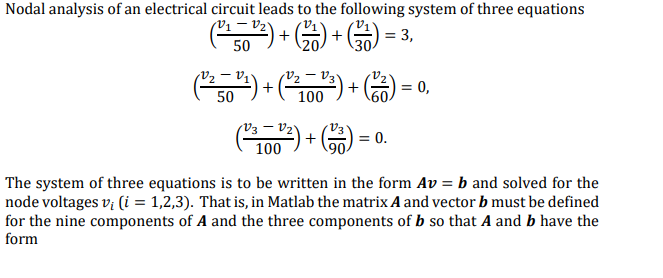
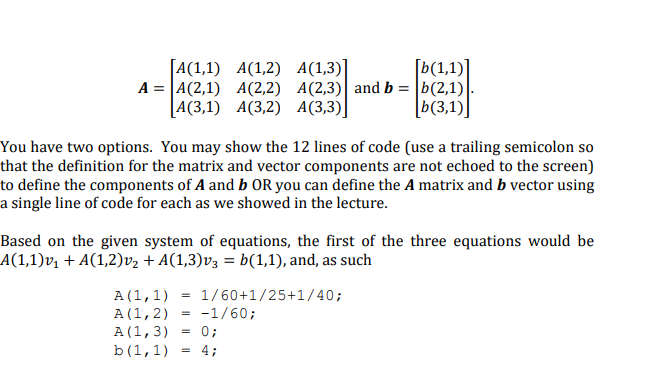
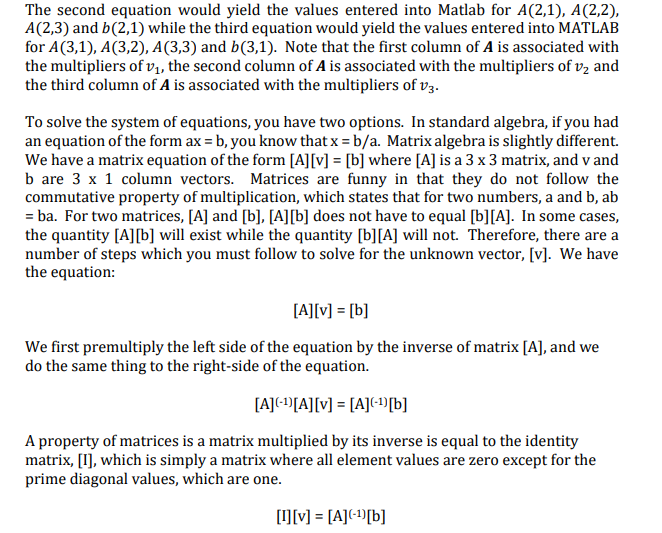
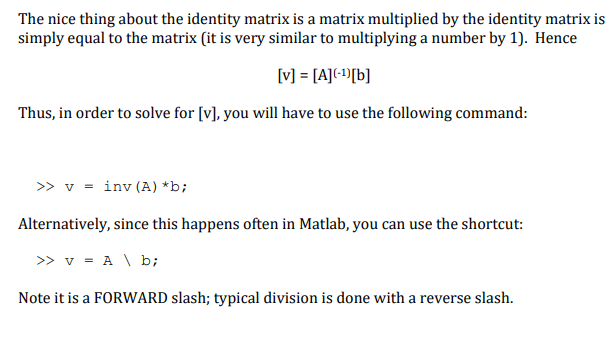
Nodal analysis of an electrical circuit leads to the following system of three equations (-50) +62) = 3, (250") + (2009) + C) = 0, (1002) +63) = 0. The system of three equations is to be written in the form Av = b and solved for the node voltages vi (i = 1,2,3). That is, in Matlab the matrix A and vector b must be defined for the nine components of A and the three components of b so that A and b have the form A(1,1) A(1,2) A(1,3) [b(1,1)] A = A(2,1) A(2,2) A(2,3) and b = |b(2,1). A(3,1) A(3,2) A(3,3) b(3,1) You have two options. You may show the 12 lines of code (use a trailing semicolon so that the definition for the matrix and vector components are not echoed to the screen) to define the components of A and b OR you can define the A matrix and b vector using a single line of code for each as we showed in the lecture. Based on the given system of equations, the first of the three equations would be A(1,1)v. + A(1,2)v2 +A(1,3)vz = b(1,1), and, as such A(1,1) 1/60+1/25+1/40; A(1,2) = -1/60; A(1,3) = 0; b(1,1) 4; The second equation would yield the values entered into Matlab for A(2,1), A(2,2), A(2,3) and b(2,1) while the third equation would yield the values entered into MATLAB for A(3,1), A(3,2), A(3,3) and b(3,1). Note that the first column of A is associated with the multipliers of v, the second column of A is associated with the multipliers of v, and the third column of A is associated with the multipliers of v3. To solve the system of equations, you have two options. In standard algebra, if you had an equation of the form ax = b, you know that x = b/a. Matrix algebra is slightly different. We have a matrix equation of the form [A][v] = [b] where [A] is a 3 x 3 matrix, and v and b are 3 x 1 column vectors. Matrices are funny in that they do not follow the commutative property of multiplication, which states that for two numbers, a and b, ab = ba. For two matrices, [A] and [b], [A][b] does not have to equal [b][A]. In some cases, the quantity [A][b] will exist while the quantity [b][A] will not. Therefore, there are a number of steps which you must follow to solve for the unknown vector, [v]. We have the equation: [A][v] = [b] We first premultiply the left side of the equation by the inverse of matrix [A], and we do the same thing to the right-side of the equation. [A](-1)[A] [v] = [A](-1)[b] A property of matrices is a matrix multiplied by its inverse is equal to the identity matrix, [1], which is simply a matrix where all element values are zero except for the prime diagonal values, which are one. [1] [v] = [A](-1)[b] The nice thing about the identity matrix is a matrix multiplied by the identity matrix is simply equal to the matrix (it is very similar to multiplying a number by 1). Hence [v] = [A](-)[b] Thus, in order to solve for [v], you will have to use the following command: >> v = inv (A) *b; Alternatively, since this happens often in Matlab, you can use the shortcut: >> y = A \ b; Note it is a FORWARD slash; typical division is done with a reverse slash
Step by Step Solution
There are 3 Steps involved in it

Get step-by-step solutions from verified subject matter experts
 Study Help