







Question: Can someone explain each question for me? It's last year exam and The one this year would be similar, so I would love if someone
Can someone explain each question for me? It's last year exam and The one this year would be similar, so I would love if someone could teach&help me out how to solve alike tasks
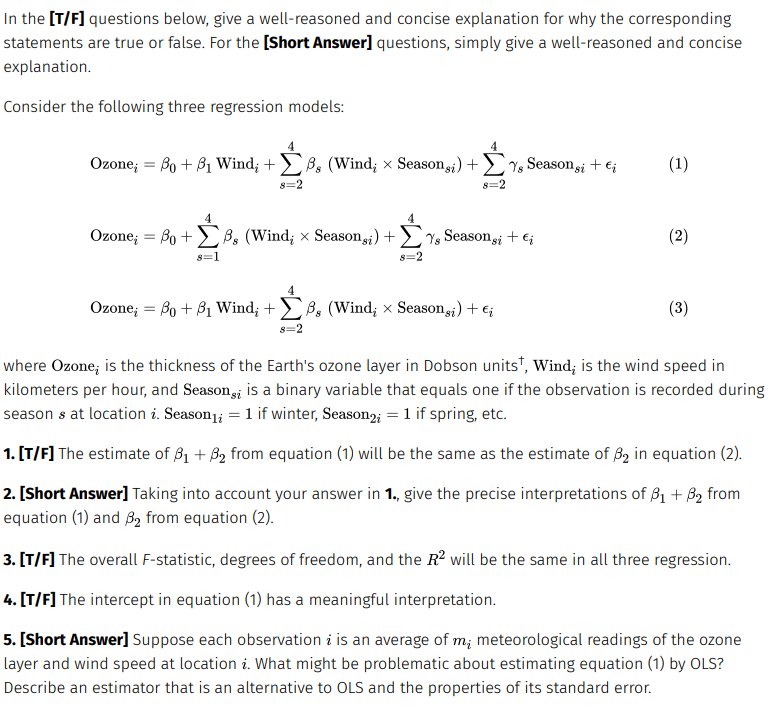
In the [T/F] questions below, give a well-reasoned and concise explanation for why the corresponding statements are true or false. For the [Short Answer] questions, simply give a well-reasoned and concise explanation. Consider the following three regression models: Ozone; = Bo + B, Wind; + B. (Wind; ~ Season gi) + 1 Seasongi + ; L) (1) 8=2 8=2 Ozone; = Bo + B. (Wind; x Seasongi) + 78 Seasongi + (2) 8=1 8=2 Ozone; = Bo + B1 Wind; + B. (Wind; Seasongi) + ; (3) where Ozone; is the thickness of the Earth's ozone layer in Dobson units, Wind; is the wind speed in kilometers per hour, and Seasongi is a binary variable that equals one if the observation is recorded during season s at location i. Seasonli = 1 if winter, Season2i = 1 if spring, etc. 1. [T/F] The estimate of Bi + B2 from equation (1) will be the same as the estimate of B, in equation (2). 2. [Short Answer] Taking into account your answer in 1., give the precise interpretations of B1 + B2 from equation (1) and B2 from equation (2) 3. [T/F] The overall F-statistic, degrees of freedom, and the R2 will be the same in all three regression. 4. [T/F] The intercept in equation (1) has a meaningful interpretation. 5. [Short Answer] Suppose each observation i is an average of m; meteorological readings of the ozone layer and wind speed at location i. What might be problematic about estimating equation (1) by OLS? Describe an estimator that is an alternative to OLS and the properties of its standard error. In the [T/F] questions below, give a well-reasoned and concise explanation for why the corresponding statements are true or false. For the [Short Answer] questions, simply give a well-reasoned and concise explanation. Consider the following three regression models: Ozone; = Bo + B, Wind; + B. (Wind; ~ Season gi) + 1 Seasongi + ; L) (1) 8=2 8=2 Ozone; = Bo + B. (Wind; x Seasongi) + 78 Seasongi + (2) 8=1 8=2 Ozone; = Bo + B1 Wind; + B. (Wind; Seasongi) + ; (3) where Ozone; is the thickness of the Earth's ozone layer in Dobson units, Wind; is the wind speed in kilometers per hour, and Seasongi is a binary variable that equals one if the observation is recorded during season s at location i. Seasonli = 1 if winter, Season2i = 1 if spring, etc. 1. [T/F] The estimate of Bi + B2 from equation (1) will be the same as the estimate of B, in equation (2). 2. [Short Answer] Taking into account your answer in 1., give the precise interpretations of B1 + B2 from equation (1) and B2 from equation (2) 3. [T/F] The overall F-statistic, degrees of freedom, and the R2 will be the same in all three regression. 4. [T/F] The intercept in equation (1) has a meaningful interpretation. 5. [Short Answer] Suppose each observation i is an average of m; meteorological readings of the ozone layer and wind speed at location i. What might be problematic about estimating equation (1) by OLS? Describe an estimator that is an alternative to OLS and the properties of its standard errorStep by Step Solution
There are 3 Steps involved in it
1 Expert Approved Answer
Step: 1 Unlock

Question Has Been Solved by an Expert!
Get step-by-step solutions from verified subject matter experts
Step: 2 Unlock
Step: 3 Unlock
 Study Help