







Question: Can someone explain how? 1-6 on image. 7-12 True or False If false explain why. 7. If y=f(x)g(x) then dy/dx f(x)g'(x) 8. If y=(x+1) (x+2)(x+3)(x+4)
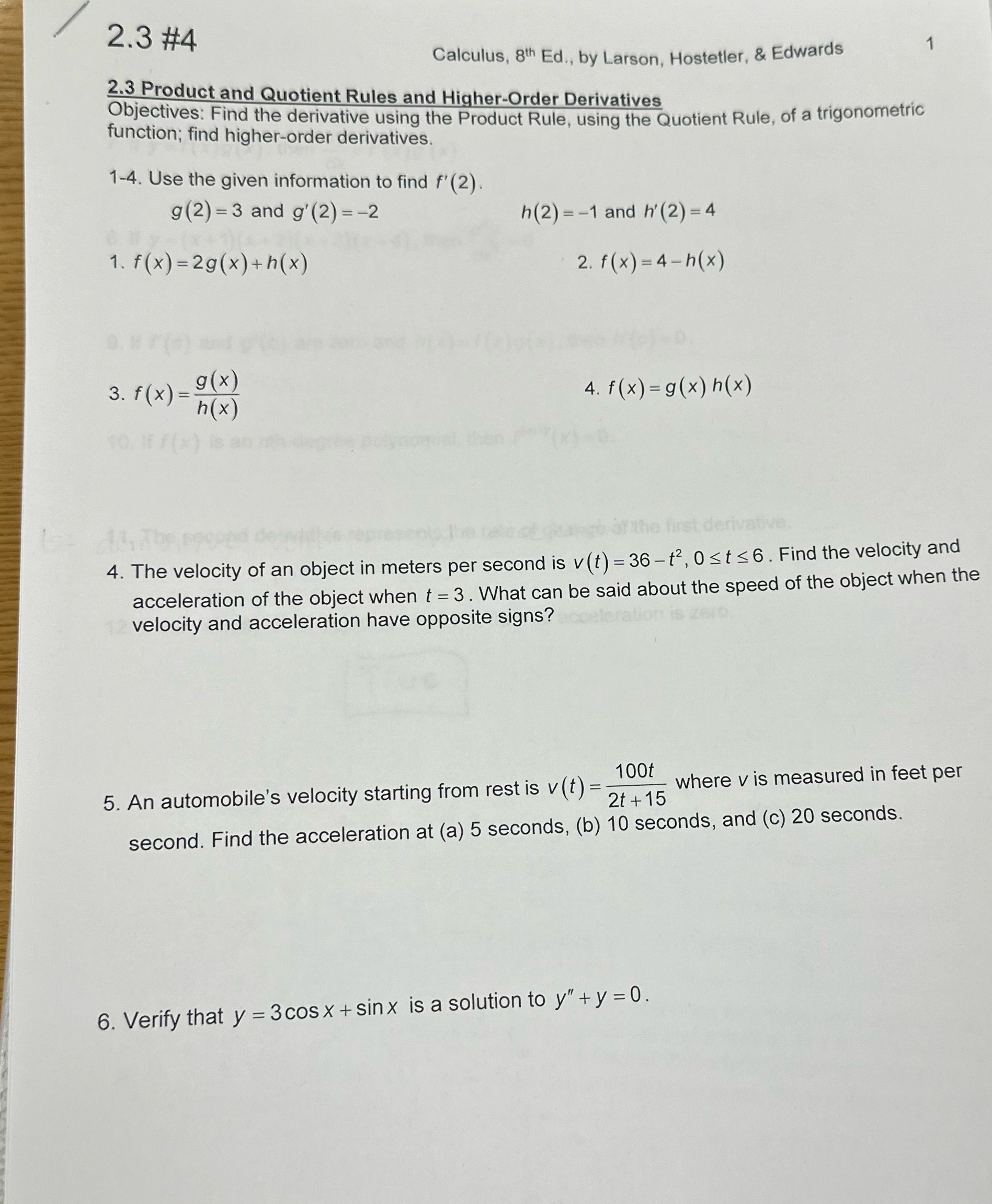
Can someone explain how? 1-6 on image. 7-12 True or False If false explain why. 7. If y=f(x)g(x) then dy/dx f(x)g'(x) 8. If y=(x+1) (x+2)(x+3)(x+4) then d^5y/dx ^5=0 9.If f'(c) and g'(c) are zero and h(x)=f(x)g(x) then h'(c)=0 10. If f(x) is an nth-degreepolynomial then f^(n+1) of (x) = 0 11. Thesecond derivative represents the rate of change of the first derivative 12. If the velocity of an object is constant, then its acceleration is zero
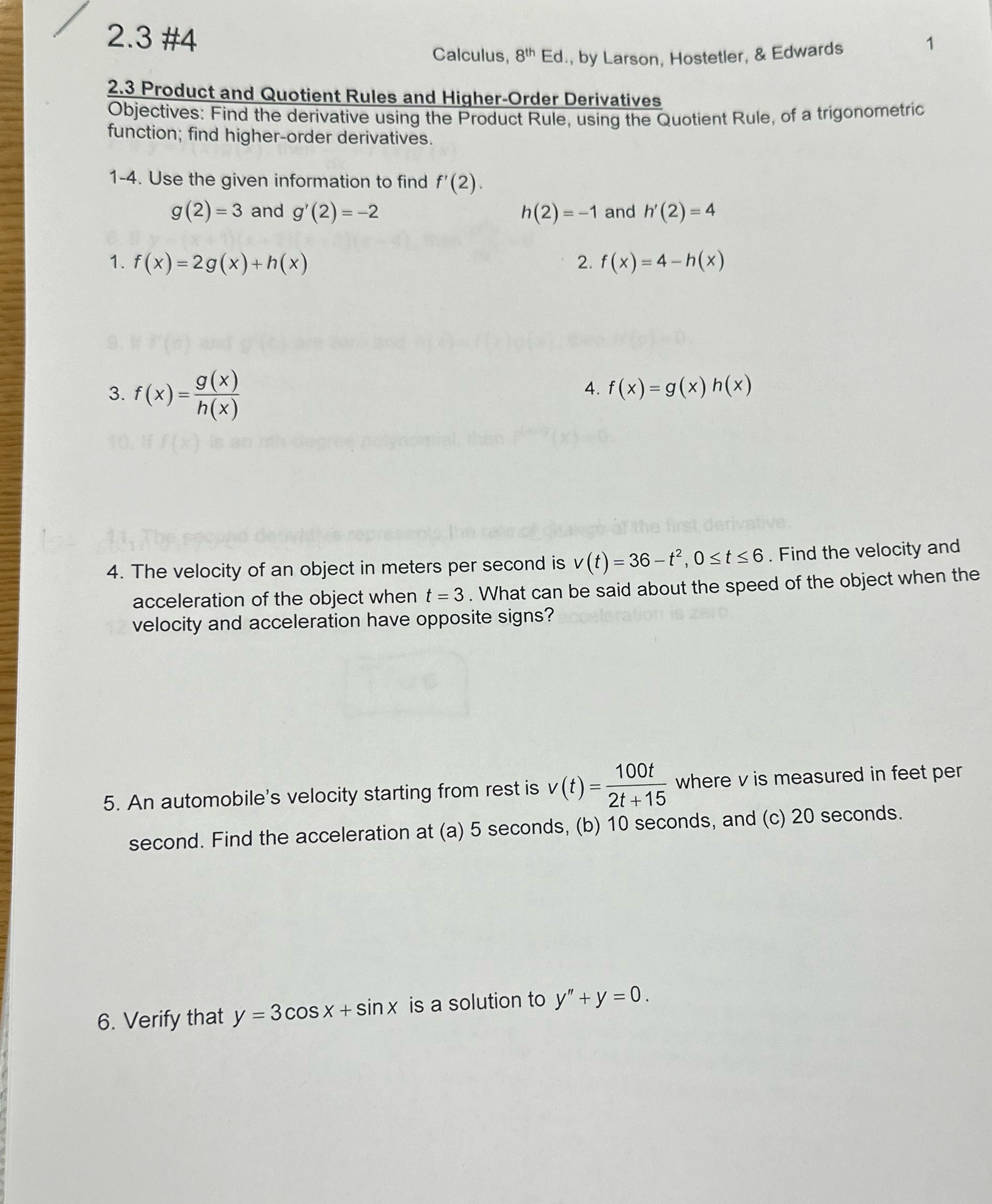
2.3 #4 Calculus, 8th Ed., by Larson, Hostetler, & Edwards 2.3 Product and Quotient Rules and Higher-Order Derivatives Objectives: Find the derivative using the Product Rule, using the Quotient Rule, of a trigonometric function; find higher-order derivatives. 1-4. Use the given information to find f' (2). g (2) = 3 and g' (2) = -2 h(2) = -1 and h'(2) = 4 1. f ( x ) = 29(x) + h (x ) 2. f ( x ) = 4- h(x) 3. f ( x) = _g (x ) h (x) 4. f ( x) = g(x) h(x) 10. If f (x) is an of the first derive 4. The velocity of an object in meters per second is v (t) = 36 - t2, 0
Step by Step Solution
There are 3 Steps involved in it

Get step-by-step solutions from verified subject matter experts
 Study Help