







Question: can someone explain those 2 formula (letters inside it means what, when to use each on, and so on) If the initial value of an
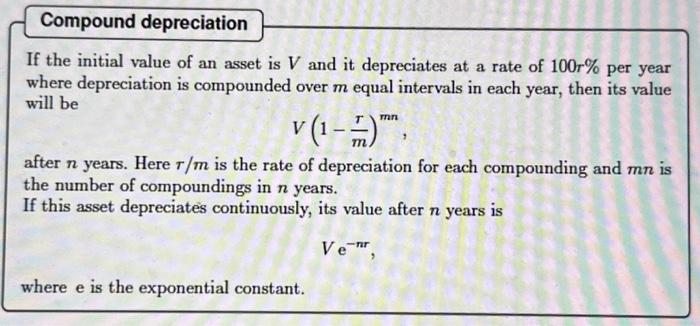
If the initial value of an asset is V and it depreciates at a rate of 100r% per year where depreciation is compounded over m equal intervals in each year, then its value will be V(1mr)mn after n years. Here r/m is the rate of depreciation for each compounding and mn is the number of compoundings in n years. If this asset depreciates continuously, its value after n years is Venr where e is the exponential constant. If the initial value of an asset is V and it depreciates at a rate of 100r% per year where depreciation is compounded over m equal intervals in each year, then its value will be V(1mr)mn after n years. Here r/m is the rate of depreciation for each compounding and mn is the number of compoundings in n years. If this asset depreciates continuously, its value after n years is Venr where e is the exponential constant
Step by Step Solution
There are 3 Steps involved in it

Get step-by-step solutions from verified subject matter experts
 Study Help