







Question: Can someone help me solve part d and e? 1. (SVD) This exercise shows that any invertible matrix can be viewed as a composition of
Can someone help me solve part d and e?
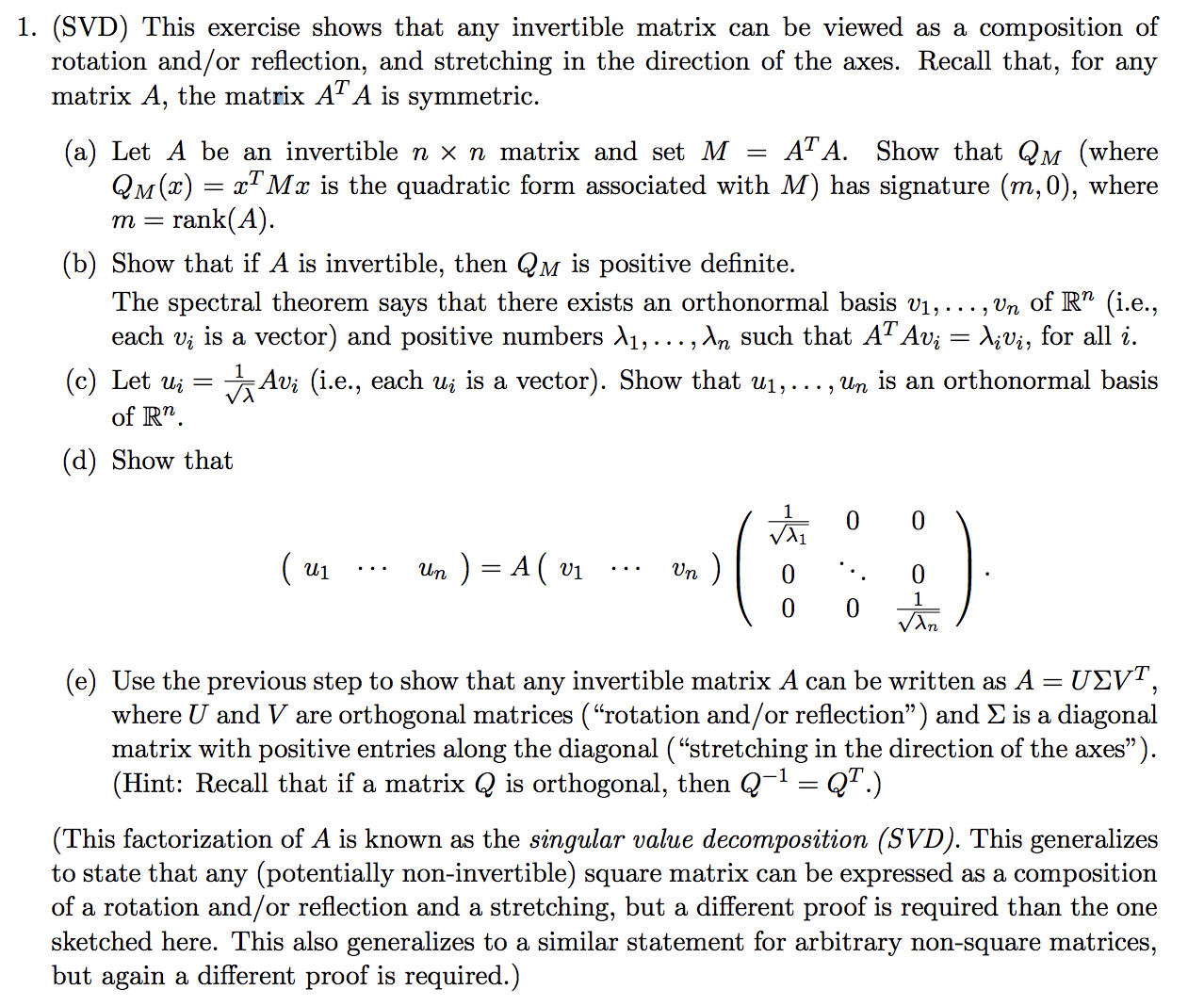
1. (SVD) This exercise shows that any invertible matrix can be viewed as a composition of rotation and/ or reection, and stretching in the direction of the axes. Recall that, for any matrix A, the matlix ATA is symmetric. (a) (b) (C) (d) Let A be an invertible n X to. matrix and set M = ATA. Show that QM (where QM(:L') = mTMm is the quadratic form associated with M) has signature (111,0), where m = rank(A). Show that if A is invertible, then QM is positive denite. The spectral theorem says that there exists an orthonormal basis '01, . . . ,1)\" of R\" (i.e., each u,- is a vector) and positive numbers A1, . . . , An such that ATA'U, = MW, for all 2'. Let a; = $147), (i.e., each u,- is a vector). Show that m, . . . , an is an orthonormal basis of R\". Show that 1 T. 0 0 (11.1 un)=A(m on) 0 -. 0 1 0 0 m. Use the previous step to show that any invertible matrix A can be written as A = U E VT, where U and V are orthogonal matrices (\"rotation and / or reection\") and E is a diagonal matrix with positive entries along the diagonal (\"stretching in the direction of the axes\" ). (Hint: Recall that if a matrix Q is orthogonal, then 621 = QT.) (This factorization of A is known as the singular value decomposition {S VD). This generalizes to state that any (potentially non-invertible) square matrix can be expressed as a composition of a rotation and / or reection and a stretching, but a different proof is required than the one sketched here. This also generalizes to a similar statement for arbitrary non-square matrices, but again a different proof is required.)
Step by Step Solution
There are 3 Steps involved in it

Get step-by-step solutions from verified subject matter experts
 Study Help