







Question: Can someone help me solve this question in Python? You can think of range () as a function that generatesalist of integers.1 In practice it
Can someone help me solve this question in Python?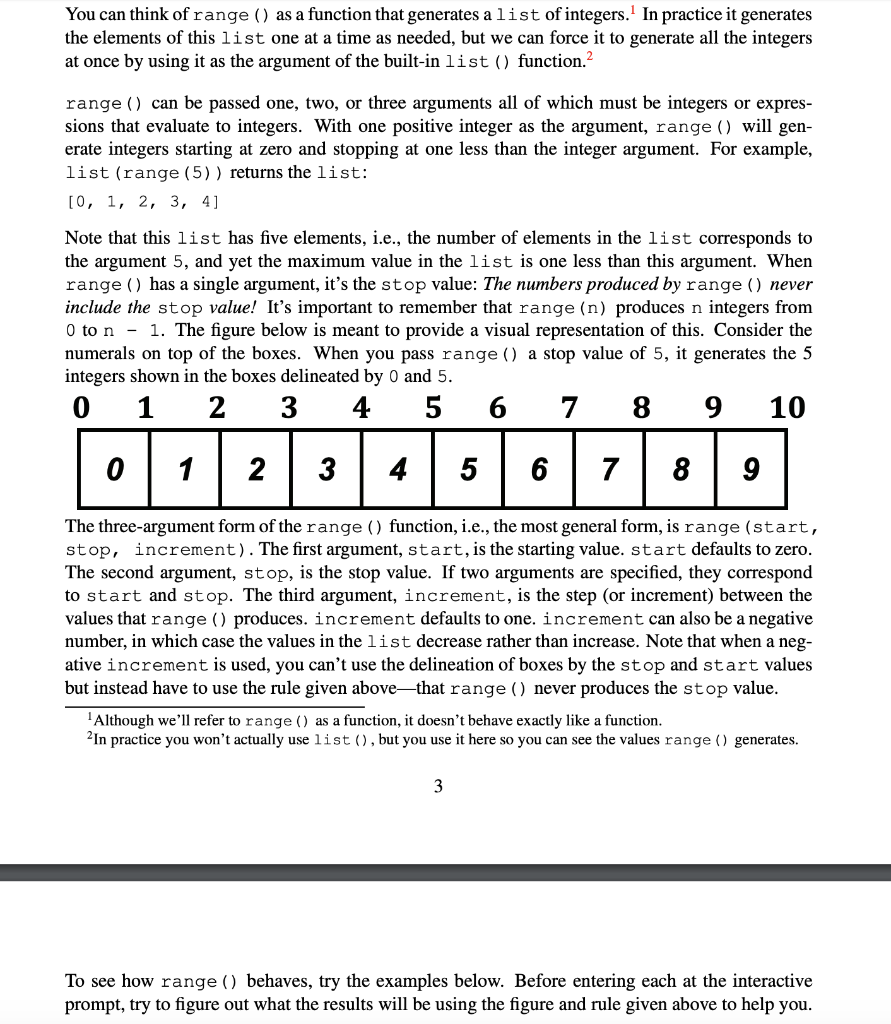
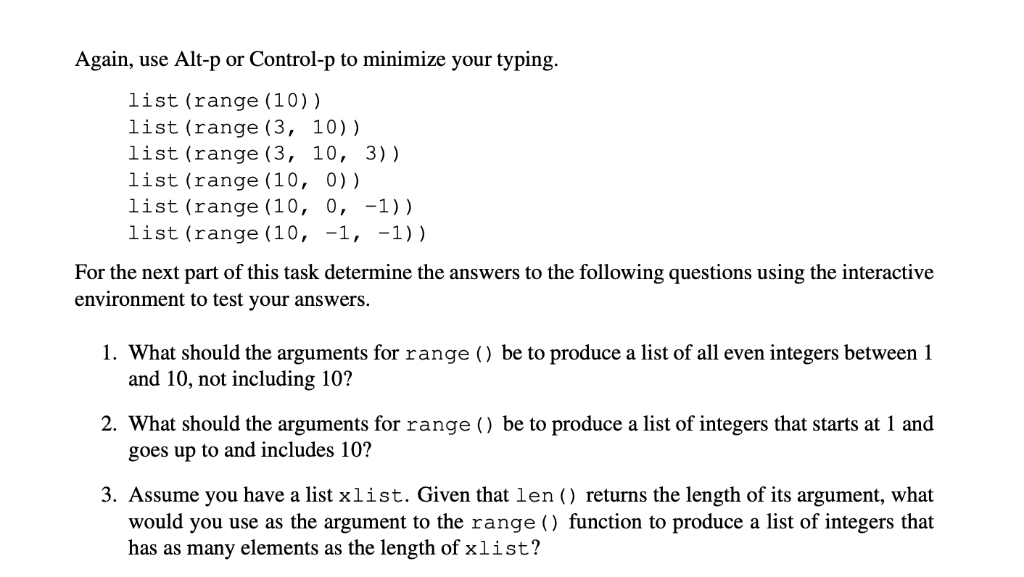
You can think of range () as a function that generatesalist of integers.1 In practice it generates the elements of this list one at a time as needed, but we can force it to generate all the integers at once by using it as the argument of the built-in list () function.2 range () can be passed one, two, or three arguments all of which must be integers or expres- sions that evaluate to integers. With one positive integer as the argument, range () will gen- erate integers starting at zero and stopping at one less than the integer argument. For example, list (range (5) ) returns the list: Note that this list has five elements, i.e., the number of elements in the list corresponds to the argument 5, and yet the maximum value in the list is one less than this argument. When range () has a single argument, it's the stop value: The numbers produced by range () never include the stop value! It's important to remember that range (n) produces n integers from 0 to n - 1. The figure below is meant to provide a visual representation of this. Consider the numerals on top of the boxes. When you pass range() a stop value of 5, it generates the 5 integers shown in the boxes delineated by 0 and 5. 0 123 45 6 78910 01 2345 6789 The three-argument form of the range ( ) function, i.e., the most general form, is range ( start, stop, increment). The first argument, start, is the starting value. start defaults to zero The second argument, stop, is the stop value. If two arguments are specified, they correspond to start and stop. The third argument, increment, is the step (or increment) between the values that range ) produces. increment defaults to one. increment can also be a negative number, in which case the values in the list decrease rather than increase. Note that when a neg- ative increment is used, you can't use the delineation of boxes by the stop and start values but instead have to use the rule given above-that range () never produces the stop value Although we'll refer to range () as a function, it doesn't behave exactly like a function 2In practice you won't actually use 1ist ), but you use it here so you can see the values range () generates. To see how range () behaves, try the examples below. Before entering each at the interactive prompt, try to figure out what the results will be using the figure and rule given above to help you Again, use Alt-p or Control-p to minimize your typing list (range (10)) list (range (3, 10) ) list (range (3, 10, 3)) list (range (10, 0)) list (range (10, 0, -1)) list (range (10, -1, For the next part of this task determine the answers to the following questions using the interactive environment to test your answers. 1. What should the arguments for range () be to produce a list of all even integers between 1 2. What should the arguments for range () be to produce a list of integers that starts at 1 and 3. Assume you have a list xlist. Given that len () returns the length of its argument, what and 10, not including 10? goes up to and includes 10? would you use as the argument to the range () function to produce a list of integers that has as many elements as the length of xlist
Step by Step Solution
There are 3 Steps involved in it

Get step-by-step solutions from verified subject matter experts
 Study Help