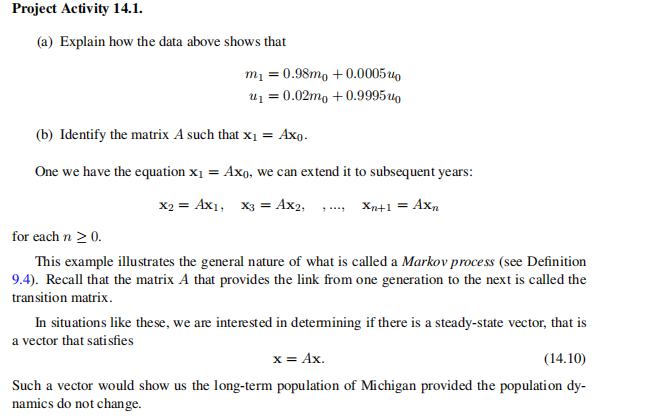
Question: can someone help me to solve activity 14.2 , please? Project Activity 14.1. (a) Explain how the data above shows that m = 0.98mo +0.000540
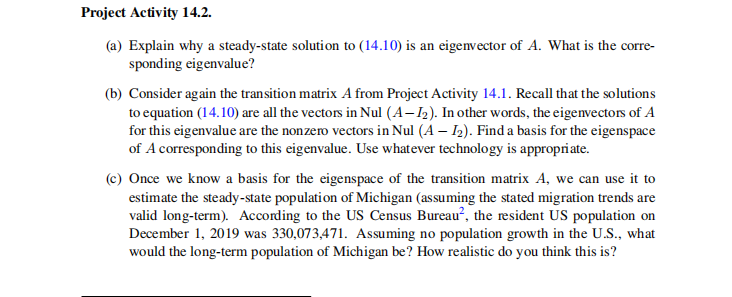 can someone help me to solve activity 14.2 , please?
Project Activity 14.1. (a) Explain how the data above shows that m = 0.98mo +0.000540 uj = 0.02mo +0.999540 (b) Identify the matrix A such that x1 = Axo. One we have the equation x = Axo, we can extend it to subsequent years: X2 = Ax, X3 = AX2, ... Xn+1 = Axn for each n > 0. This example illustrates the general nature of what is called a Markov process (see Definition 9.4). Recall that the matrix A that provides the link from one generation to the next is called the transition matrix. In situations like these, we are interested in determining if there is a steady-state vector, that is a vector that satisfies x = Ax. (14.10) Such a vector would show us the long-term population of Michigan provided the population dy- namics do not change. Project Activity 14.2. (a) Explain why a steady-state solution to (14.10) is an eigenvector of A. What is the corre- sponding eigenvalue? (b) Consider again the transition matrix A from Project Activity 14.1. Recall that the solutions to equation (14.10) are all the vectors in Nul (A-12). In other words, the eigenvectors of A for this eigenvalue are the nonzero vectors in Nul (A - 12). Find a basis for the eigenspace of A corresponding to this eigenvalue. Use whatever technology is appropriate. c) Once we know a basis for the eigenspace of the transition matrix A, we can use it to estimate the steady-state population of Michigan (assuming the stated migration trends are valid long-term). According to the US Census Bureau, the resident US population on December 1, 2019 was 330,073,471. Assuming no population growth in the U.S., what would the long-term population of Michigan be? How realistic do you think this is? Project Activity 14.1. (a) Explain how the data above shows that m = 0.98mo +0.000540 uj = 0.02mo +0.999540 (b) Identify the matrix A such that x1 = Axo. One we have the equation x = Axo, we can extend it to subsequent years: X2 = Ax, X3 = AX2, ... Xn+1 = Axn for each n > 0. This example illustrates the general nature of what is called a Markov process (see Definition 9.4). Recall that the matrix A that provides the link from one generation to the next is called the transition matrix. In situations like these, we are interested in determining if there is a steady-state vector, that is a vector that satisfies x = Ax. (14.10) Such a vector would show us the long-term population of Michigan provided the population dy- namics do not change. Project Activity 14.2. (a) Explain why a steady-state solution to (14.10) is an eigenvector of A. What is the corre- sponding eigenvalue? (b) Consider again the transition matrix A from Project Activity 14.1. Recall that the solutions to equation (14.10) are all the vectors in Nul (A-12). In other words, the eigenvectors of A for this eigenvalue are the nonzero vectors in Nul (A - 12). Find a basis for the eigenspace of A corresponding to this eigenvalue. Use whatever technology is appropriate. c) Once we know a basis for the eigenspace of the transition matrix A, we can use it to estimate the steady-state population of Michigan (assuming the stated migration trends are valid long-term). According to the US Census Bureau, the resident US population on December 1, 2019 was 330,073,471. Assuming no population growth in the U.S., what would the long-term population of Michigan be? How realistic do you think this is









 Study Help