







Question: Can someone help me to solve this problem ? Thank you. 3. Optional Bonus: (2 points) Consider the sum 12 k=1 ( k + 2)
Can someone help me to solve this problem ?
Thank you.
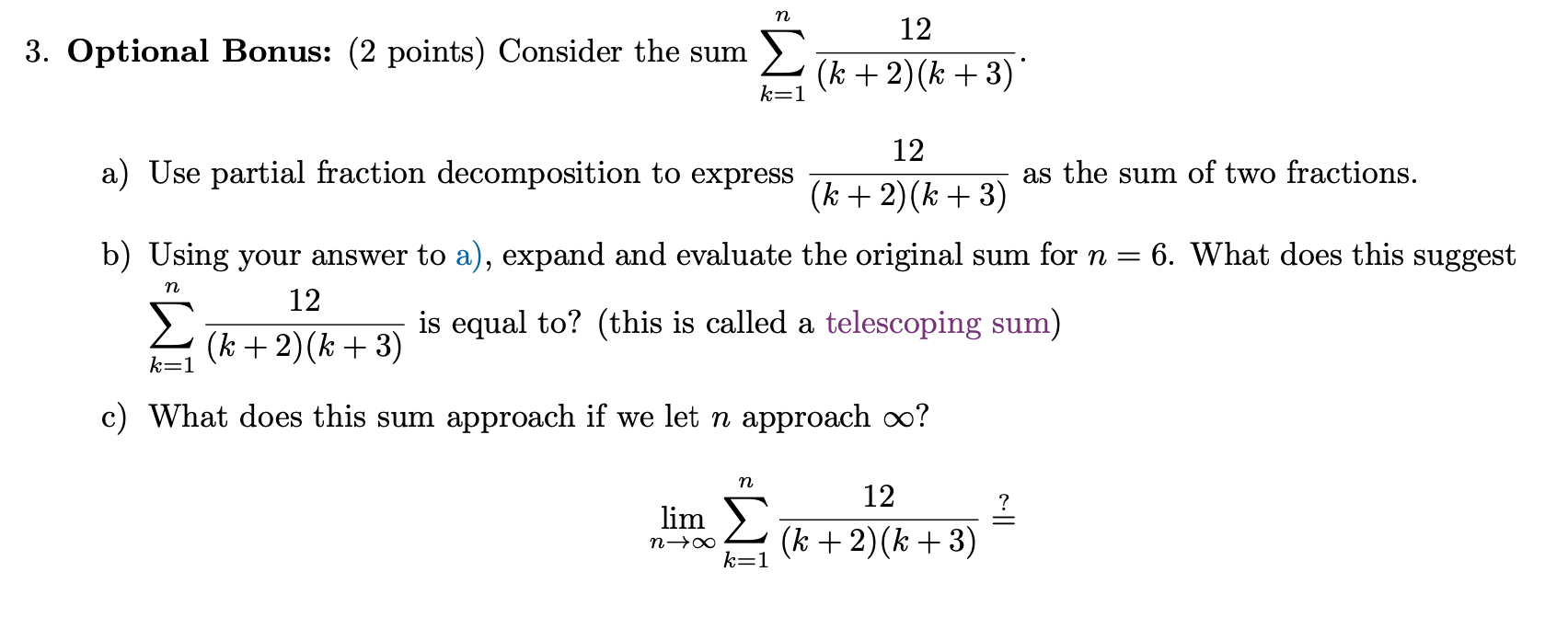
3. Optional Bonus: (2 points) Consider the sum 12 k=1 ( k + 2) (k + 3)' a) Use partial fraction decomposition to express 12 (k + 2) (k +3) as the sum of two fractions. b) Using your answer to a), expand and evaluate the original sum for n = 6. What does this suggest n 12 k=1 (k + 2) (k + 3) is equal to? (this is called a telescoping sum) c) What does this sum approach if we let n approach co? lim 12 k=1 (k + 2) (k +3)
Step by Step Solution
There are 3 Steps involved in it
1 Expert Approved Answer
Step: 1 Unlock

Question Has Been Solved by an Expert!
Get step-by-step solutions from verified subject matter experts
Step: 2 Unlock
Step: 3 Unlock
 Study Help