







Question: can someone help me with solving e? A newly issued bond pays its coupons once annually. Its coupon rate is 7.5%, its maturity is 20
 can someone help me with solving e?
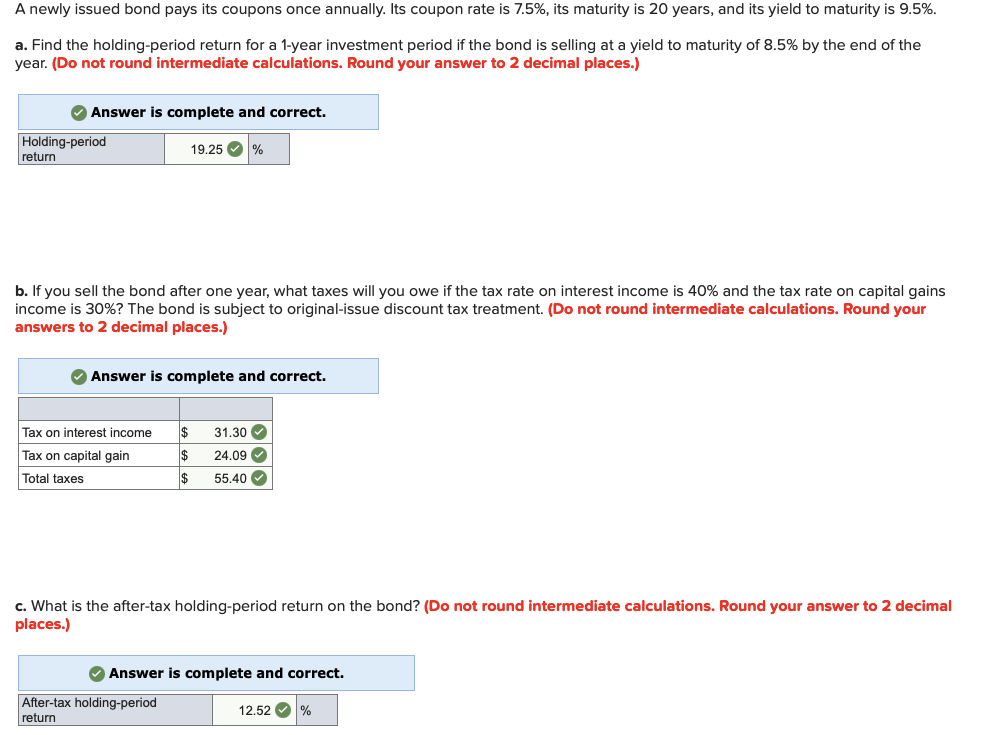
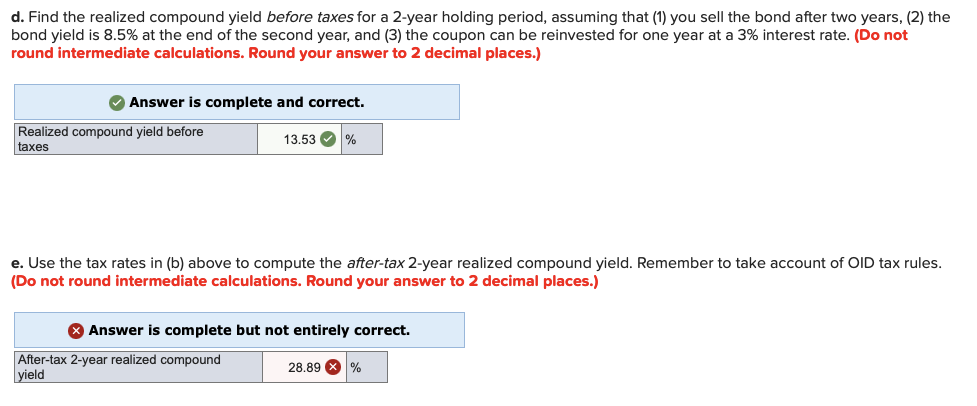
A newly issued bond pays its coupons once annually. Its coupon rate is 7.5%, its maturity is 20 years, and its yield to maturity is 9.5%. a. Find the holding-period return for a 1-year investment period if the bond is selling at a yield to maturity of 8.5% by the end of the year. (Do not round intermediate calculations. Round your answer to 2 decimal places.) Answer is complete and correct. Holding-period 19.25% return b. If you sell the bond after one year, what taxes will you owe if the tax rate on interest income is 40% and the tax rate on capital gains income is 30%? The bond is subject to original-issue discount tax treatment. (Do not round intermediate calculations. Round your answers to 2 decimal places.) Answer is complete and correct. $ Tax on interest income Tax on capital gain Total taxes 31.30 24.09 $ $ 55.40 c. What is the after-tax holding-period return on the bond? (Do not round intermediate calculations. Round your answer to 2 decimal places.) Answer is complete and correct. After-tax holding-period 12.52 % return d. Find the realized compound yield before taxes for a 2-year holding period, assuming that (1) you sell the bond after two years, (2) the bond yield is 8.5% at the end of the second year, and (3) the coupon can be reinvested for one year at a 3% interest rate. (Do not round intermediate calculations. Round your answer to 2 decimal places.) Answer is complete and correct. Realized compound yield before taxes 13.53% e. Use the tax rates in (b) above to compute the after-tax 2-year realized compound yield. Remember to take account of OID tax rules. (Do not round intermediate calculations. Round your answer to 2 decimal places.) X Answer is complete but not entirely correct. After-tax 2-year realized compound yield 28.89 X % A newly issued bond pays its coupons once annually. Its coupon rate is 7.5%, its maturity is 20 years, and its yield to maturity is 9.5%. a. Find the holding-period return for a 1-year investment period if the bond is selling at a yield to maturity of 8.5% by the end of the year. (Do not round intermediate calculations. Round your answer to 2 decimal places.) Answer is complete and correct. Holding-period 19.25% return b. If you sell the bond after one year, what taxes will you owe if the tax rate on interest income is 40% and the tax rate on capital gains income is 30%? The bond is subject to original-issue discount tax treatment. (Do not round intermediate calculations. Round your answers to 2 decimal places.) Answer is complete and correct. $ Tax on interest income Tax on capital gain Total taxes 31.30 24.09 $ $ 55.40 c. What is the after-tax holding-period return on the bond? (Do not round intermediate calculations. Round your answer to 2 decimal places.) Answer is complete and correct. After-tax holding-period 12.52 % return d. Find the realized compound yield before taxes for a 2-year holding period, assuming that (1) you sell the bond after two years, (2) the bond yield is 8.5% at the end of the second year, and (3) the coupon can be reinvested for one year at a 3% interest rate. (Do not round intermediate calculations. Round your answer to 2 decimal places.) Answer is complete and correct. Realized compound yield before taxes 13.53% e. Use the tax rates in (b) above to compute the after-tax 2-year realized compound yield. Remember to take account of OID tax rules. (Do not round intermediate calculations. Round your answer to 2 decimal places.) X Answer is complete but not entirely correct. After-tax 2-year realized compound yield 28.89 X %
Step by Step Solution
There are 3 Steps involved in it

Get step-by-step solutions from verified subject matter experts
 Study Help