Question: Can someone help me with this assignment? Melissa flipped her lucky coin 19 times and got @ heads. Melissa used these numbers to estimate the
Can someone help me with this assignment?
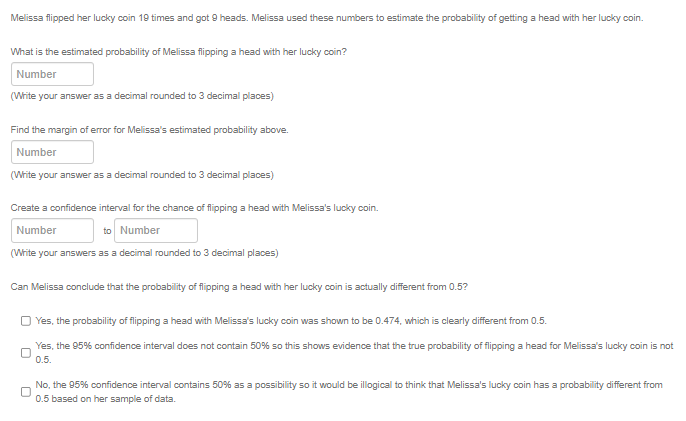
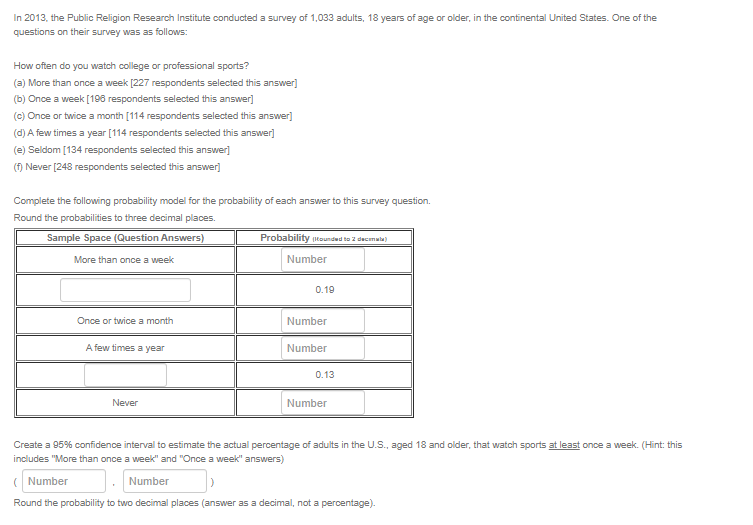
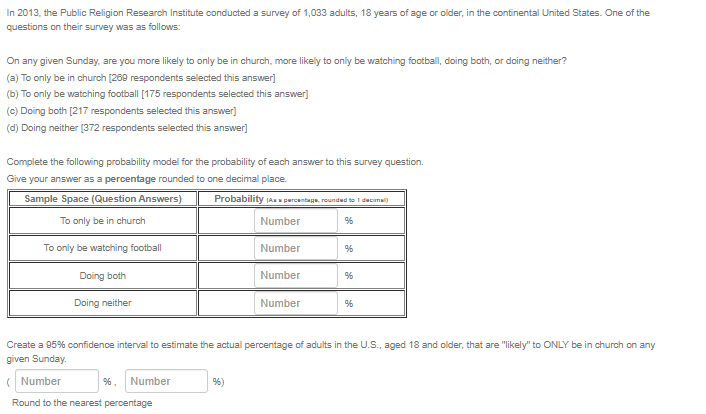
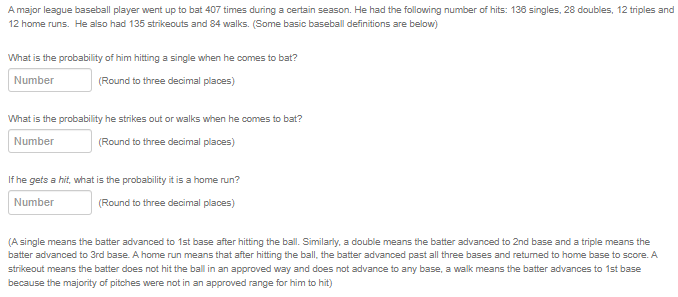
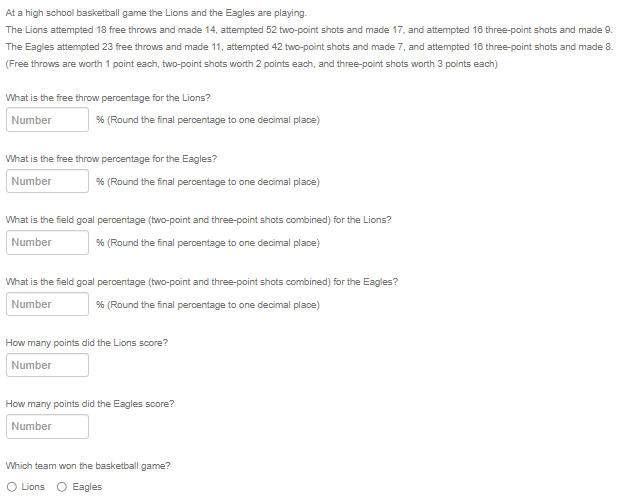
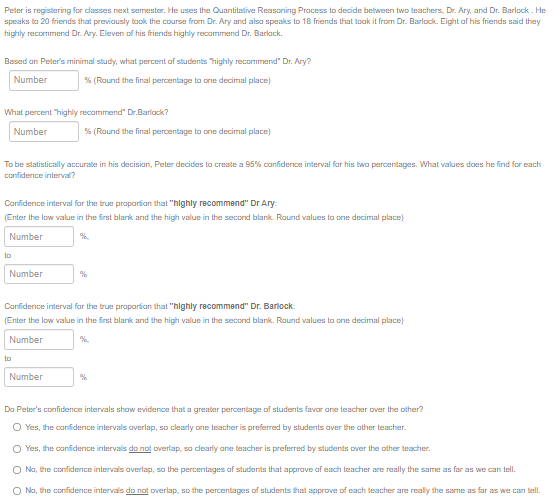
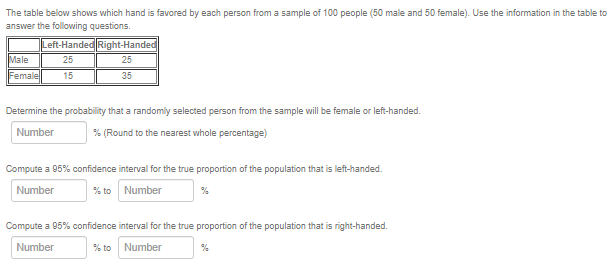
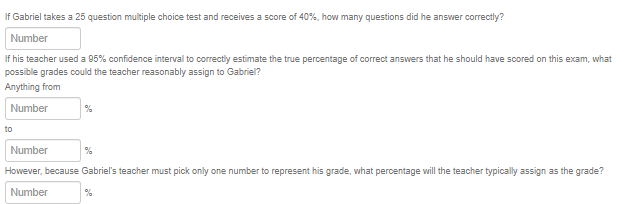
Melissa flipped her lucky coin 19 times and got @ heads. Melissa used these numbers to estimate the probability of getting a head with her lucky coin. What is the estimated probability of Melissa flipping a head with her lucky coin? Number (Write your answer as a decimal rounded to 3 decimal places) Find the margin of error for Melissa's estimated probability above. Number (Write your answer as a decimal rounded to 3 decimal places) Create a confidence interval for the chance of flipping a head with Melissa's lucky coin. Number to Number (Write your answers as a decimal rounded to 3 decimal places) Can Melissa conclude that the probability of flipping a head with her lucky coin is actually different from 0.5? O Yes, the probability of flipping a head with Melissa's lucky coin was shown to be 0.474, which is clearly different from 0.5. Yes, the 95% confidence interval does not contain 50% so this shows evidence that the true probability of flipping a head for Melissa's lucky coin is not 0.5. No, the 95% confidence interval contains 50% as a possibility so it would be illogical to think that Melissa's lucky coin has a probability different from 0.5 based on her sample of data.In 2013, the Public Religion Research Institute conducted a survey of 1,033 adults, 18 years of age or older, in the continental United States. One of the questions on their survey was as follows: How often do you watch college or professional sports? (a) More than once a week [227 respondents selected this answer] (b) Once a week [198 respondents selected this answer] (c) Once or twice a month [114 respondents selected this answer] (d) A few times a year [114 respondents selected this answer] (e) Seldom [134 respondents selected this answer] (f) Never [248 respondents selected this answer] Complete the following probability model for the probability of each answer to this survey question. Round the probabilities to three decimal places. Sample Space (Question Answers] Probability (Rounded to 2 dscansb) More than once a week Number 0.19 Once or twice a month Number A few times a year Number 0.13 Never Number Create a 95% confidence interval to estimate the actual percentage of adults in the U.S., aged 18 and older, that watch sports at least once a week. (Hint: this includes "More than once a week" and "Once a week" answers) Number Number Round the probability to two decimal places (answer as a decimal, not a percentage).In 2013, the Public Religion Research Institute conducted a survey of 1,033 adults, 18 years of age or older, in the continental United States. One of the questions on their survey was as follows: On any given Sunday, are you more likely to only be in church, more likely to only be watching football, doing both, or doing neither? (a) To only be in church [260 respondents selected this answer] (b) To only be watching football [175 respondents selected this answer] (c) Doing both [217 respondents selected this answer] (d) Doing neither [372 respondents selected this answer] Complete the following probability model for the probability of each answer to this survey question. Give your answer as a percentage rounded to one decimal place. Sample Space (Question Answers) Probability (Ax x percentups, rounded to I decimal] To only be in church Number To only be watching football Number Doing both Number Doing neither Number Create a 05% confidence interval to estimate the actual percentage of adults in the U.S., aged 18 and older, that are "likely" to ONLY be in church on any given Sunday. Number Number 96) Round to the nearest percentageA major league baseball player went up to bat 407 times during a certain season. He had the following number of hits: 136 singles, 28 doubles, 12 triples and 12 home runs. He also had 135 strikeouts and 84 walks. (Some basic baseball definitions are below) What is the probability of him hitting a single when he comes to bat? Number (Round to three decimal places) What is the probability he strikes out or walks when he comes to bat? Number (Round to three decimal places) If he gets a hit, what is the probability it is a home run? Number (Round to three decimal places) (A single means the batter advanced to 1st base after hitting the ball. Similarly, a double means the batter advanced to 2nd base and a triple means the batter advanced to 3rd base. A home run means that after hitting the ball, the batter advanced past all three bases and retumed to home base to score. A strikeout means the batter does not hit the ball in an approved way and does not advance to any base, a walk means the batter advances to 1st base because the majority of pitches were not in an approved range for him to hit)At a high school basketball game the Lions and the Eagles are playing. The Lions attempted 18 free throws and made 14, attempted 52 two-point shots and made 17, and attempted 10 three-point shots and made 9. The Eagles attempted 23 free throws and made 11, attempted 42 two-point shots and made 7, and attempted 16 three-point shots and made &. (Free throws are worth 1 point each, two-point shots worth 2 points each, and three-point shots worth 3 points each) What is the free throw percentage for the Lions? Number 9% (Round the final percentage to one decimal place) What is the free throw percentage for the Eagles? Number 36 (Round the final percentage to one decimal place) What is the field goal percentage (two-point and three-point shots combined) for the Lions? Number 36 (Round the final percentage to one decimal place) What is the field goal percentage (two-point and three-point shots combined) for the Eagles? Number * (Round the final percentage to one decimal place) How many points did the Lions score? Number How many points did the Eagles score? Number Which team won the basketball game? Lions O EaglesPeter is registering for classes next semester. He uses the Quantitative Reasoning Process to decide between two teachers, Dr. Ary, and Dr. Barlock . He speaks to 20 friends that previously took the course from Dr. Ary and also speaks to 18 friends that look it from Dr. Barlock. Eight of his friends said they highly recommend Dr. Ary. Eleven of his friends highly recommend Dr. Barlock. Based on Peter's minimal study, what percent of students "highly recommend" Dr. Ary? Number % (Round the final percentage to one decimal place) What percent "highly recommend" Dr. Barlock? Number ( Round the final percentage to one decimal place) To be statistically accurate in his decision, Peter decides to create a 95% confidence interval for his two percentages. What values does he find for each confidence interval? Confidence interval for the true proportion that "highly recommend" Or Ary (Enter the low value in the first blank and the high value in the second blank. Round values to one decimal place) Number Number Confidence interval for the true proportion that "highly recommend" Dr. Barlock: (Enter the low value in the first blank and the high value in the second blank. Round values to one decimal place) Number ic Number Do Peter's confidence intervals show evidence that a greater percentage of students favor one teacher over the other? O Yes, the confidence intervals overlap, so clearly one teacher is preferred by students over the other teacher. Q Yes, the confidence intervals do not overlap, so dearly one teacher is preferred by students over the other teacher. O No, the confidence intervals overlap, so the percentages of students that approve of each teacher are really the same as far as we can tell. O No, the confidence intervals do not overlap, so the percentages of students that approve of each teacher are realy the same as far as we can tell.The table below shows which hand is favored by each person from a sample of 100 people (50 male and 50 female). Use the information in the table to answer the following questions. Left-Handed Right-Handed Male 25 25 Female 15 35 Determine the probability that a randomly selected person from the sample will be female or left-handed. Number (Round to the nearest whole percentage) Compute a 95% confidence interval for the true proportion of the population that is left-handed. Number %% to Number Compute a 95% confidence interval for the true proportion of the population that is right-handed. Number % to NumberIf Gabriel takes a 25 question multiple choice test and receives a score of 40%%, how many questions did he answer correctly? Number If his teacher used a 95% confidence interval to correctly estimate the true percentage of correct answers that he should have scored on this exam, what possible grades could the teacher reasonably assign to Gabriel? Anything from Number Number However, because Gabriel's teacher must pick only one number to represent his grade, what percentage will the teacher typically assign as the grade? Number %
Step by Step Solution
There are 3 Steps involved in it
1 Expert Approved Answer
Step: 1 Unlock
Question Has Been Solved by an Expert!
Get step-by-step solutions from verified subject matter experts
Step: 2 Unlock
Step: 3 Unlock
Students Have Also Explored These Related Mathematics Questions!