







Question: can someone help please A normal impartial combinatorial game is a collection of positions together with, for each position X, a list of other positions
can someone help please
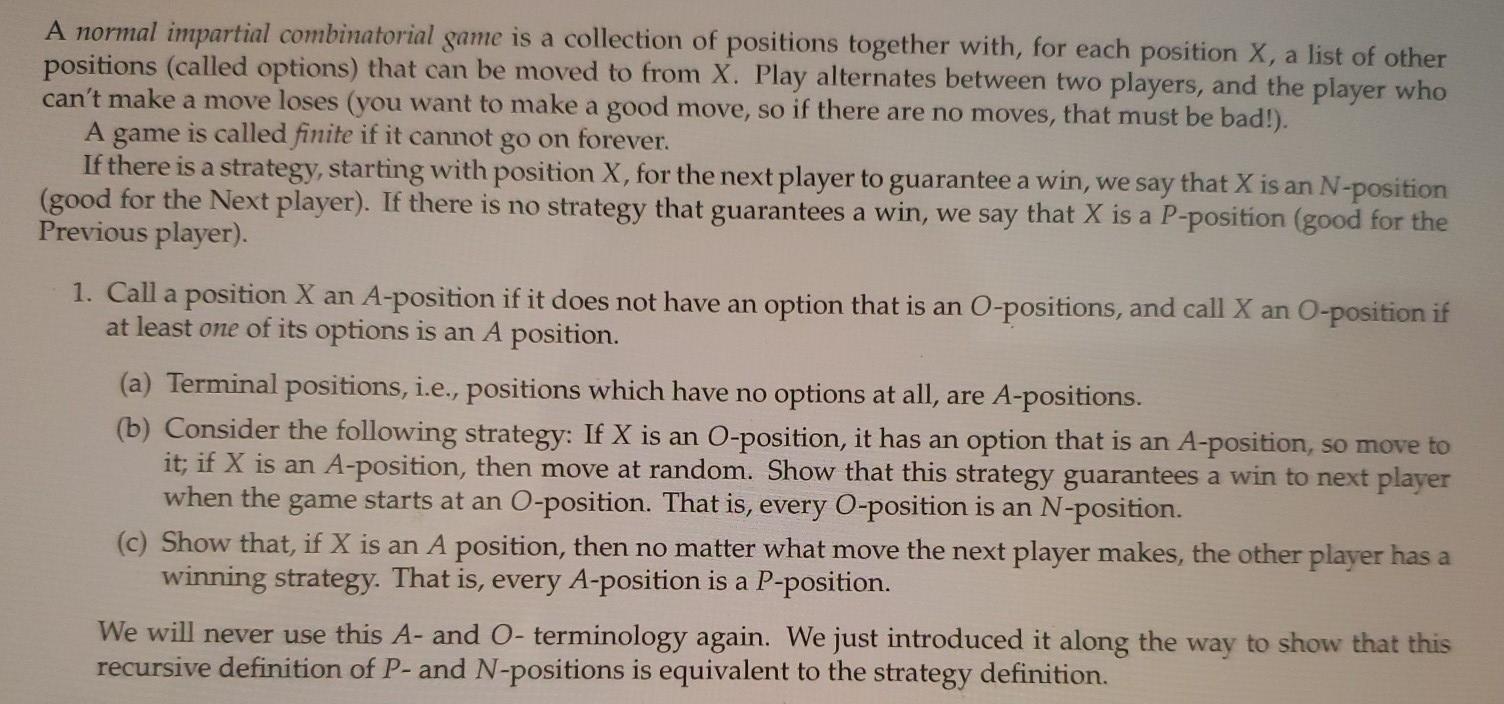
A normal impartial combinatorial game is a collection of positions together with, for each position X, a list of other positions (called options) that can be moved to from X. Play alternates between two players, and the player who can't make a move loses (you want to make a good move, so if there are no moves, that must be bad!). A game is called finite if it cannot go on forever. If there is a strategy, starting with position X, for the next player to guarantee a win, we say that X is an N-position (good for the Next player). If there is no strategy that guarantees a win, we say that X is a P-position (good for the Previous player). 1. Call a position X an A-position if it does not have an option that is an O-positions, and call X an O-position if at least one of its options is an A position. (a) Terminal positions, i.e., positions which have no options at all, are A-positions. (b) Consider the following strategy: If X is an O-position, it has an option that is an A-position, so move to it; if X is an A-position, then move at random. Show that this strategy guarantees a win to next player when the game starts at an O-position. That is, every O-position is an N-position. (C) Show that, if X is an A position, then no matter what move the next player makes, the other player has a winning strategy. That is, every A-position is a P-position. We will never use this A- and O- terminology again. We just introduced it along the way to show that this recursive definition of P- and N-positions is equivalent to the strategy definition. A normal impartial combinatorial game is a collection of positions together with, for each position X, a list of other positions (called options) that can be moved to from X. Play alternates between two players, and the player who can't make a move loses (you want to make a good move, so if there are no moves, that must be bad!). A game is called finite if it cannot go on forever. If there is a strategy, starting with position X, for the next player to guarantee a win, we say that X is an N-position (good for the Next player). If there is no strategy that guarantees a win, we say that X is a P-position (good for the Previous player). 1. Call a position X an A-position if it does not have an option that is an O-positions, and call X an O-position if at least one of its options is an A position. (a) Terminal positions, i.e., positions which have no options at all, are A-positions. (b) Consider the following strategy: If X is an O-position, it has an option that is an A-position, so move to it; if X is an A-position, then move at random. Show that this strategy guarantees a win to next player when the game starts at an O-position. That is, every O-position is an N-position. (C) Show that, if X is an A position, then no matter what move the next player makes, the other player has a winning strategy. That is, every A-position is a P-position. We will never use this A- and O- terminology again. We just introduced it along the way to show that this recursive definition of P- and N-positions is equivalent to the strategy definition
Step by Step Solution
There are 3 Steps involved in it

Get step-by-step solutions from verified subject matter experts
 Study Help