







Question: can someone help QUESTION 8 The dataframe called lodgepole_pine.csv (https://drive.google.com/file/d/1jZ60qmjKWlihFAkFTxwuchnEv1zB3Ss1/view?usp=sharin g) shows pine cone size (mass, in g) of lodgepole pine in 3 different environments.
can someone help
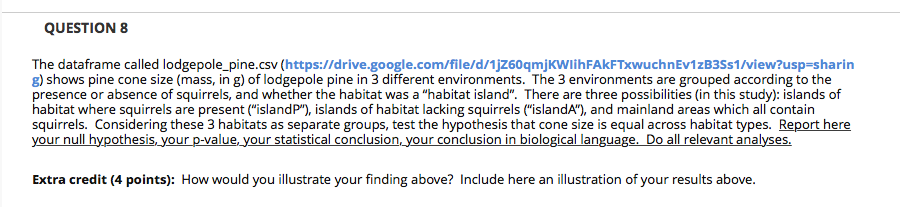
QUESTION 8 The dataframe called lodgepole_pine.csv (https://drive.google.com/file/d/1jZ60qmjKWlihFAkFTxwuchnEv1zB3Ss1/view?usp=sharin g) shows pine cone size (mass, in g) of lodgepole pine in 3 different environments. The 3 environments are grouped according to the presence or absence of squirrels, and whether the habitat was a "habitat island". There are three possibilities (in this study): islands of habitat where squirrels are present ("islandP"), islands of habitat lacking squirrels ("islandA"), and mainland areas which all contain squirrels. Considering these 3 habitats as separate groups, test the hypothesis that cone size is equal across habitat types. Report here your null hypothesis, your p-value, your statistical conclusion, your conclusion in biological language. Do all relevant analyses. Extra credit (4 points): How would you illustrate your finding above? Include here an illustration of your results above
Step by Step Solution
There are 3 Steps involved in it

Get step-by-step solutions from verified subject matter experts
 Study Help