







Question: Can someone please give me a working mips code to this problem. Problem 2 30 points Write a MIPS assembly program that implements a simple
Can someone please give me a working mips code to this problem.
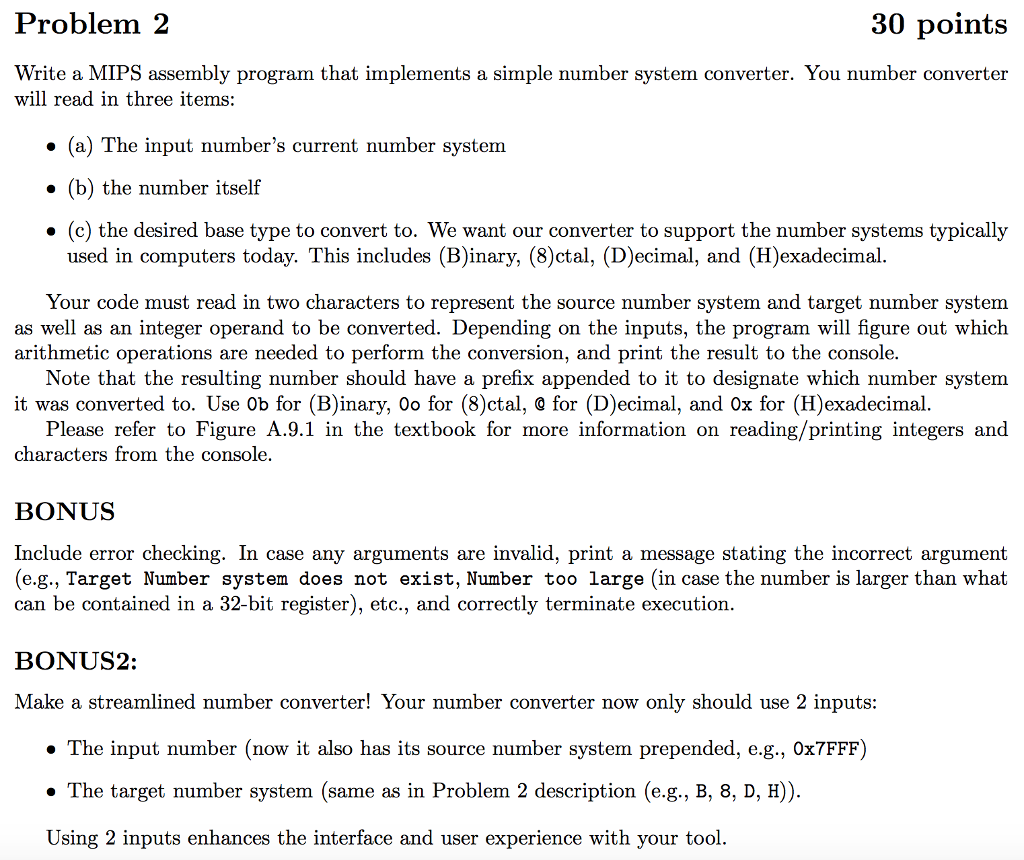
Problem 2 30 points Write a MIPS assembly program that implements a simple number system converter. You number converter will read in three items: (a) The input number's current number system . (b) the number itself (c) the desired base type to convert to. We want our converter to support the number systems typically used in computers today. This includes (B)inary, (8)ctal, (D)ecimal, and (H)exadecimal Your code must read in two characters to represent the source number system and target number system arithmetic operations are needed to perform the conversion, and print the result to the console. it was converted to. Use Ob for (B)inary, Oo for (8)ctal, O for (D)ecimal, and Ox for (H)exadecimal characters from the console as well as an integer operand to be converted. Depending on the inputs, the program will figure out which Note that the resulting number should have a prefix appended to it to designate which number svstem Please refer to Figure A.9.1 in the textbook for more information on reading/printing integers and BONUS Include error checking. In case any arguments are invalid, print a message stating the incorrect argument e.g., Target Number system does not exist, Number too large (in case the number is larger than what can be contained in a 32-bit register), etc., and correctly terminate execution. BONUS2: Make a streamlined number converter! Your number converter now only should use 2 inputs: The input number (now it also has its source number system prepended, e.g., 0x7FFF) The target number system (same as in Problem 2 description (e.g., B, 8, D, H)) Using 2 inputs enhances the interface and user experience with your tool
Step by Step Solution
There are 3 Steps involved in it

Get step-by-step solutions from verified subject matter experts
 Study Help