



Question: Can someone please give me an explination on how these answers were found? The diagram at right shows a WIFI network with an access point,
Can someone please give me an explination on how these answers were found?
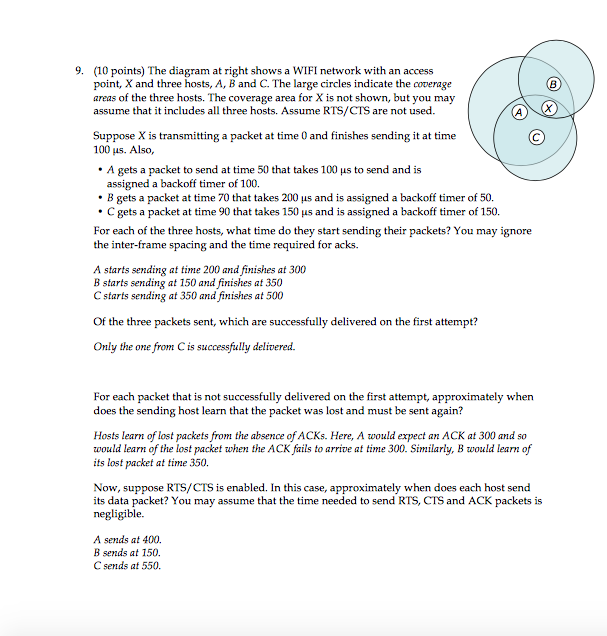
The diagram at right shows a WIFI network with an access point, X and three hosts, A, B and C. The large circles indicate the coverage areas of the three hosts. The coverage area for X is not shown, but you may assume that it includes all three hosts. Assume RTS/CTS are not used. Suppose X is transmitting a packet at time 0 and finishes sending it at time 100 mu s. Also, A gets a packet to send at time 50 that takes 100 mu s to send and is assigned a backoff timer of 100. B gets a packet at time 70 that takes 200 mu s and is assigned a backoff timer of 50. C gets a packet at time 90 that takes 150 mu s and is assigned a backoff timer of 150. For each of the three hosts, what time do they start sending their packets? You may ignore the inter-frame spacing and the time required for acks. A starts sending at time 200 and finishes at 300 B starts sending at 150 and finishes at 350 C starts sending at 350 and finishes at 500 Of the three packets sent, which are successfully delivered on the first attempt? Only the one from C is successfully delivered. For each packet that is not successfully delivered on the first attempt, approximately when does the sending host learn that the packet was lost and must be sent again? Hosts learn of lost packets from the absence of ACKs. Here, A would expect an ACK at 300 and so would learn of the lost (jacket when the ACK fails to arrive at time 300. Similarly, B would learn of its lost packet at time 350. Now, suppose RTS/CIS is enabled. In this case, approximately when does each host send its data packet? You may assume that the time needed to send RTS, CTS and ACK packets is negligible. A sends at 400. B sends at 150. C sends at 550. The diagram at right shows a WIFI network with an access point, X and three hosts, A, B and C. The large circles indicate the coverage areas of the three hosts. The coverage area for X is not shown, but you may assume that it includes all three hosts. Assume RTS/CTS are not used. Suppose X is transmitting a packet at time 0 and finishes sending it at time 100 mu s. Also, A gets a packet to send at time 50 that takes 100 mu s to send and is assigned a backoff timer of 100. B gets a packet at time 70 that takes 200 mu s and is assigned a backoff timer of 50. C gets a packet at time 90 that takes 150 mu s and is assigned a backoff timer of 150. For each of the three hosts, what time do they start sending their packets? You may ignore the inter-frame spacing and the time required for acks. A starts sending at time 200 and finishes at 300 B starts sending at 150 and finishes at 350 C starts sending at 350 and finishes at 500 Of the three packets sent, which are successfully delivered on the first attempt? Only the one from C is successfully delivered. For each packet that is not successfully delivered on the first attempt, approximately when does the sending host learn that the packet was lost and must be sent again? Hosts learn of lost packets from the absence of ACKs. Here, A would expect an ACK at 300 and so would learn of the lost (jacket when the ACK fails to arrive at time 300. Similarly, B would learn of its lost packet at time 350. Now, suppose RTS/CIS is enabled. In this case, approximately when does each host send its data packet? You may assume that the time needed to send RTS, CTS and ACK packets is negligible. A sends at 400. B sends at 150. C sends at 550
Step by Step Solution
There are 3 Steps involved in it

Get step-by-step solutions from verified subject matter experts