Question: can someone please help me determine what the issue, tbe decision, and the law and reasoning for this case? Brigid Hanus (Hanus), individually and on
can someone please help me determine what the issue, tbe decision, and the law and reasoning for this case?
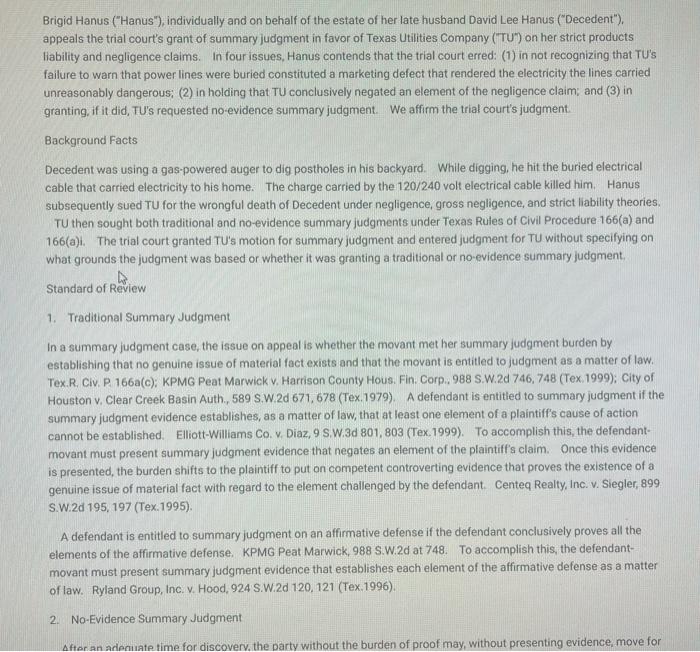
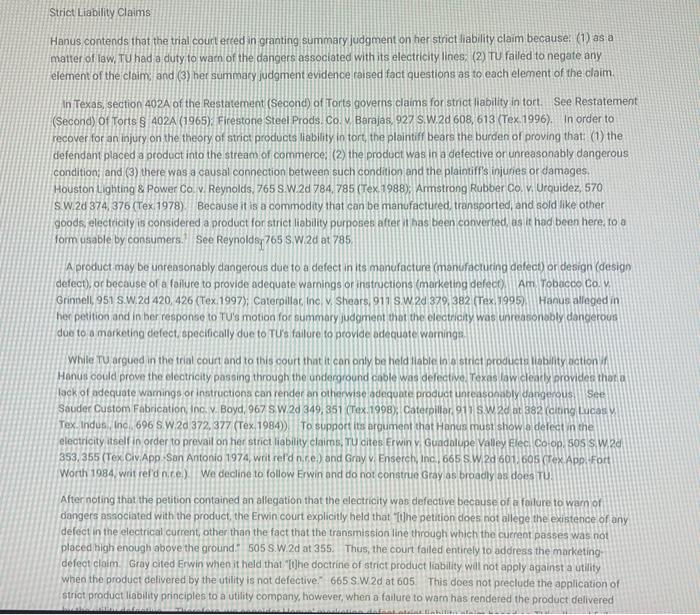
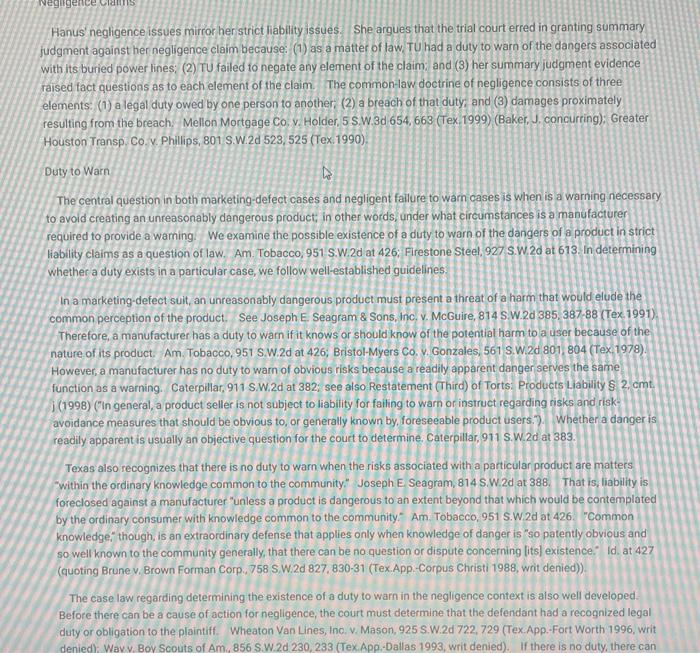
Brigid Hanus ("Hanus"), individually and on behalf of the estate of her late husband David Lee Hanus ("Decedent'), appeals the trial court's grant of summary judgment in favor of Texas Utilities Company ("TU") on her strict products liability and negligence claims. In four issues, Hanus contends that the trial court erred: (1) in not recognizing that TU's failure to warn that power lines were buried constituted a marketing defect that rendered the electricity the lines carried unreasonably dangerous; (2) in holding that TU conclusively negated an element of the negligence claim; and (3) in granting, if it did, TU's requested no evidence summary judgment. We affirm the trial court's judgment Background Facts Decedent was using a gas-powered auger to dig postholes in his backyard. While digging, he hit the buried electrical cable that carried electricity to his home. The charge carried by the 120/240 volt electrical cable killed him. Hanus subsequently sued TU for the wrongful death of Decedent under negligence, gross negligence, and strict liability theories. TU then sought both traditional and no-evidence summary judgments under Texas Rules of Civil Procedure 166(a) and 166(a). The trial court granted TU's motion for summary judgment and entered judgment for TU without specifying on what grounds the judgment was based or whether it was granting a traditional or no evidence summary judgment Standard of Review 1. Traditional Summary Judgment In a summary judgment case, the issue on appeal is whether the movant met her summary judgment burden by establishing that no genuine issue of material fact exists and that the movent is entitled to judgment as a matter of law. Tex.R. Civ. P 166a(c): KPMG Peat Marwick v. Harrison County Hous, Fin. Corp. 988 S.W.2d 746, 748 (Tex 1999); City of Houston v. Clear Creek Basin Auth., 589 S.W.2d 671,678 (Tex, 1979). A defendant is entitled to summary judgment if the summary judgment evidence establishes, as a matter of law, that at least one element of a plaintiff's cause of action cannot be established. Elliott-Williams Co. v. Diaz, 9 S.W.3d 801, 803 (Tex 1999). To accomplish this, the defendant- movant must present summary judgment evidence that negates an element of the plaintiff's claim. Once this evidence is presented, the burden shifts to the plaintiff to put on competent controverting evidence that proves the existence of a genuine issue of material fact with regard to the element challenged by the defendant Centeq Realty, Inc. v. Siegler, 899 S.W.2d 195, 197 (Tex.1995). A defendant is entitled to summary judgment on an affirmative defense if the defendant conclusively proves all the elements of the affirmative defense. KPMG Peat Marwick, 988 S.W.2d at 748. To accomplish this, the defendant- movant must present summary judgment evidence that establishes each element of the affirmative defense as a matter of law. Ryland Group, Inc. v. Hood, 924 S.W.2d 120, 121 (Tex.1996). 2. No-Evidence Summary Judgment After an adonate time for discovery. the party without the burden of proof may, without presenting evidence move for Strict Liability Claims Hanus contends that the trial court erred in granting summary judgment on her strict liability claim because: (1) as a matter of law, TU had a duty to warn of the dangers associated with its electricity lines (2) TU failed to negate any element of the claim; and (3) her summary judgment evidence raised fact questions as to each element of the claim in Texas, section 402A of the Restatement (Second) of Torts governs claims for strict liability in tort. See Restatement (Second) of Torts $ 402A (1965). Firestone Steel Prods. Co w Barajas 927 S.W.2d 608,613 (Tex 1996). In order to recover for an injury on the theory of strict products liablity in tort, the plaintiff bears the burden of proving that: (1) the defendant placed a product into the stream of commerce; (2) the product was in a defective or unreasonably dangerous condition, and (3) there was a causal connection between such condition and the plaintiff's injuries or damages. Houston Lighting & Power Co. v. Reynolds, 765 S.W.2d 784 785 (Tex 1988), Armstrong Rubber Co. v. Urquidez, 570 S W20 374,376 (Tex: 1978) Because it is a commodity that can be manufactured transported, and sold like other goods, electricity is considered a product for strict liability purposes after it has been converted, as it had been here to a form usable by consumers. See Reynolds, 765 S W20 at 785 A product may be unreasonably dangerous due to a defect in its manufacture (manufacturing defect) or design (design defect), or because of a failure to provide adequate warnings or instructions (marketing defect) Am Tobacco Co., Grinnell, 951 S.W.2d 420,426 (Tex 1997); Caterpillar Inc, V Shears, 911 S W.2d 379, 382 (Tex 1995). Hanus alleged in her petition and in her response to TU's motion for summary judgment that the electricity was unreasonably dangerous due to a marketing defect specifically due to Tus failure to provide adequate warnings While TU argued in the trial court and to this court that it can only be held liable in a strict products liability biction Hanus could prove the electricity passing through the underground cable was defective, Texas law clearly provides that a lack of adequate womings or instructions can render an otherwise adequate product unreasonably dangerous See Sauder Custom Fabrication, Inc. v. Boyd, 967 SW 20 349, 351 (Tex.1998), Caterpillar 911 S W2d at 382 (citing Lucas Tex, IndusInc. 696 SW.20 372, 377 (Tex 1984)). To support is orgument that Hanus must show delect in the electricity itself in order to prevail on her sinct liability claims, Tu dites Erwin y Guadalupe Valley Flec Co-op, SOS S.W.2 353, 355 (Tex Clv App San Antonio 1974, writreld nce) and Gray v Enserch, Inc., 665 S.W.2d 601, 605(ex App. Fort Worth 1984 writreld nie). We decline to follow Erwin and do not construie Gray as broadly as does TU After noting that the petition contained an allegation that the electricity was defective because of a failure to warn of dangers associated with the product, the Erwin court explicitly held that the petition does not allege the existence of any defect in the electrical current, other than the fact that the transmission line through which the current passes was not placed high enough above the ground 505 S.W.2d at 355. Thus, the court failed entirely to address the marketing defect claim. Gray cited Erwin when it held that the doctrine of strict product liability will not apply against a utility when the product delivered by the utility is not defective." 665 S.W.2d at 605 This does not preclude the application of strict product liability principles to a utility company, however, when a failure to warn has rendered the product delivered MINE Negligence Cams Hanus' negligence issues mirror her strict liability issues. She argues that the trial court erred in granting summary judgment against her negligence claim because: (1) as a matter of law. TU had a duty to warn of the dangers associated with its buried power lines: (2) TU failed to negate any element of the claim; and (3) her summary judgment evidence raised fact questions as to each element of the claim. The common-law doctrine of negligence consists of three elements: (1) a legal duty owed by one person to another (2) a breach of that duty; and (3) damages proximately resulting from the breach. Mellon Mortgage Co. v. Holder, 5 SW 3d 654, 663 (Tex 1999) (Baker, J. concurring): Greater Houston Transp. Co. v. Phillips, 801 S.W.2d 523,525 (Tex. 1990) Duty to Warn ho The central question in both marketing-defect cases and negligent failure to warn cases is when is a warning necessary to avoid creating an unreasonably dangerous product in other words, under what circumstances is a manufacturer required to provide a warning. We examine the possible existence of a duty to warn of the dangers of a product in strict liability claims as a question of law. Am. Tobacco, 951 S.W.2d at 426; Firestone Steel, 927 S.W.20 at 613. In determining whether a duty exists in a particular case, we follow well-established guidelines In a marketing-defect suit, an unreasonably dangerous product must present a threat of a harm that would elude the common perception of the product. See Joseph E. Seagram & Sons, Inc. v. McGuire, 814 S.W.2d 385,387-88 (Tex 1991), Therefore, a manufacturer has a duty to warn if it knows or should know of the potential harm to a user because of the nature of its product. Am. Tobacco, 951 S.W.2d at 426; Bristol-Myers Co. v. Gonzales, 561 S.W.2d 801804 (Tex 1978) However, a manufacturer has no duty to warn of obvious risks because a readily apparent danger serves the same function as a warning. Caterpillar, 911 S.W.2d at 382; see also Restatement (Third) of Torts Products Liability $ 2.cmt. (1998) ("In general, a product seller is not subject to liability for failing to warn or instruct regarding risks and risk- avoidance measures that should be obvious to, or generally known by, foreseeable product users. Whether a danger is readily apparent is usually an objective question for the court to determine Caterpillar, 911 S.W.2d at 383. Texas also recognizes that there is no duty to warn when the risks associated with a particular product are matters "Within the ordinary knowledge common to the community." Joseph E Seagram, 814 S.W.2d at 388. That is, liability is foreclosed against a manufacturer "unless a product is dangerous to an extent beyond that which would be contemplated by the ordinary consumer with knowledge common to the community. Am. Tobacco, 951 S.W.2d at 426. "Common knowledge though, is an extraordinary defense that applies only when knowledge of danger is "so patently obvious and so well known to the community generally, that there can be no question or dispute concerning lits) existence. id. at 427 (quoting Brune v. Brown Forman Corp. 758 S.W.2d 827,830-31 (Tex App-Corpus Christi 1988, writ denied)) The case law regarding determining the existence of a duty to warn in the negligence context is also well developed Before there can be a cause of action for negligence, the court must determine that the defendant had a recognized legal duty or obligation to the plaintiff Wheaton Van Lines, Inc. v. Mason 925 S.W.2d 722,729 (Tex App.-Fort Worth 1996, writ denied): Way, Boy Scouts of Am. 856 S.W.2d 230, 233 (Tex App-Dallas 1993, writ denied). If there is no duty, there can









 Study Help