Question: Can someone please help me with my Manufacturing Engineering homework on Decision Analysis? If you need more information you can use the Making Hard Decisions

Can someone please help me with my Manufacturing Engineering homework on Decision Analysis? If you need more information you can use the Making Hard Decisions with Decision Tools 3rd book
Can someone please help me with my ManufacturingCan someone please help me with my ManufacturingCan someone please help me with my Manufacturing

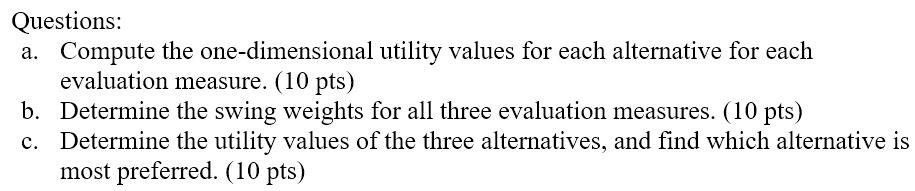
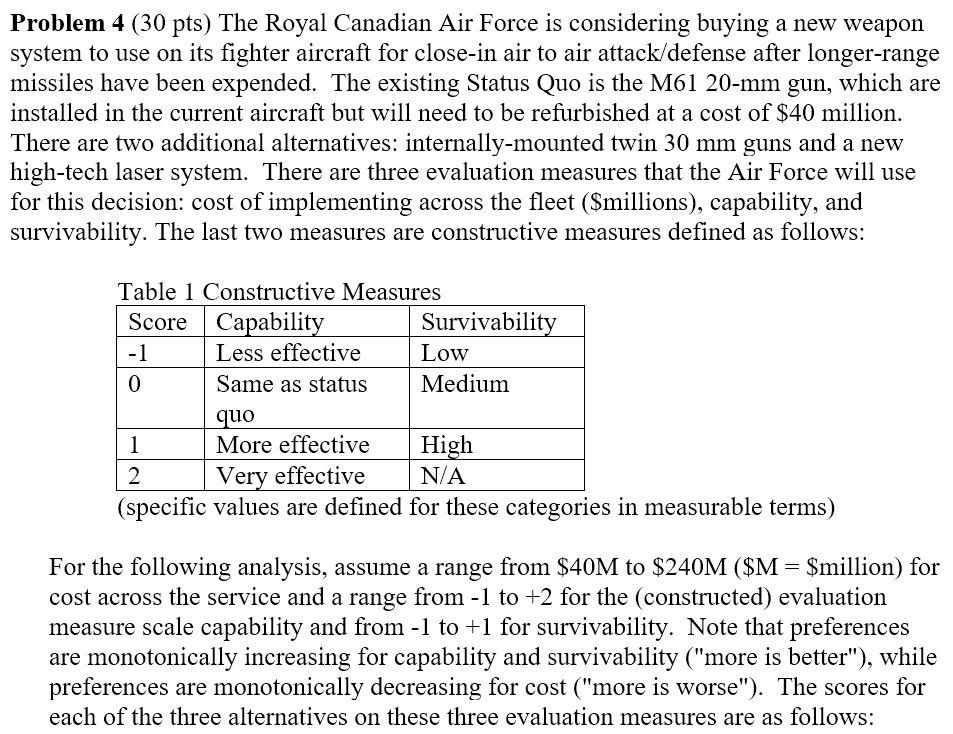
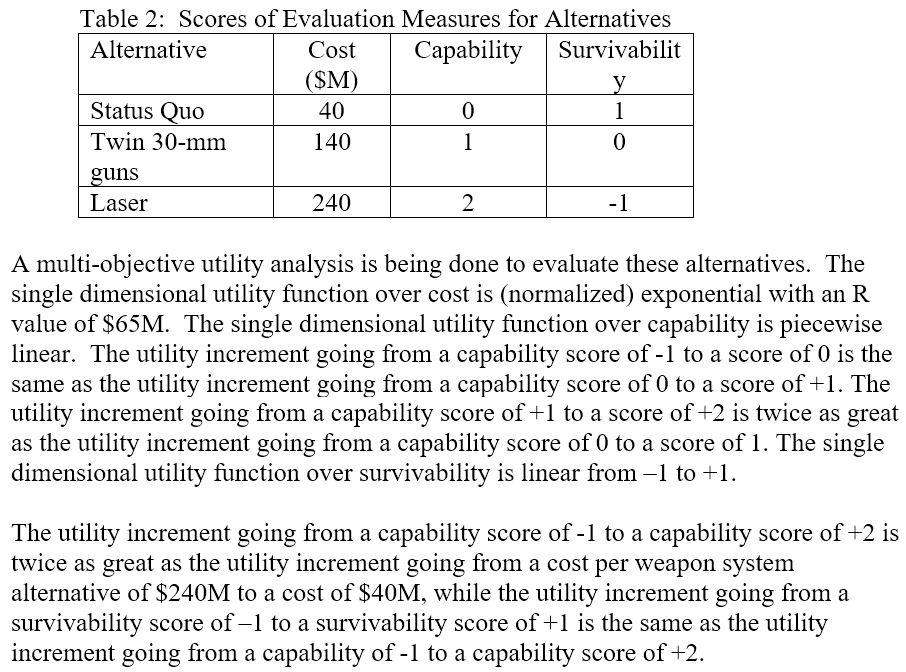
Problem 4 ( 30 pts) The Royal Canadian Air Force is considering buying a new weapon system to use on its fighter aircraft for close-in air to air attack/defense after longer-range missiles have been expended. The existing Status Quo is the M61 20-mm gun, which are installed in the current aircraft but will need to be refurbished at a cost of $40 million. There are two additional alternatives: internally-mounted twin 30mm guns and a new high-tech laser system. There are three evaluation measures that the Air Force will use for this decision: cost of implementing across the fleet (\$millions), capability, and survivability. The last two measures are constructive measures defined as follows: Toh1a 1 Conatmintira Mancurac (specific values are defined for these categories in measurable terms) For the following analysis, assume a range from $40M to $240M($M=$million) for cost across the service and a range from 1 to +2 for the (constructed) evaluation measure scale capability and from 1 to +1 for survivability. Note that preferences are monotonically increasing for capability and survivability ("more is better"), while preferences are monotonically decreasing for cost ("more is worse"). The scores for each of the three alternatives on these three evaluation measures are as follows: Table 2: Scores of Evaluation Measures for Alternatives A multi-objective utility analysis is being done to evaluate these alternatives. The single dimensional utility function over cost is (normalized) exponential with an R value of $65M. The single dimensional utility function over capability is piecewise linear. The utility increment going from a capability score of 1 to a score of 0 is the same as the utility increment going from a capability score of 0 to a score of +1. The utility increment going from a capability score of +1 to a score of +2 is twice as great as the utility increment going from a capability score of 0 to a score of 1 . The single dimensional utility function over survivability is linear from 1 to +1. The utility increment going from a capability score of 1 to a capability score of +2 is twice as great as the utility increment going from a cost per weapon system alternative of $240M to a cost of $40M, while the utility increment going from a survivability score of 1 to a survivability score of +1 is the same as the utility increment going from a capability of 1 to a capability score of +2. Questions: a. Compute the one-dimensional utility values for each alternative for each evaluation measure. (10pts) b. Determine the swing weights for all three evaluation measures. (10 pts) c. Determine the utility values of the three alternatives, and find which alternative is most preferred. (10 pts) Problem 4 ( 30 pts) The Royal Canadian Air Force is considering buying a new weapon system to use on its fighter aircraft for close-in air to air attack/defense after longer-range missiles have been expended. The existing Status Quo is the M61 20-mm gun, which are installed in the current aircraft but will need to be refurbished at a cost of $40 million. There are two additional alternatives: internally-mounted twin 30mm guns and a new high-tech laser system. There are three evaluation measures that the Air Force will use for this decision: cost of implementing across the fleet (\$millions), capability, and survivability. The last two measures are constructive measures defined as follows: Toh1a 1 Conatmintira Mancurac (specific values are defined for these categories in measurable terms) For the following analysis, assume a range from $40M to $240M($M=$million) for cost across the service and a range from 1 to +2 for the (constructed) evaluation measure scale capability and from 1 to +1 for survivability. Note that preferences are monotonically increasing for capability and survivability ("more is better"), while preferences are monotonically decreasing for cost ("more is worse"). The scores for each of the three alternatives on these three evaluation measures are as follows: Table 2: Scores of Evaluation Measures for Alternatives A multi-objective utility analysis is being done to evaluate these alternatives. The single dimensional utility function over cost is (normalized) exponential with an R value of $65M. The single dimensional utility function over capability is piecewise linear. The utility increment going from a capability score of 1 to a score of 0 is the same as the utility increment going from a capability score of 0 to a score of +1. The utility increment going from a capability score of +1 to a score of +2 is twice as great as the utility increment going from a capability score of 0 to a score of 1 . The single dimensional utility function over survivability is linear from 1 to +1. The utility increment going from a capability score of 1 to a capability score of +2 is twice as great as the utility increment going from a cost per weapon system alternative of $240M to a cost of $40M, while the utility increment going from a survivability score of 1 to a survivability score of +1 is the same as the utility increment going from a capability of 1 to a capability score of +2. Questions: a. Compute the one-dimensional utility values for each alternative for each evaluation measure. (10pts) b. Determine the swing weights for all three evaluation measures. (10 pts) c. Determine the utility values of the three alternatives, and find which alternative is most preferred. (10 pts)

Step by Step Solution

There are 3 Steps involved in it

1 Expert Approved Answer
Step: 1 Unlock blur-text-image

Question Has Been Solved by an Expert!

Get step-by-step solutions from verified subject matter experts

Step: 2 Unlock
Step: 3 Unlock

Students Have Also Explored These Related General Management Questions!