







Question: can someone please help me with this 8.4 Developing overbooking strategy using profit/loss table and critical fractile criterion. An airline serving short routes is considering
can someone please help me with this 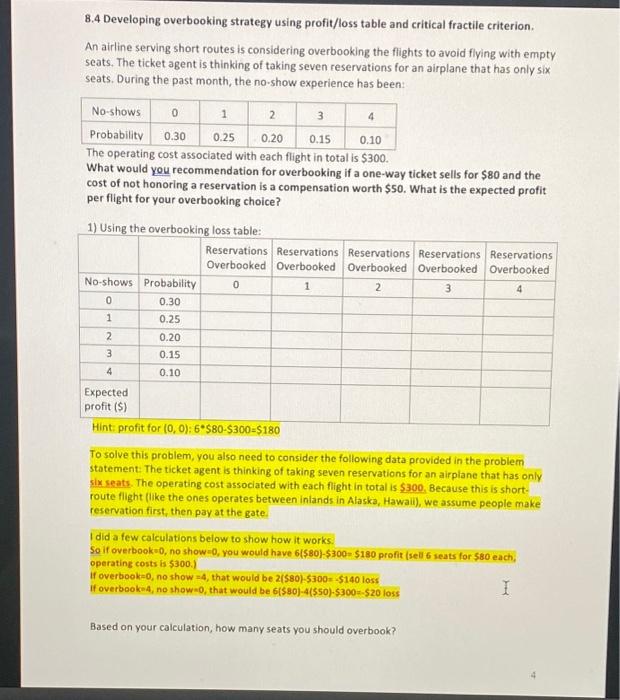
8.4 Developing overbooking strategy using profit/loss table and critical fractile criterion. An airline serving short routes is considering overbooking the flights to avoid flying with empty seats. The ticket agent is thinking of taking seven reservations for an airplane that has only six seats. During the past month, the no-show experience has been: No-shows 0 1 2 3 4 Probability 0.30 0.25 0.20 0.15 0.10 The operating cost associated with each flight in total is $300. What would you recommendation for overbooking if a one-way ticket sells for $80 and the cost of not honoring a reservation is a compensation worth $50. What is the expected profit per flight for your overbooking choice? 1) Using the overbooking loss table: Reservations Reservations Reservations Reservations Reservations Overbooked Overbooked Overbooked Overbooked Overbooked No-shows Probability 1 3 0.30 0 2 4 0 1 0.25 2 3 0.20 0.15 0.10 4 Expected profit ($) Hint profit for (0, 0); 6*$80-$300-S180 To solve this problem, you also need to consider the following data provided in the problem statement. The ticket agent is thinking of taking seven reservations for an airplane that has only six seats. The operating cost associated with each flight in total is $300, Because this is short- route flight (like the ones operates between inlands in Alaska, Hawaii), we assume people make reservation first, then pay at the gate. I did a few calculations below to show how it works. So it overbook=0, no show=0, you would have 6(580)-$300= $180 profit (sell 6 seats for $80 each, operating costs is $300.) if overbook=0, no show 4, that would be 2/580)-5300 $140 loss If overbook-4, no show=0, that would be 6{$80)-4(550)-5300-$20 loss 1 Based on your calculation, how many seats you should overbook Step by Step Solution
There are 3 Steps involved in it
1 Expert Approved Answer
Step: 1 Unlock

Question Has Been Solved by an Expert!
Get step-by-step solutions from verified subject matter experts
Step: 2 Unlock
Step: 3 Unlock
 Study Help