Question: Can someone please help me with this? Problem 6: In 1640, Fermat proved that every prime p=1 (mod 4) is the sum of two squares;
Can someone please help me with this?
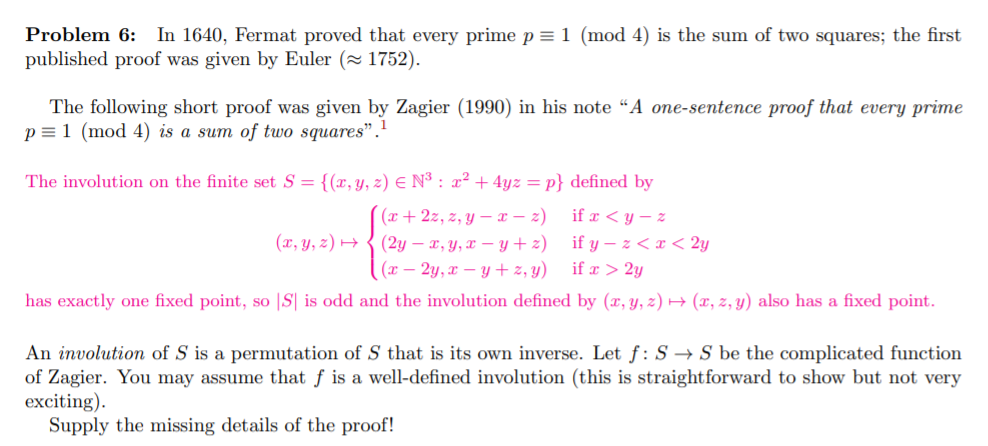
Problem 6: In 1640, Fermat proved that every prime p=1 (mod 4) is the sum of two squares; the first published proof was given by Euler (1752). The following short proof was given by Zagier (1990) in his note "A one-sentence proof that every prime p=1 (mod 4) is a sum of two squares. 1 The involution on the finite set S = {(x, y, z) E N3 : x2 + 4yz =p} defined by (x + 2z, z, y - x - 2) if r 2y has exactly one fixed point, so S is odd and the involution defined by (2, 4, 2) + (x,x,y) also has a fixed point. An involution of S is a permutation of S that is its own inverse. Let f: SS be the complicated function of Zagier. You may assume that f is a well-defined involution (this is straightforward to show but not very exciting) Supply the missing details of the proof! Problem 6: In 1640, Fermat proved that every prime p=1 (mod 4) is the sum of two squares; the first published proof was given by Euler (1752). The following short proof was given by Zagier (1990) in his note "A one-sentence proof that every prime p=1 (mod 4) is a sum of two squares. 1 The involution on the finite set S = {(x, y, z) E N3 : x2 + 4yz =p} defined by (x + 2z, z, y - x - 2) if r 2y has exactly one fixed point, so S is odd and the involution defined by (2, 4, 2) + (x,x,y) also has a fixed point. An involution of S is a permutation of S that is its own inverse. Let f: SS be the complicated function of Zagier. You may assume that f is a well-defined involution (this is straightforward to show but not very exciting) Supply the missing details of the proof









 Study Help