



Question: Can someone please show me step by step how to solve this problem? I am very stuck. thanks! Consider a roller coaster. The roller coaster
Can someone please show me step by step how to solve this problem? I am very stuck. thanks!
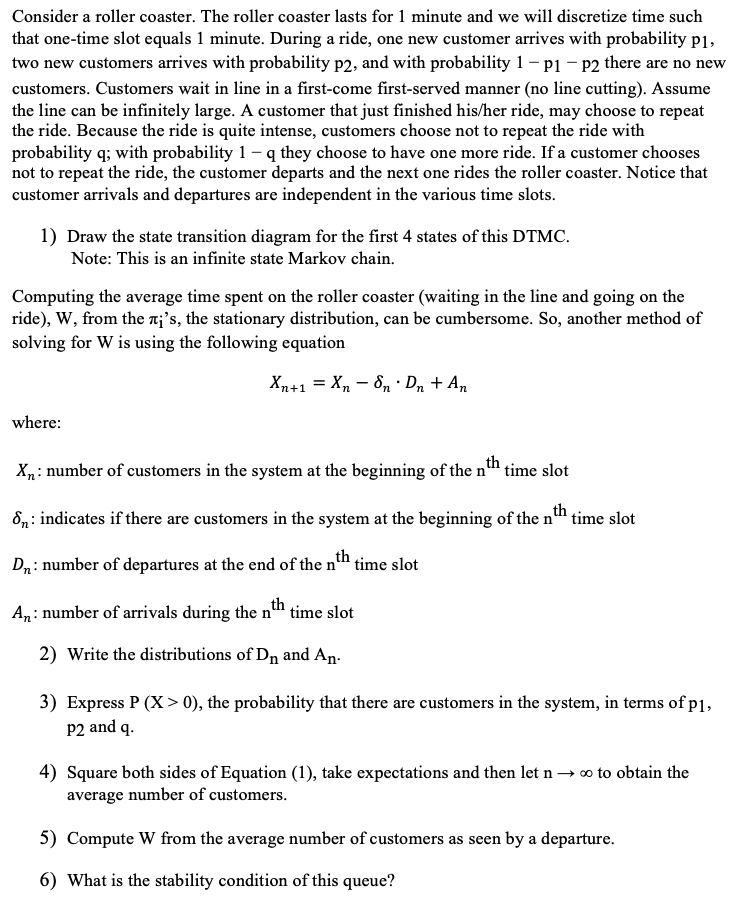
Consider a roller coaster. The roller coaster lasts for 1 minute and we will discretize time such that one-time slot equals 1 minute. During a ride, one new customer arrives with probability p1, two new customers arrives with probability p2, and with probability 1 p1 p2 there are no new customers. Customers wait in line in a rst-come rst-served manner (no line cutting). Assume the line can be innitely large. A customer thatjust nished hisner ride, may choose to repeat the ride. Because the ride is quite intense, customers choose not to repeat the ride with probability q; with probability 1 q they choose to have one more ride. If a customer chooses not to repeat the ride, the customer departs and the next one rides the roller coaster. Notice that customer arrivals and departures are independent in the various time slots. 1) Draw the state transition diagram for the first 4 states of this DTMC. Note: This is an innite state Markov chain. Computing the average time spent on the roller coaster (waiting in the line and going on the ride), W, from the iti's, the stationary distribution, can be cumbersome. So, another method of solving for W is using the following equation Xn+1 = XII _an .011 +An where: X n: number of customers in the system at the beginning of the rut]:1 time slot 6\": indicates if there are customers in the system at the beginning of the nth time slot D": number of departures at the end of the 1:11;]:l time slot A": number of arrivals during the n:l time slot 2) Write the dis1ributions of D11 and An. 3) Express P (X > 0), the probability that there are customers in the system, in terms of p1 , p2 and q. 4) Square both sides of Equation (1), take expectations and then let :1 > 00 to obtain the average number of customers. 5) Compute W from the average number of customers as seen by a departure. 6) What is the stability condition of this queue
Step by Step Solution
There are 3 Steps involved in it

Get step-by-step solutions from verified subject matter experts