







Question: can someone work this using matlab please? Thanks! Using Matlab, Python, Excel or other software of your choice, you will compare energy production of a
can someone work this using matlab please? Thanks! 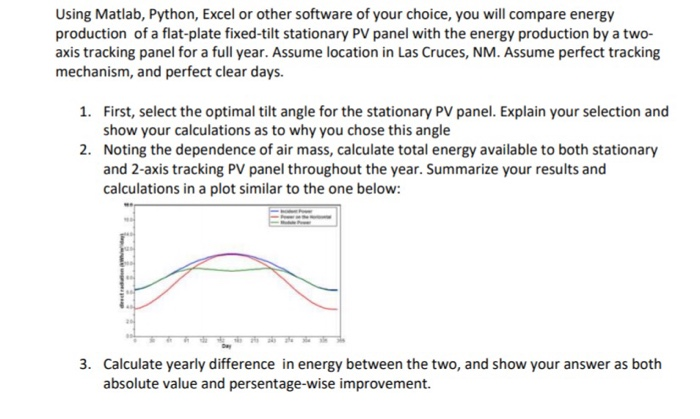
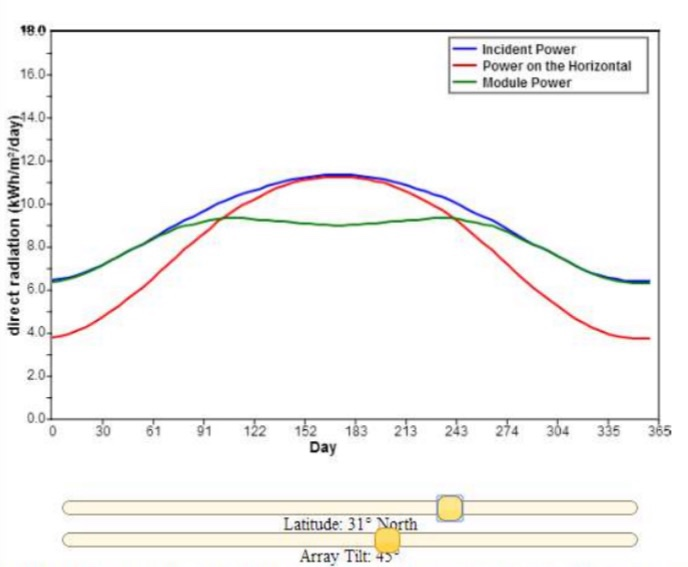
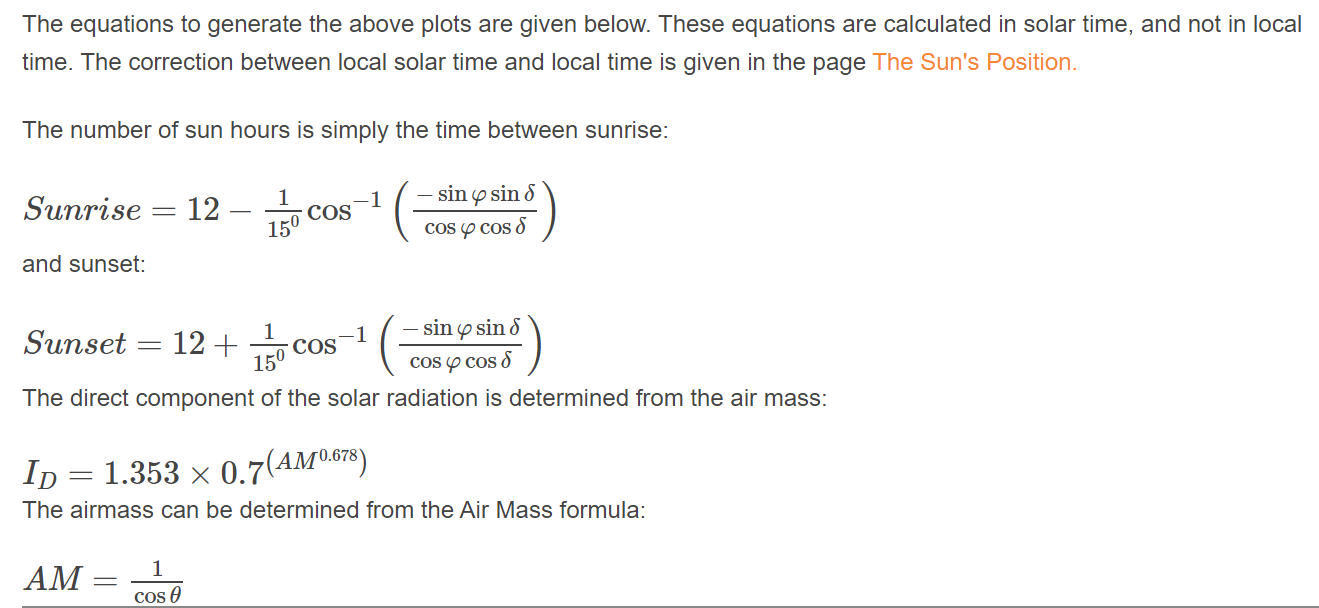
Using Matlab, Python, Excel or other software of your choice, you will compare energy production of a flat-plate fixed-tilt stationary PV panel with the energy production by a two- axis tracking panel for a full year. Assume location in Las Cruces, NM. Assume perfect tracking mechanism, and perfect clear days. 1. First, select the optimal tilt angle for the stationary PV panel. Explain your selection and show your calculations as to why you chose this angle 2. Noting the dependence of air mass, calculate total energy available to both stationary and 2-axis tracking PV panel throughout the year. Summarize your results and calculations in a plot similar to the one below: 3. Calculate yearly difference in energy between the two, and show your answer as both absolute value and persentage-wise improvement. 18.0 Incident Power Power on the Horizontal Module Power 18 direct radiation (kWh/m/day). 0.06 30 67 91 122 152 183 Day 213 243 214 364 335 365 Latitude: 31 North Array Tit: 43 The equations to generate the above plots are given below. These equations are calculated in solar time, and not in local time. The correction between local solar time and local time is given in the page The Sun's Position. The number of sun hours is simply the time between sunrise: Sunrise = 12 Locos-1 ( case yo sienos) and sunset: 50 Sunset = 12 + Io cos-1 / -sin y sin 8 cos y cos d The direct component of the solar radiation is determined from the air mass: Id = 1.353 x 0.7(AM0.678) The airmass can be determined from the Air Mass formula: AM = cose Using Matlab, Python, Excel or other software of your choice, you will compare energy production of a flat-plate fixed-tilt stationary PV panel with the energy production by a two- axis tracking panel for a full year. Assume location in Las Cruces, NM. Assume perfect tracking mechanism, and perfect clear days. 1. First, select the optimal tilt angle for the stationary PV panel. Explain your selection and show your calculations as to why you chose this angle 2. Noting the dependence of air mass, calculate total energy available to both stationary and 2-axis tracking PV panel throughout the year. Summarize your results and calculations in a plot similar to the one below: 3. Calculate yearly difference in energy between the two, and show your answer as both absolute value and persentage-wise improvement. 18.0 Incident Power Power on the Horizontal Module Power 18 direct radiation (kWh/m/day). 0.06 30 67 91 122 152 183 Day 213 243 214 364 335 365 Latitude: 31 North Array Tit: 43 The equations to generate the above plots are given below. These equations are calculated in solar time, and not in local time. The correction between local solar time and local time is given in the page The Sun's Position. The number of sun hours is simply the time between sunrise: Sunrise = 12 Locos-1 ( case yo sienos) and sunset: 50 Sunset = 12 + Io cos-1 / -sin y sin 8 cos y cos d The direct component of the solar radiation is determined from the air mass: Id = 1.353 x 0.7(AM0.678) The airmass can be determined from the Air Mass formula: AM = cose
Step by Step Solution
There are 3 Steps involved in it

Get step-by-step solutions from verified subject matter experts
 Study Help