







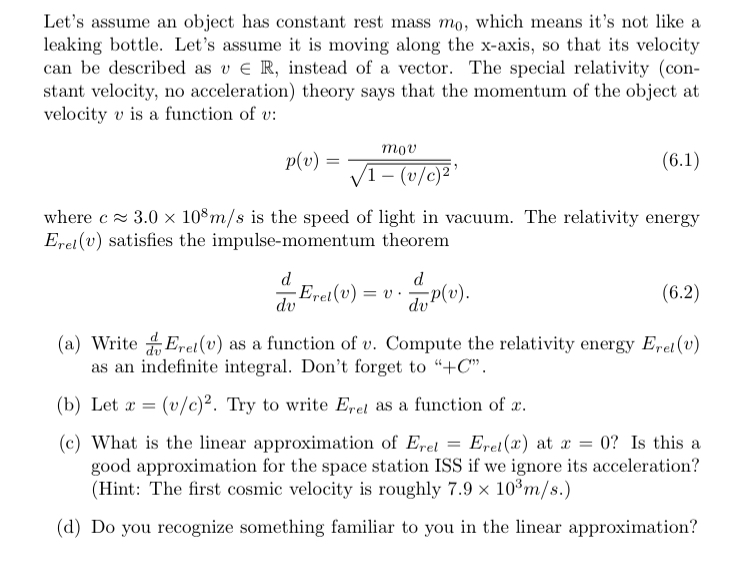
Question: Can these questions be solved above? Let's assume an object has constant rest mass mo, which means it's not like a leaking bottle. Let's assume
Can these questions be solved above?
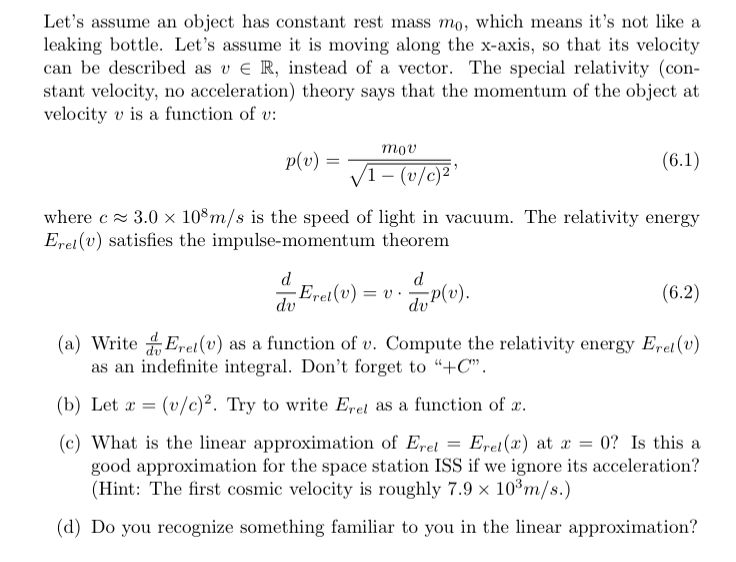
Let's assume an object has constant rest mass mo, which means it's not like a leaking bottle. Let's assume it is moving along the x-axis, so that its velocity can be described as v E R, instead of a vector. The special relativity (con- stant velocity, no acceleration) theory says that the momentum of the object at velocity v is a function of v: mov p(v) = VI - (v/c)2' (6.1) where c ~ 3.0 x 10⁸m/s is the speed of light in vacuum. The relativity energy Erel(v) satisfies the impulse-momentum theorem du Erel(v) = v . . du P(v). (6.2) (a) Write - Erei(v) as a function of v. Compute the relativity energy Ever(v) as an indefinite integral. Don't forget to "+C". (b) Let x = (v/c)2. Try to write Erez as a function of a. (c) What is the linear approximation of Eret = Eres(x) at x = 0? Is this a good approximation for the space station ISS if we ignore its acceleration? (Hint: The first cosmic velocity is roughly 7.9 x 10³m/s.) (d) Do you recognize something familiar to you in the linear approximation
Step by Step Solution
There are 3 Steps involved in it

Get step-by-step solutions from verified subject matter experts
 Study Help