







Question: can u convert these solutions to pyhton code , and these python code must be run, thanks a lot .. 1.Dynamicsymbols and Scalars: The problem's
can u convert these solutions to pyhton code , and these python code must be run, thanks a lot ..
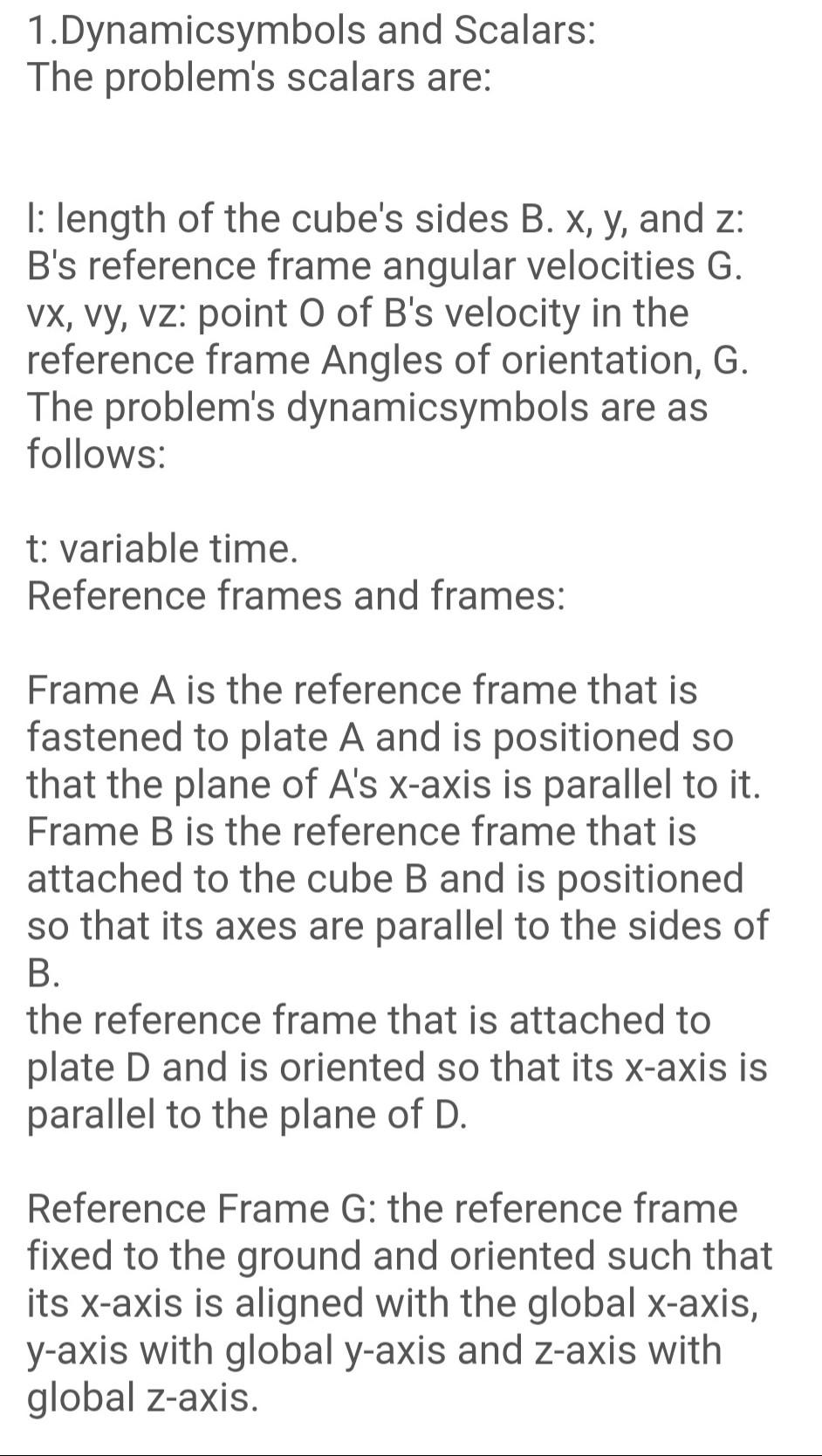
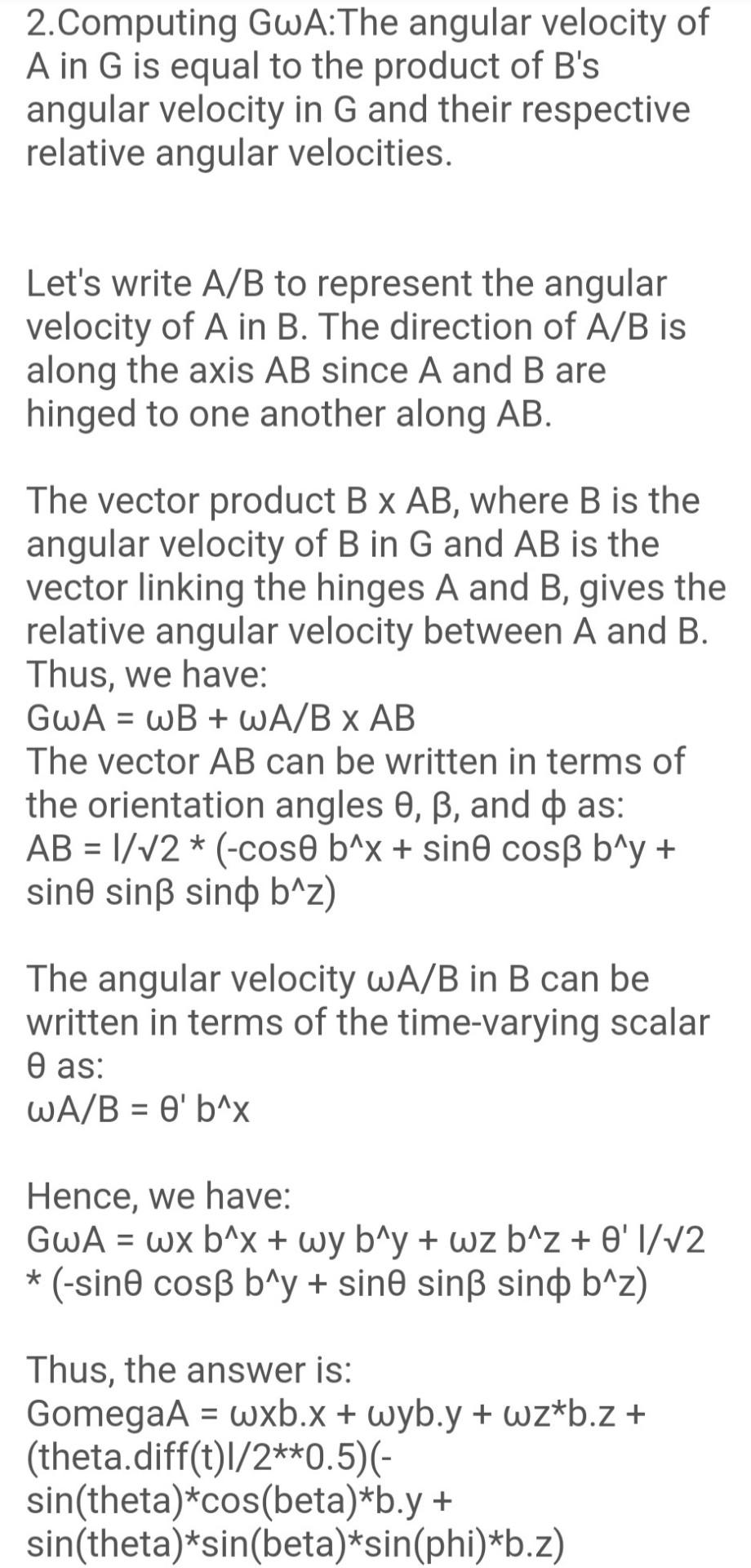
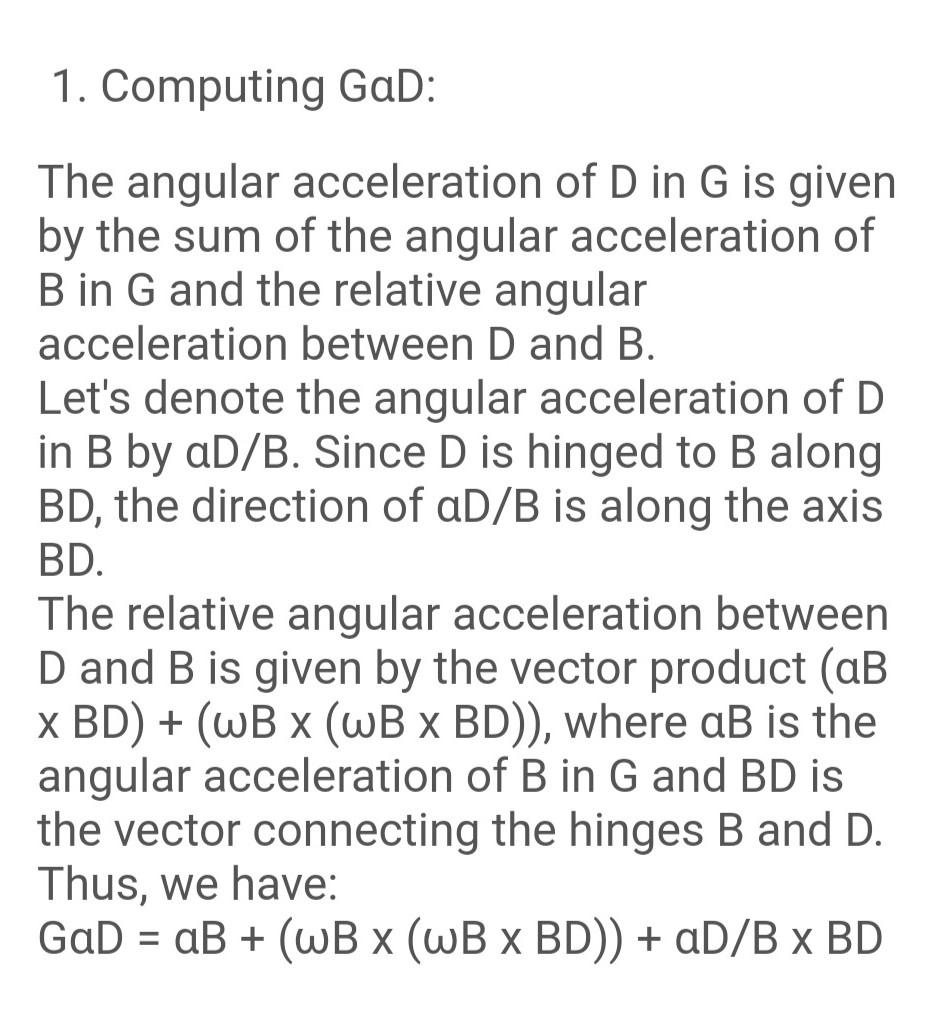
1.Dynamicsymbols and Scalars: The problem's scalars are: I: length of the cube's sides B.x,y, and z : B Bs reference frame angular velocities G. vx,vy,vz : point O of B's velocity in the reference frame Angles of orientation, G. The problem's dynamicsymbols are as follows: t: variable time. Reference frames and frames: Frame A is the reference frame that is fastened to plate A and is positioned so that the plane of A's x-axis is parallel to it. Frame B is the reference frame that is attached to the cube B and is positioned so that its axes are parallel to the sides of B. the reference frame that is attached to plate D and is oriented so that its x-axis is parallel to the plane of D. Reference Frame G: the reference frame fixed to the ground and oriented such that its x-axis is aligned with the global x-axis, y-axis with global y-axis and z-axis with global z-axis. 2.Computing GwA:The angular velocity of A in G is equal to the product of B's angular velocity in G and their respective relative angular velocities. Let's write A/B to represent the angular velocity of A in B. The direction of A/B is along the axis AB since A and B are hinged to one another along AB. The vector product BAB, where B is the angular velocity of B in G and AB is the vector linking the hinges A and B, gives the relative angular velocity between A and B. Thus, we have: GA=B+A/BAB The vector AB can be written in terms of the orientation angles ,, and as: AB=I/2(cosbx+sincosby+ sinsinsinbz) The angular velocity A/B in B can be written in terms of the time-varying scalar as: A/B=bx Hence, we have: GA=xbx+yby+zbz+/2 (sincosby+sinsinsinbz) Thus, the answer is: GomegaA =xbx+yb.y+zb.z+ (theta.diff(t)I/2**0.5)(sin( theta) cos(beta)).y+ sin(theta))sin(beta))sin(phi))b.z) 1. Computing GaD: The angular acceleration of D in G is given by the sum of the angular acceleration of B in G and the relative angular acceleration between D and B. Let's denote the angular acceleration of D in B by aD/B. Since D is hinged to B along BD, the direction of aD/B is along the axis BD. The relative angular acceleration between D and B is given by the vector product ( AB xBD)+(B(BBD)), where aB is the angular acceleration of B in G and BD is the vector connecting the hinges B and D. Thus, we have: GaD=aB+(B(BBD))+aD/BBD
Step by Step Solution
There are 3 Steps involved in it

Get step-by-step solutions from verified subject matter experts
 Study Help