







Question: Can you answer C and D ? C (30 marks). Use the Smith-Waterman algorithm to find an optimal-scoring local alignment of these two sequences. Your
Can you answer C and D ? 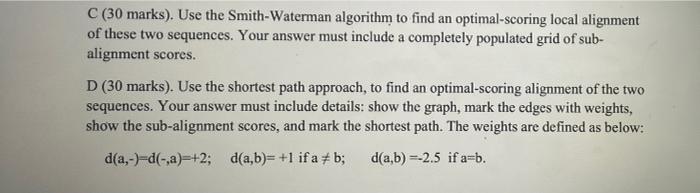
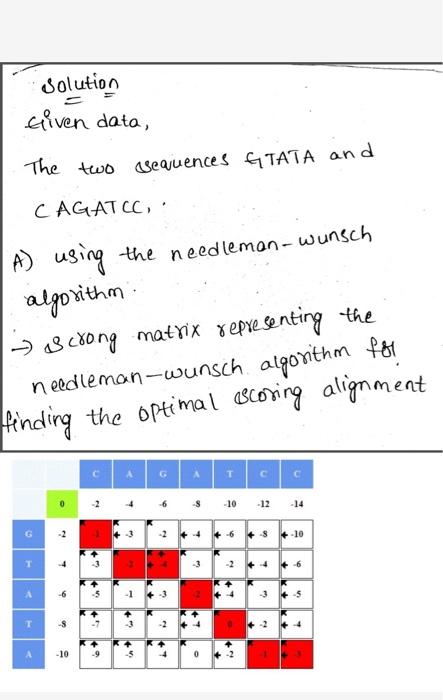
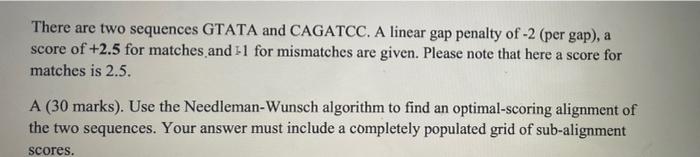
C (30 marks). Use the Smith-Waterman algorithm to find an optimal-scoring local alignment of these two sequences. Your answer must include a completely populated grid of sub- alignment scores. D (30 marks). Use the shortest path approach, to find an optimal-scoring alignment of the two sequences. Your answer must include details: show the graph, mark the edges with weights, show the sub-alignment scores, and mark the shortest path. The weights are defined as below: da,-)-(-a)=+2; d(a,b)= +1 if a #b; d(a,b) =-2.5 if a=b. Solution Eiven data, The two sequences GTATA and CAGATCC, the A) using the needleman-wunsch algorithm - 3 csong matrix representing needleman-wunsch algorithm for finding the optimal scoring alignment A G 0 2 4 Ge -10 12-14 2 6 1 3 4 -3 -2 + -6 + -1 +-3 -3 +5 + + 1 -8 3 -2 -2 2 -10 -9 -5 +7 4 0 There are two sequences GTATA and CAGATCC. A linear gap penalty of -2 (per gap), a score of +2.5 for matches and 11 for mismatches are given. Please note that here a score for matches is 2.5. A (30 marks). Use the Needleman-Wunsch algorithm to find an optimal-scoring alignment of the two sequences. Your answer must include a completely populated grid of sub-alignment scores Step by Step Solution
There are 3 Steps involved in it
1 Expert Approved Answer
Step: 1 Unlock

Question Has Been Solved by an Expert!
Get step-by-step solutions from verified subject matter experts
Step: 2 Unlock
Step: 3 Unlock
 Study Help