Question: Can you answer data table 1, data table 2,calculations 1 - A,B,C and 2,3,4,5. Introduction: Isotopes are atoms of the same chemical element, each having
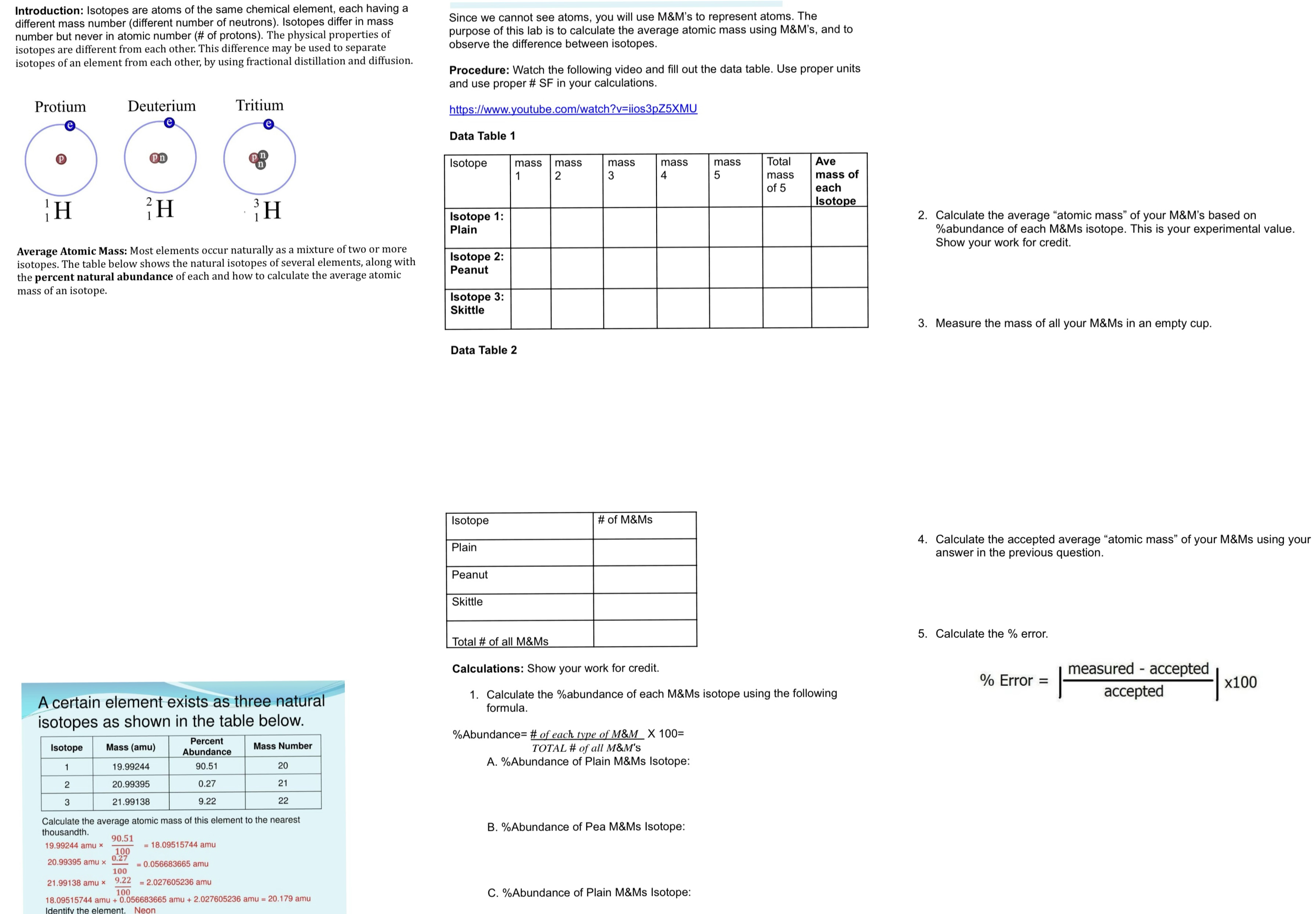
Can you answer data table 1, data table 2,calculations 1 - A,B,C and 2,3,4,5.
Introduction: Isotopes are atoms of the same chemical element, each having a different mass number (different number of neutrons). Isotopes differ in mass number but never in atomic number (# of protons). The physical properties of isotopes are different from each other. This difference may be used to separate isotopes of an element from each other, by using fractional distillation and diffusion. Protium Deuterium Tritium O O @ 1H 7H iH Average Atomic Mass: Most elements occur naturally as a mixture of two or more isotopes. The table below shows the natural isotopes of several elements, along with the percent natural abundance of each and how to calculate the average atomic mass of an isotope. A certain element exists as three natural isotopes as shown in the table below. Percent Isotope | Mass (amu) Abundance | Mass Number 1 19,9244 90.51 20 2 20.99395 0.27 21 3 21.99138 9.22 22 Calculate the average atomic mass of this element to the nearest thousandth. 90.51 19.99244 amu * = 18.09515744 amu 0.27 20.99395 amu x Too 7 0.058680665 amu 21,99138 amux 9:22 = 2027605236 amu 100, 18.09515744 amu + 0.056683665 amu + 2.027605236 amu = 20.179 amu Identify the element. Neon Since we cannot see atoms, you will use M&M's to represent atoms. The purpose of this lab is to calculate the average atomic mass using M&M's, and to observe the difference between isotopes. Procedure: Watch the following video and fill out the data table. Use proper units and use proper # SF in your calculations. https:/www.youtube.com/watch?v=iios3pZ5XMU Data Table 1 Isotope mass | mass mass mass mass Total Ave 1 2 3 4 5 mass_ | mass of of 5 each Isotope Isotope 1: Plain Isotope 2: Peanut Isotope 3: Skittle Data Table 2 Isotope # of M&Ms Plain Peanut Skittle Total # of all M&Ms Calculations: Show your work for credit. 1. Calculate the %abundance of each M&Ms isotope using the following formula. %Abundance= # of each type of M&M_ X 100= TOTAL # of all M&M's A. %Abundance of Plain M&Ms Isotope: B. %Abundance of Pea M&Ms Isotope: C. %Abundance of Plain M&Ms Isotope: 2. Calculate the average \"atomic mass\" of your M&M's based on Yabundance of each M&Ms isotope. This is your experimental value. Show your work for credit. 3. Measure the mass of all your M&Ms in an empty cup. 4. Calculate the accepted average \"atomic mass\" of your M&Ms using your answer in the previous question. 5. Calculate the % error. measured - accepted accepted % Error = x100









 Study Help