



Question: Can you answer number d, j, and k. d, j, and k is still not answered 4. Assume you manage a risky portfolio with an
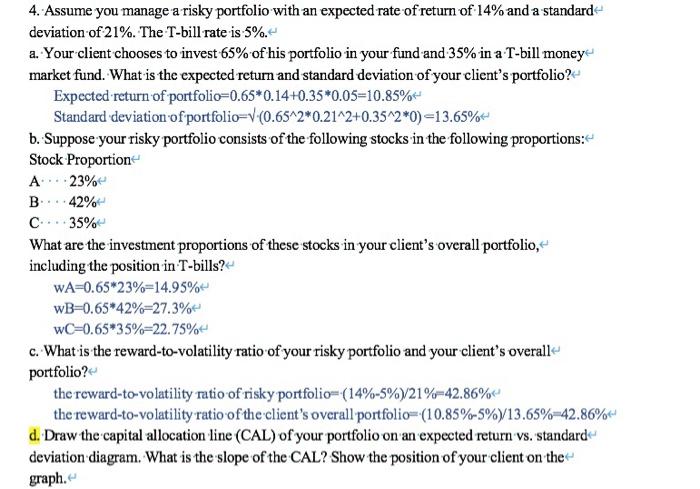
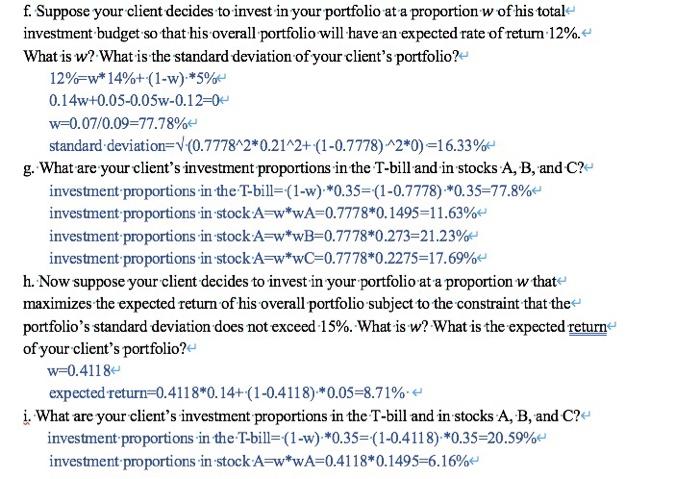
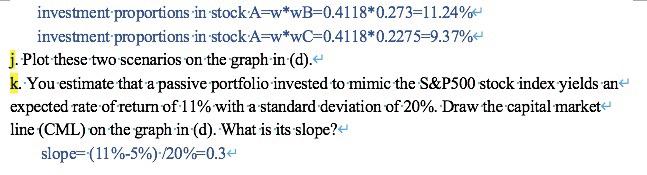
4. Assume you manage a risky portfolio with an expected rate of return of 14% and a standard deviation of 21%. The T-bill rate is 5%. a. Your client chooses to invest 65% of his portfolio in your fund and 35% in a T-bill money market fund. What is the expected return and standard deviation of your client's portfolio? Expected return of portfolio =0.650.14+0.350.05=10.85% Standard deviation of portfolio =(0.6520.212+0.3520)=13.65% b. Suppose your risky portfolio consists of the following stocks in the following proportions: Stock Proportion A.23%B42%C...35% What are the investment proportions of these stocks in your client's overall portfolio, including the position in T-bills? wA=0.6523%=14.95%wB=0.6542%=27.3%wC=0.6535%=22.75% c. What is the reward-to-volatility ratio of your risky portfolio and your client's overall portfolio? the reward-to-volatility ratio of risky portfolio =(14%5%)/21%=42.86% the reward-to-volatility ratio of the client's overall portfolio =(10.85%5%)/13.65%=42.86% d. Draw the capital allocation line (CAL) of your portfolio on an expected return vs. standard deviation diagram. What is the slope of the CAL? Show the position of your client on the graph. f. Suppose your client decides to invest in your portfolio at a proportion w of his total investment budget so that his overall portfolio will have an expected rate of return 12%. What is w ? What is the standard deviation of your client's portfolio? 12%=w14%+(1w)5%0.14w+0.050.05w0.12=0w=0.07/0.09=77.78% standarddeviation=(0.777820.212+(10.7778)20)=16.33% g. What are your client's investment proportions in the T-bill and in stocks A,B, and C ? investment proportions in the T-bill =(1w)0.35=(10.7778)0.35=77.8% investment proportions in stock A=w w A=0.77780.1495=11.63% investment proportions in stock A=wwB=0.77780.273=21.23% investment proportions in stock A=wwC=0.77780.2275=17.69% h. Now suppose your client decides to invest in your portfolio at a proportion w that maximizes the expected return of his overall portfolio subject to the constraint that the portfolio's standard deviation does not exceed 15%. What is w ? What is the expected return of your client's portfolio? w=0.4118expectedreturn=0.41180.14+(10.4118)0.05=8.71%. i. What are your client's investment proportions in the T-bill and in stocks A, B, and C? investment proportions in the-T-bill =(1w)0.35=(10.4118)0.35=20.59% investment proportions in stock A=wwA=0.41180.1495=6.16% investment proportions in stock A=wwB=0.41180.273=11.24% investment proportions in stock A=wwC=0.41180.2275=9.37% j. Plot these two scenarios on the graph in (d). k. You estimate that a passive portfolio invested to mimic the S\&P500 stock index yields an expected rate of return of 11% with a standard deviation of 20%. Draw the capital market line (CML) on the graph in (d). What is its slope? slope =(11%5%)/20%=0.3 4. Assume you manage a risky portfolio with an expected rate of return of 14% and a standard deviation of 21%. The T-bill rate is 5%. a. Your client chooses to invest 65% of his portfolio in your fund and 35% in a T-bill money market fund. What is the expected return and standard deviation of your client's portfolio? Expected return of portfolio =0.650.14+0.350.05=10.85% Standard deviation of portfolio =(0.6520.212+0.3520)=13.65% b. Suppose your risky portfolio consists of the following stocks in the following proportions: Stock Proportion A.23%B42%C...35% What are the investment proportions of these stocks in your client's overall portfolio, including the position in T-bills? wA=0.6523%=14.95%wB=0.6542%=27.3%wC=0.6535%=22.75% c. What is the reward-to-volatility ratio of your risky portfolio and your client's overall portfolio? the reward-to-volatility ratio of risky portfolio =(14%5%)/21%=42.86% the reward-to-volatility ratio of the client's overall portfolio =(10.85%5%)/13.65%=42.86% d. Draw the capital allocation line (CAL) of your portfolio on an expected return vs. standard deviation diagram. What is the slope of the CAL? Show the position of your client on the graph. f. Suppose your client decides to invest in your portfolio at a proportion w of his total investment budget so that his overall portfolio will have an expected rate of return 12%. What is w ? What is the standard deviation of your client's portfolio? 12%=w14%+(1w)5%0.14w+0.050.05w0.12=0w=0.07/0.09=77.78% standarddeviation=(0.777820.212+(10.7778)20)=16.33% g. What are your client's investment proportions in the T-bill and in stocks A,B, and C ? investment proportions in the T-bill =(1w)0.35=(10.7778)0.35=77.8% investment proportions in stock A=w w A=0.77780.1495=11.63% investment proportions in stock A=wwB=0.77780.273=21.23% investment proportions in stock A=wwC=0.77780.2275=17.69% h. Now suppose your client decides to invest in your portfolio at a proportion w that maximizes the expected return of his overall portfolio subject to the constraint that the portfolio's standard deviation does not exceed 15%. What is w ? What is the expected return of your client's portfolio? w=0.4118expectedreturn=0.41180.14+(10.4118)0.05=8.71%. i. What are your client's investment proportions in the T-bill and in stocks A, B, and C? investment proportions in the-T-bill =(1w)0.35=(10.4118)0.35=20.59% investment proportions in stock A=wwA=0.41180.1495=6.16% investment proportions in stock A=wwB=0.41180.273=11.24% investment proportions in stock A=wwC=0.41180.2275=9.37% j. Plot these two scenarios on the graph in (d). k. You estimate that a passive portfolio invested to mimic the S\&P500 stock index yields an expected rate of return of 11% with a standard deviation of 20%. Draw the capital market line (CML) on the graph in (d). What is its slope? slope =(11%5%)/20%=0.3
Step by Step Solution
There are 3 Steps involved in it

Get step-by-step solutions from verified subject matter experts