Question: Can you answer the question below the prompt? I will provide Chapters 6 and 9 subjects below in order to answer the question. The question
Can you answer the question below the prompt? I will provide Chapters 6 and 9 subjects below in order to answer the question. The question is the last thing listed, below the prompt.
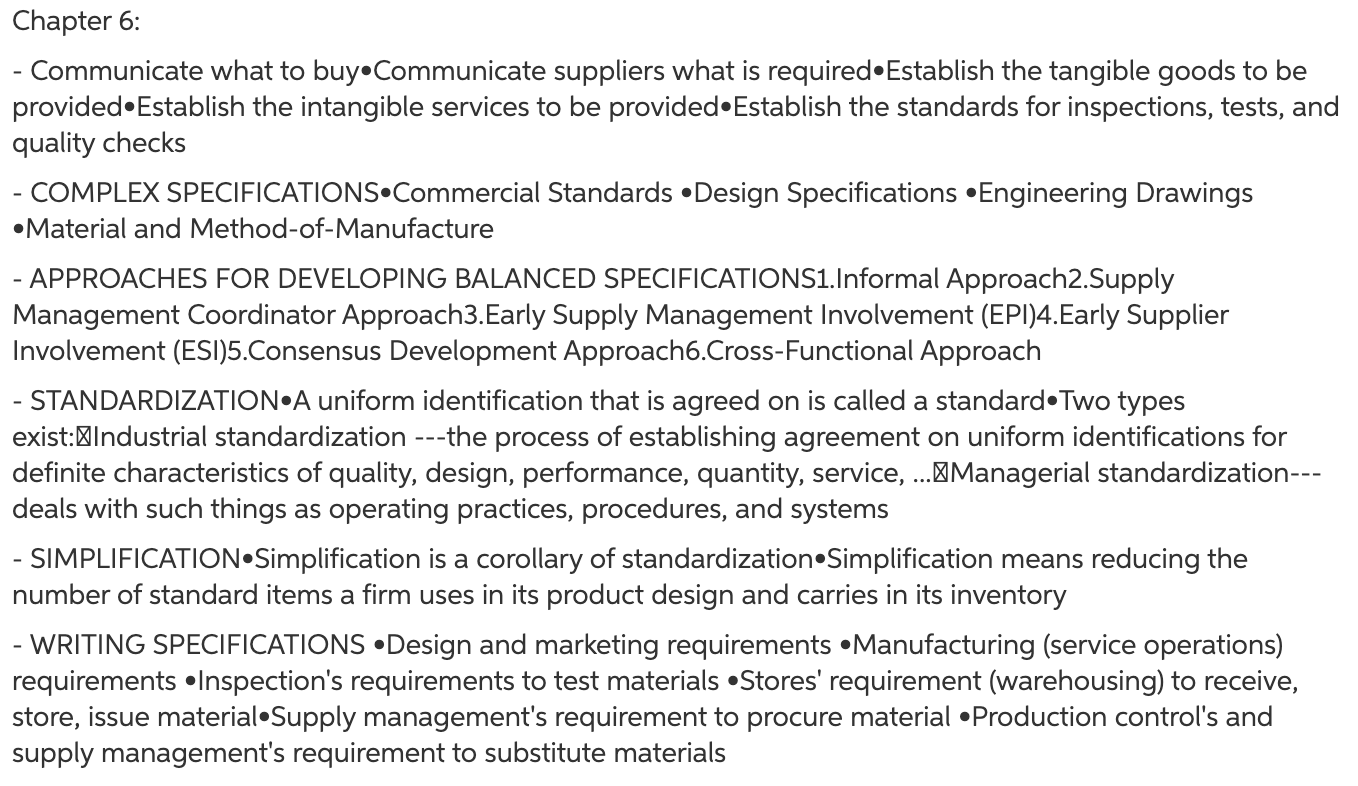
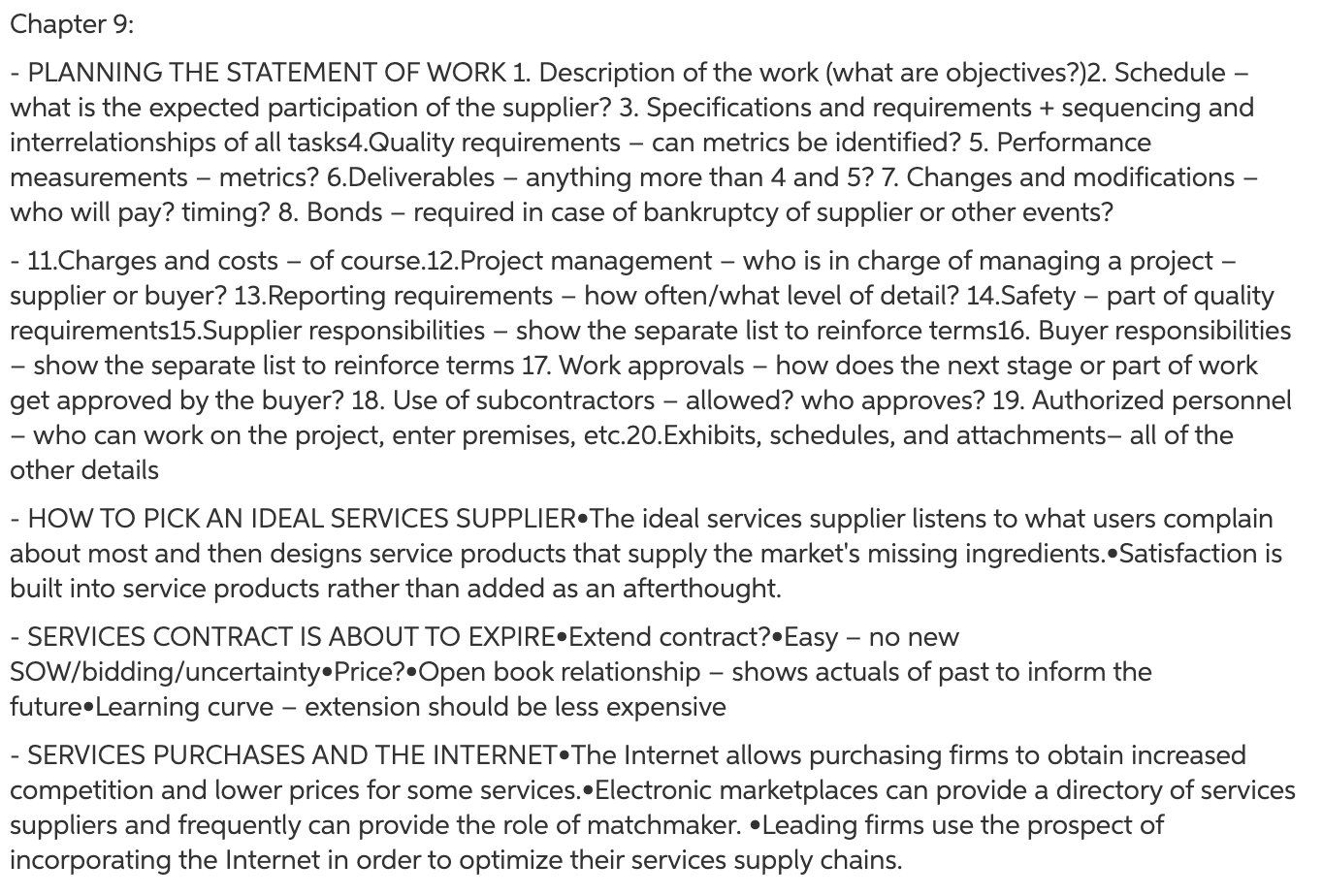
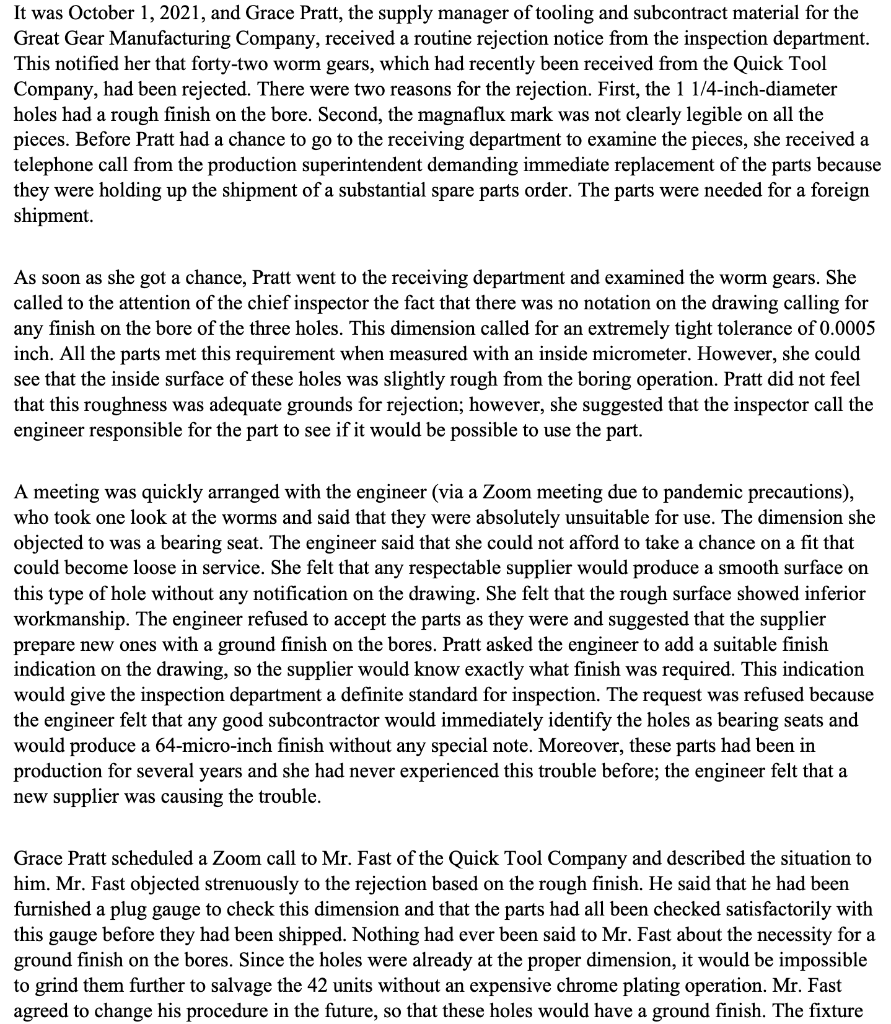
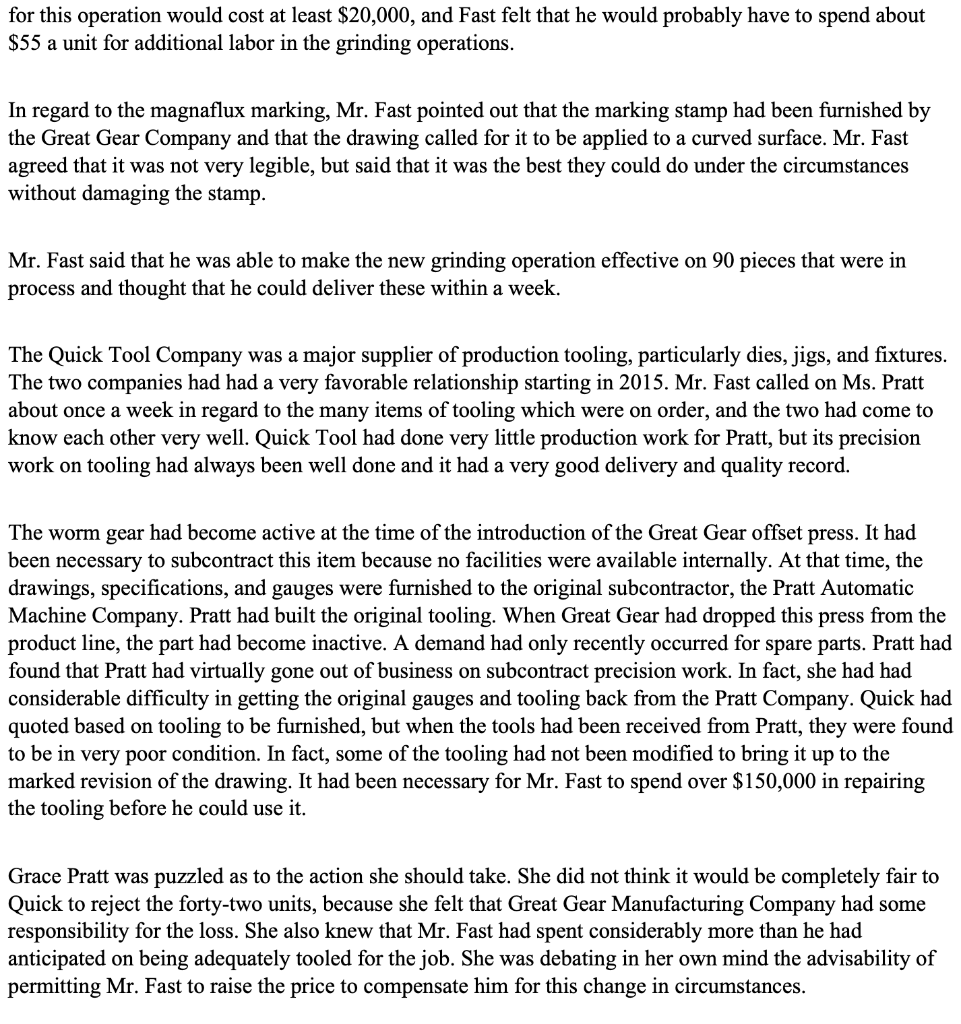

Chapter 6: - Communicate what to buyCommunicate suppliers what is requiredEstablish the tangible goods to be providedEstablish the intangible services to be providedEstablish the standards for inspections, tests, and quality checks COMPLEX SPECIFICATIONSCommercial Standards Design Specifications Engineering Drawings Material and Method-of-Manufacture - APPROACHES FOR DEVELOPING BALANCED SPECIFICATIONS1.Informal Approach2.Supply Management Coordinator Approach3.Early Supply Management Involvement (EPI)4.Early Supplier Involvement (ESI)5.Consensus Development Approach6.Cross-functional Approach STANDARDIZATIONA uniform identification that is agreed on is called a standardTwo types exist:'Industrial standardization ---the process of establishing agreement on uniform identifications for definite characteristics of quality, design, performance, quantity, service, ... Managerial standardization--- deals with such things as operating practices, procedures, and systems - SIMPLIFICATIONSimplification is a corollary of standardizationSimplification means reducing the number of standard items a firm uses in its product design and carries in its inventory - WRITING SPECIFICATIONS Design and marketing requirements Manufacturing (service operations) requirements Inspection's requirements to test materials Stores' requirement (warehousing) to receive, store, issue materialSupply management's requirement to procure material Production control's and supply management's requirement to substitute materials Chapter 9: - PLANNING THE STATEMENT OF WORK 1. Description of the work (what are objectives?)2. Schedule what is the expected participation of the supplier? 3. Specifications and requirements + sequencing and interrelationships of all tasks4.Quality requirements can metrics be identified? 5. Performance measurements metrics? 6.Deliverables anything more than 4 and 5? 7. Changes and modifications who will pay? timing? 8. Bonds required in case of bankruptcy of supplier or other events? - 11.Charges and costs of course.12.Project management - who is in charge of managing a project - supplier or buyer? 13. Reporting requirements how often/what level of detail? 14.Safety part of quality requirements15.Supplier responsibilities show the separate list to reinforce terms16. Buyer responsibilities - show the separate list to reinforce terms 17. Work approvals how does the next stage or part of work get approved by the buyer? 18. Use of subcontractors allowed? who approves? 19. Authorized personnel who can work on the project, enter premises, etc.20.Exhibits, schedules, and attachments, all of the other details - HOW TO PICK AN IDEAL SERVICES SUPPLIERThe ideal services supplier listens to what users complain about most and then designs service products that supply the market's missing ingredients. Satisfaction is built into service products rather than added as an afterthought. - SERVICES CONTRACT IS ABOUT TO EXPIREExtend contract?Easy - no new SOW/bidding/uncertaintyPrice?Open book relationship shows actuals of past to inform the futureLearning curve - extension should be less expensive - SERVICES PURCHASES AND THE INTERNETThe Internet allows purchasing firms to obtain increased competition and lower prices for some services. Electronic marketplaces can provide a directory of services suppliers and frequently can provide the role of matchmaker. Leading firms use the prospect of incorporating the Internet in order to optimize their services supply chains. It was October 1, 2021, and Grace Pratt, the supply manager of tooling and subcontract material for the Great Gear Manufacturing Company, received a routine rejection notice from the inspection department. This notified her that forty-two worm gears, which had recently been received from the Quick Tool Company, had been rejected. There were two reasons for the rejection. First, the 1 1/4-inch-diameter holes had a rough finish on the bore. Second, the magnaflux mark was not clearly legible on all the pieces. Before Pratt had a chance to go to the receiving department to examine the pieces, she received a telephone call from the production superintendent demanding immediate replacement of the parts because they were holding up the shipment of a substantial spare parts order. The parts were needed for a foreign shipment. As soon as she got a chance, Pratt went to the receiving department and examined the worm gears. She called to the attention of the chief inspector the fact that there was no notation on the drawing calling for any finish on the bore of the three holes. This dimension called for an extremely tight tolerance of 0.0005 inch. All the parts met this requirement when measured with an inside micrometer. However, she could see that the inside surface of these holes was slightly rough from the boring operation. Pratt did not feel that this roughness was adequate grounds for rejection; however, she suggested that the inspector call the engineer responsible for the part to see if it would be possible to use the part. A meeting was quickly arranged with the engineer (via a Zoom meeting due to pandemic precautions), who took one look at the worms and said that they were absolutely unsuitable for use. The dimension she objected to was a bearing seat. The engineer said that she could not afford to take a chance on a fit that could become loose in service. She felt that any respectable supplier would produce a smooth surface on this type of hole without any notification on the drawing. She felt that the rough surface showed inferior workmanship. The engineer refused to accept the parts as they were and suggested that the supplier prepare new ones with a ground finish on the bores. Pratt asked the engineer to add a suitable finish indication on the drawing, so the supplier would know exactly what finish was required. This indication would give the inspection department a definite standard for inspection. The request was refused because the engineer felt that any good subcontractor would immediately identify the holes as bearing seats and would produce a 64-micro-inch finish without any special note. Moreover, these parts had been in production for several years and she had never experienced this trouble before; the engineer felt that a new supplier was causing the trouble. Grace Pratt scheduled a Zoom call to Mr. Fast of the Quick Tool Company and described the situation to him. Mr. Fast objected strenuously to the rejection based on the rough finish. He said that he had been furnished a plug gauge to check this dimension and that the parts had all been checked satisfactorily with this gauge before they had been shipped. Nothing had ever been said to Mr. Fast about the necessity for a ground finish on the bores. Since the holes were already at the proper dimension, it would be impossible to grind them further to salvage the 42 units without an expensive chrome plating operation. Mr. Fast agreed to change his procedure in the future, so that these holes would have a ground finish. The fixture for this operation would cost at least $20,000, and Fast felt that he would probably have to spend about $55 a unit for additional labor in the grinding operations. In regard to the magnaflux marking, Mr. Fast pointed out that the marking stamp had been furnished by the Great Gear Company and that the drawing called for it to be applied to a curved surface. Mr. Fast agreed that it was not very legible, but said that it was the best they could do under the circumstances without damaging the stamp. Mr. Fast said that he was able to make the new grinding operation effective on 90 pieces that were in process and thought that he could deliver these within a week. The Quick Tool Company was a major supplier of production tooling, particularly dies, jigs, and fixtures. The two companies had had a very favorable relationship starting in 2015. Mr. Fast called on Ms. Pratt about once a week in regard to the many items of tooling which were on order, and the two had come to know each other very well. Quick Tool had done very little production work for Pratt, but its precision work on tooling had always been well done and it had a very good delivery and quality record. The worm gear had become active at the time of the introduction of the Great Gear offset press. It had been necessary to subcontract this item because no facilities were available internally. At that time, the drawings, specifications, and gauges were furnished to the original subcontractor, the Pratt Automatic Machine Company. Pratt had built the original tooling. When Great Gear had dropped this press from the product line, the part had become inactive. A demand had only recently occurred for spare parts. Pratt had found that Pratt had virtually gone out of business on subcontract precision work. In fact, she had had considerable difficulty in getting the original gauges and tooling back from the Pratt Company. Quick had quoted based on tooling to be furnished, but when the tools had been received from Pratt, they were found to be in very poor condition. In fact, some of the tooling had not been modified to bring it up to the marked revision of the drawing. It had been necessary for Mr. Fast to spend over $150,000 in repairing the tooling before he could use it. Grace Pratt was puzzled as to the action she should take. She did not think it would be completely fair to Quick to reject the forty-two units, because she felt that Great Gear Manufacturing Company had some responsibility for the loss. She also knew that Mr. Fast had spent considerably more than he had anticipated on being adequately tooled for the job. She was debating in her own mind the advisability of permitting Mr. Fast to raise the price to compensate him for this change in circumstances. 1. List and explain (6) topics in total from Chapters 6 and 9 that are relevant to this issue. Chapter 6: - Communicate what to buyCommunicate suppliers what is requiredEstablish the tangible goods to be providedEstablish the intangible services to be providedEstablish the standards for inspections, tests, and quality checks COMPLEX SPECIFICATIONSCommercial Standards Design Specifications Engineering Drawings Material and Method-of-Manufacture - APPROACHES FOR DEVELOPING BALANCED SPECIFICATIONS1.Informal Approach2.Supply Management Coordinator Approach3.Early Supply Management Involvement (EPI)4.Early Supplier Involvement (ESI)5.Consensus Development Approach6.Cross-functional Approach STANDARDIZATIONA uniform identification that is agreed on is called a standardTwo types exist:'Industrial standardization ---the process of establishing agreement on uniform identifications for definite characteristics of quality, design, performance, quantity, service, ... Managerial standardization--- deals with such things as operating practices, procedures, and systems - SIMPLIFICATIONSimplification is a corollary of standardizationSimplification means reducing the number of standard items a firm uses in its product design and carries in its inventory - WRITING SPECIFICATIONS Design and marketing requirements Manufacturing (service operations) requirements Inspection's requirements to test materials Stores' requirement (warehousing) to receive, store, issue materialSupply management's requirement to procure material Production control's and supply management's requirement to substitute materials Chapter 9: - PLANNING THE STATEMENT OF WORK 1. Description of the work (what are objectives?)2. Schedule what is the expected participation of the supplier? 3. Specifications and requirements + sequencing and interrelationships of all tasks4.Quality requirements can metrics be identified? 5. Performance measurements metrics? 6.Deliverables anything more than 4 and 5? 7. Changes and modifications who will pay? timing? 8. Bonds required in case of bankruptcy of supplier or other events? - 11.Charges and costs of course.12.Project management - who is in charge of managing a project - supplier or buyer? 13. Reporting requirements how often/what level of detail? 14.Safety part of quality requirements15.Supplier responsibilities show the separate list to reinforce terms16. Buyer responsibilities - show the separate list to reinforce terms 17. Work approvals how does the next stage or part of work get approved by the buyer? 18. Use of subcontractors allowed? who approves? 19. Authorized personnel who can work on the project, enter premises, etc.20.Exhibits, schedules, and attachments, all of the other details - HOW TO PICK AN IDEAL SERVICES SUPPLIERThe ideal services supplier listens to what users complain about most and then designs service products that supply the market's missing ingredients. Satisfaction is built into service products rather than added as an afterthought. - SERVICES CONTRACT IS ABOUT TO EXPIREExtend contract?Easy - no new SOW/bidding/uncertaintyPrice?Open book relationship shows actuals of past to inform the futureLearning curve - extension should be less expensive - SERVICES PURCHASES AND THE INTERNETThe Internet allows purchasing firms to obtain increased competition and lower prices for some services. Electronic marketplaces can provide a directory of services suppliers and frequently can provide the role of matchmaker. Leading firms use the prospect of incorporating the Internet in order to optimize their services supply chains. It was October 1, 2021, and Grace Pratt, the supply manager of tooling and subcontract material for the Great Gear Manufacturing Company, received a routine rejection notice from the inspection department. This notified her that forty-two worm gears, which had recently been received from the Quick Tool Company, had been rejected. There were two reasons for the rejection. First, the 1 1/4-inch-diameter holes had a rough finish on the bore. Second, the magnaflux mark was not clearly legible on all the pieces. Before Pratt had a chance to go to the receiving department to examine the pieces, she received a telephone call from the production superintendent demanding immediate replacement of the parts because they were holding up the shipment of a substantial spare parts order. The parts were needed for a foreign shipment. As soon as she got a chance, Pratt went to the receiving department and examined the worm gears. She called to the attention of the chief inspector the fact that there was no notation on the drawing calling for any finish on the bore of the three holes. This dimension called for an extremely tight tolerance of 0.0005 inch. All the parts met this requirement when measured with an inside micrometer. However, she could see that the inside surface of these holes was slightly rough from the boring operation. Pratt did not feel that this roughness was adequate grounds for rejection; however, she suggested that the inspector call the engineer responsible for the part to see if it would be possible to use the part. A meeting was quickly arranged with the engineer (via a Zoom meeting due to pandemic precautions), who took one look at the worms and said that they were absolutely unsuitable for use. The dimension she objected to was a bearing seat. The engineer said that she could not afford to take a chance on a fit that could become loose in service. She felt that any respectable supplier would produce a smooth surface on this type of hole without any notification on the drawing. She felt that the rough surface showed inferior workmanship. The engineer refused to accept the parts as they were and suggested that the supplier prepare new ones with a ground finish on the bores. Pratt asked the engineer to add a suitable finish indication on the drawing, so the supplier would know exactly what finish was required. This indication would give the inspection department a definite standard for inspection. The request was refused because the engineer felt that any good subcontractor would immediately identify the holes as bearing seats and would produce a 64-micro-inch finish without any special note. Moreover, these parts had been in production for several years and she had never experienced this trouble before; the engineer felt that a new supplier was causing the trouble. Grace Pratt scheduled a Zoom call to Mr. Fast of the Quick Tool Company and described the situation to him. Mr. Fast objected strenuously to the rejection based on the rough finish. He said that he had been furnished a plug gauge to check this dimension and that the parts had all been checked satisfactorily with this gauge before they had been shipped. Nothing had ever been said to Mr. Fast about the necessity for a ground finish on the bores. Since the holes were already at the proper dimension, it would be impossible to grind them further to salvage the 42 units without an expensive chrome plating operation. Mr. Fast agreed to change his procedure in the future, so that these holes would have a ground finish. The fixture for this operation would cost at least $20,000, and Fast felt that he would probably have to spend about $55 a unit for additional labor in the grinding operations. In regard to the magnaflux marking, Mr. Fast pointed out that the marking stamp had been furnished by the Great Gear Company and that the drawing called for it to be applied to a curved surface. Mr. Fast agreed that it was not very legible, but said that it was the best they could do under the circumstances without damaging the stamp. Mr. Fast said that he was able to make the new grinding operation effective on 90 pieces that were in process and thought that he could deliver these within a week. The Quick Tool Company was a major supplier of production tooling, particularly dies, jigs, and fixtures. The two companies had had a very favorable relationship starting in 2015. Mr. Fast called on Ms. Pratt about once a week in regard to the many items of tooling which were on order, and the two had come to know each other very well. Quick Tool had done very little production work for Pratt, but its precision work on tooling had always been well done and it had a very good delivery and quality record. The worm gear had become active at the time of the introduction of the Great Gear offset press. It had been necessary to subcontract this item because no facilities were available internally. At that time, the drawings, specifications, and gauges were furnished to the original subcontractor, the Pratt Automatic Machine Company. Pratt had built the original tooling. When Great Gear had dropped this press from the product line, the part had become inactive. A demand had only recently occurred for spare parts. Pratt had found that Pratt had virtually gone out of business on subcontract precision work. In fact, she had had considerable difficulty in getting the original gauges and tooling back from the Pratt Company. Quick had quoted based on tooling to be furnished, but when the tools had been received from Pratt, they were found to be in very poor condition. In fact, some of the tooling had not been modified to bring it up to the marked revision of the drawing. It had been necessary for Mr. Fast to spend over $150,000 in repairing the tooling before he could use it. Grace Pratt was puzzled as to the action she should take. She did not think it would be completely fair to Quick to reject the forty-two units, because she felt that Great Gear Manufacturing Company had some responsibility for the loss. She also knew that Mr. Fast had spent considerably more than he had anticipated on being adequately tooled for the job. She was debating in her own mind the advisability of permitting Mr. Fast to raise the price to compensate him for this change in circumstances. 1. List and explain (6) topics in total from Chapters 6 and 9 that are relevant to this issue









 Study Help