







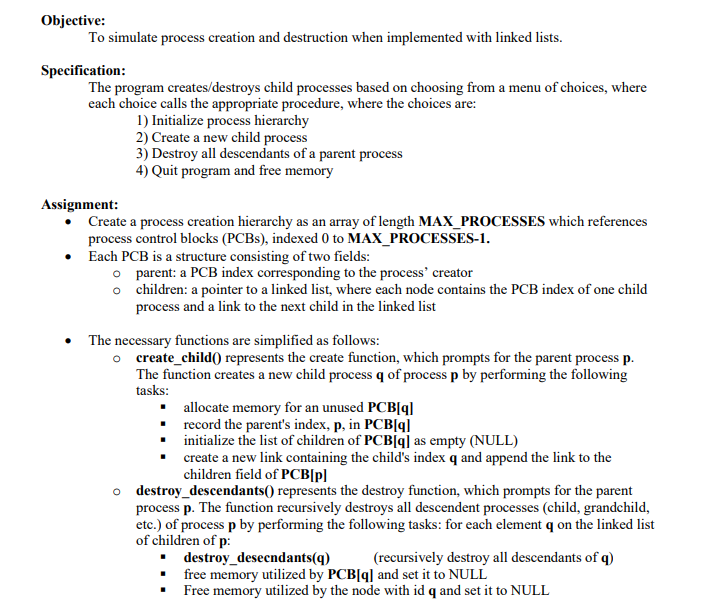
Question: CAN YOU CREATE THIS USING C CODE. SAMPLE RESULT SHOULD BE LIKE THE ONE POSTED. Objective: To simulate process creation and destruction when implemented with
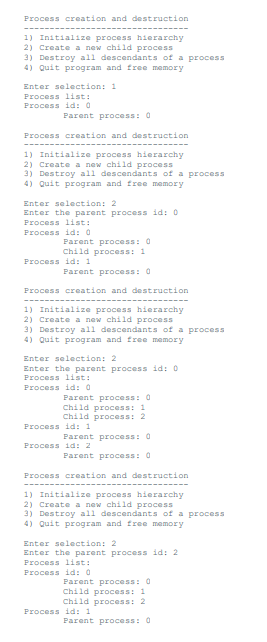
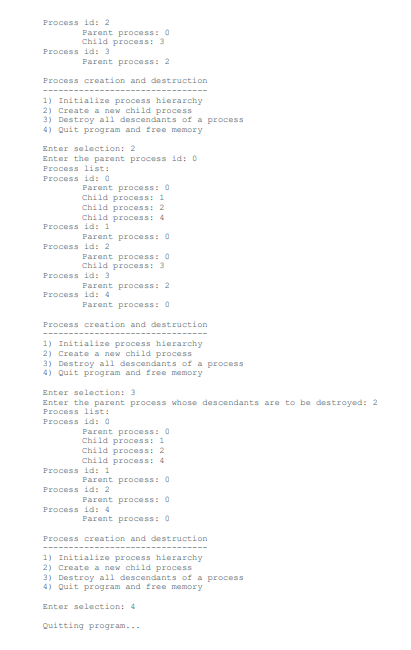
CAN YOU CREATE THIS USING C CODE. SAMPLE RESULT SHOULD BE LIKE THE ONE POSTED.
Objective: To simulate process creation and destruction when implemented with linked lists. Specification: The program creates/destroys child processes based on choosing from a menu of choices, where each choice calls the appropriate procedure, where the choices are: 1) Initialize process hierarchy 2) Create a new child process 3) Destroy all descendants of a parent process 4) Quit program and free memory Assignment: - Create a process creation hierarchy as an array of length MAX_PROCESSES which references process control blocks (PCBs), indexed 0 to MAX_PROCESSES-1. - Each PCB is a structure consisting of two fields: parent: a PCB index corresponding to the process' creator children: a pointer to a linked list, where each node contains the PCB index of one child process and a link to the next child in the linked list - The necessary functions are simplified as follows: - create_child( represents the create function, which prompts for the parent process p. The function creates a new child process q of process p by performing the following tasks: allocate memory for an unused PCB[q] - record the parent's index, p, in PCB[q] - initialize the list of children of PCB[q] as empty (NULL) - create a new link containing the child's index q and append the link to the children field of PCB[p] destroy_descendants() represents the destroy function, which prompts for the parent process p. The function recursively destroys all descendent processes (child, grandchild, etc.) of process p by performing the following tasks: for each element q on the linked list of children of p : - destroy_desecndants(q) (recursively destroy all descendants of q ) - free memory utilized by PCB[q] and set it to NULL - Free memory utilized by the node with id q and set it to NULL Process creation and destruction 1) Initialize process hierarchy 2) Create a new child process 3) Destroy all descendants of a process 4) Quit program and tree memory Enter selection: 1 Frocess 11st: Process id: 0 Parent process: a Process creation and destruction 1) Initialize process hierarchy 2) Create a new child process 3) Destroy all descendants of a process 4) Quit program and tree memory Enter selection: 2 Enter the parent process 1d: 0 Process list: Process id: a Parent process: a Child process: 1 Process id: 1 Parent process: 0 Process creation and destruction 1) Initialize process hierarchy 2) Create a new child process 3) Destroy all descendants of a process 4) Quit program and free memory Enter selection: 2 Enter the parent process id: 0 Process 11st: Process 1d: 0 Parent process: a child process: 1 child process: 2 Process 1d: 1 Parent process: 0 Process 1d: 2 Parent process: 0 Process creation and destruction 1) Initialize process hierarchy 2) Create a new child process 3) Destroy a 11 descendants of a process 4) Quit program and free memory Enter selection: 2 Enter the parent process id: 2 Process 11st: Frocess id: 0 . Parent process: 0 child process: 1 child process: 2 Process 1d: 1 Parent process: 0
Step by Step Solution
There are 3 Steps involved in it

Get step-by-step solutions from verified subject matter experts
 Study Help