







Question: can you do 2 and 3??? Consider a modification to the birth-death process that we studied in class: Besides birth and death of individuals, let
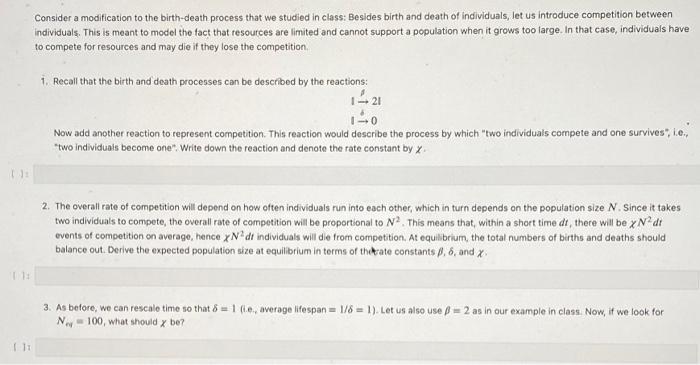
Consider a modification to the birth-death process that we studied in class: Besides birth and death of individuals, let us introduce competition between individuals. This is meant to model the fact that resources are limited and cannot support a population when it grows too large. In that case, individuals have to compete for resources and may die if they lose the competition 1. Recall that the birth and death processes can be described by the reactions: 14-21 1-0 Now add another reaction to represent competition. This reaction would describe the process by which "two individuals compete and one survives", i.e. "two individuals become one". Write down the reaction and denote the rate constant by x 2. The overall rate of competition will depend on how often individuals run into each other, which in turn depends on the population size N. Since it takes two individuals to compete, the overall rate of competition will be proportional to N. This means that, within a short time dt, there will be x Ndt events of competition on average, hence XNdr individuals will die from competition. At equilibrium, the total numbers of births and deaths should balance out. Derive the expected population size at equilibrium in terms of the rate constants 7,6, and X 3. As before, we can rescale time so that I le, average lifespan 1/6 1). Let us also use 2 as in our example in class. Now, if we look for N-100, what should y be? Consider a modification to the birth-death process that we studied in class: Besides birth and death of individuals, let us introduce competition between individuals. This is meant to model the fact that resources are limited and cannot support a population when it grows too large. In that case, individuals have to compete for resources and may die if they lose the competition 1. Recall that the birth and death processes can be described by the reactions: 14-21 1-0 Now add another reaction to represent competition. This reaction would describe the process by which "two individuals compete and one survives", i.e. "two individuals become one". Write down the reaction and denote the rate constant by x 2. The overall rate of competition will depend on how often individuals run into each other, which in turn depends on the population size N. Since it takes two individuals to compete, the overall rate of competition will be proportional to N. This means that, within a short time dt, there will be x Ndt events of competition on average, hence XNdr individuals will die from competition. At equilibrium, the total numbers of births and deaths should balance out. Derive the expected population size at equilibrium in terms of the rate constants 7,6, and X 3. As before, we can rescale time so that I le, average lifespan 1/6 1). Let us also use 2 as in our example in class. Now, if we look for N-100, what should y be
Step by Step Solution
There are 3 Steps involved in it

Get step-by-step solutions from verified subject matter experts
 Study Help