







Question: Can you do part b? (a) Solve question 2.4 .1 from the textbook: (5 pts) 2.4.1 Open reaction network. Suppose a reaction utwork is composer
Can you do part b?
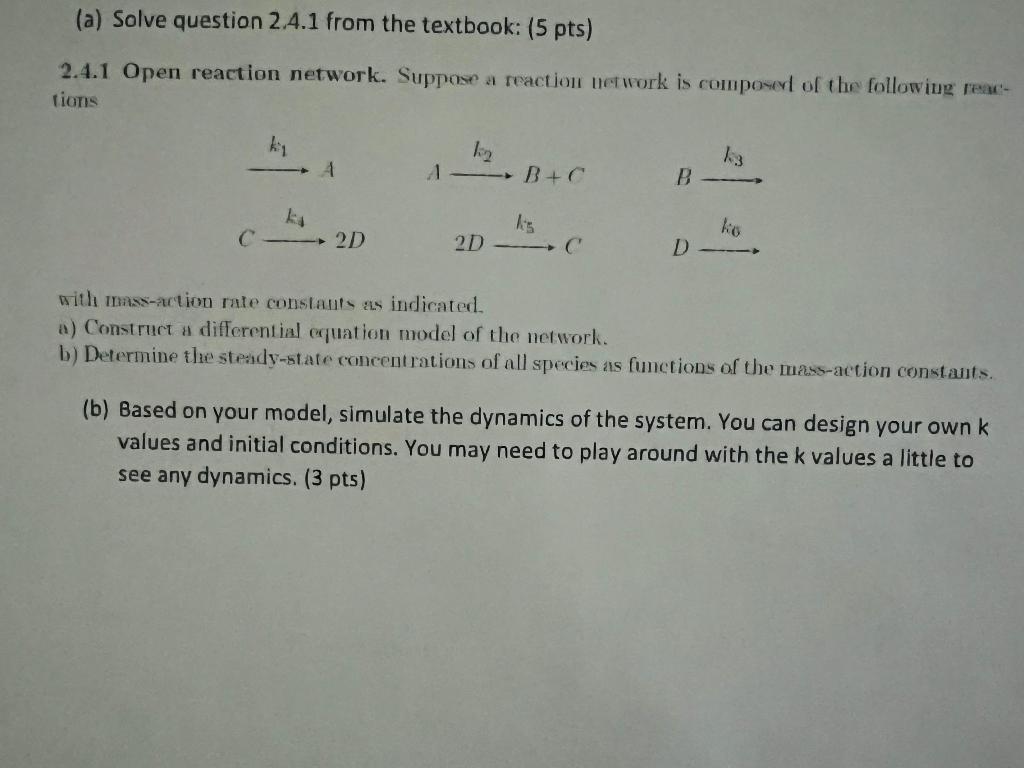
(a) Solve question 2.4 .1 from the textbook: (5 pts) 2.4.1 Open reaction network. Suppose a reaction utwork is composer of the followiug reactions k1Ak2B+CBl3Ck42Dk5CDk0 with mass-action rate constauts as indicated. a) Construct a differential equation model of the network. b) Determine the steady-state concentrations of all species as functions of the mass-action constauts. (b) Based on your model, simulate the dynamics of the system. You can design your own k values and initial conditions. You may need to play around with the k values a little to see any dynamics. ( 3 pts) (a) Solve question 2.4 .1 from the textbook: (5 pts) 2.4.1 Open reaction network. Suppose a reaction utwork is composer of the followiug reactions k1Ak2B+CBl3Ck42Dk5CDk0 with mass-action rate constauts as indicated. a) Construct a differential equation model of the network. b) Determine the steady-state concentrations of all species as functions of the mass-action constauts. (b) Based on your model, simulate the dynamics of the system. You can design your own k values and initial conditions. You may need to play around with the k values a little to see any dynamics. ( 3 pts)
Step by Step Solution
There are 3 Steps involved in it

Get step-by-step solutions from verified subject matter experts
 Study Help