





Question: Can you explain and calculate this question step by step? Q6. (Learning Outcome 3) To minimize the possible false alarm, the building fire alarm system

Can you explain and calculate this question step by step?
Can you explain and calculate this question step
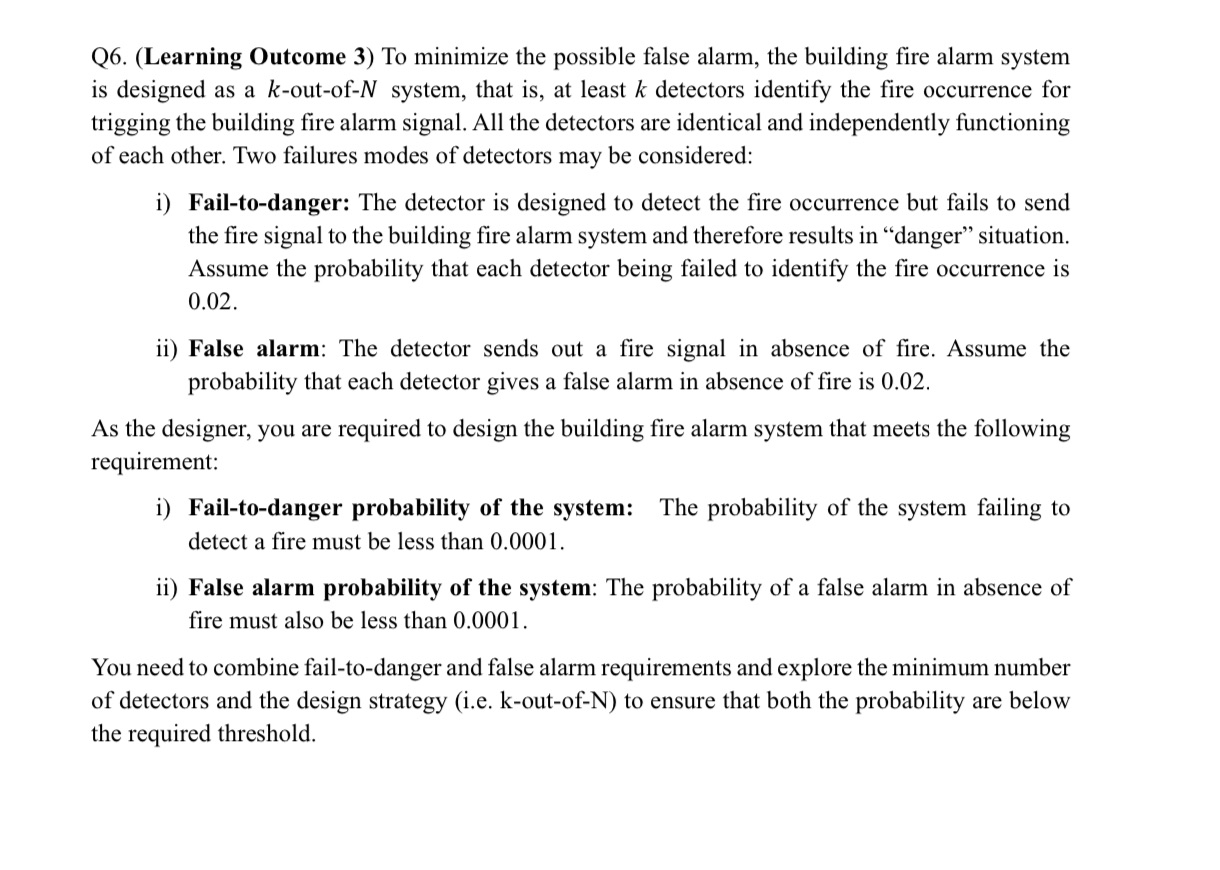
Q6. (Learning Outcome 3) To minimize the possible false alarm, the building fire alarm system is designed as a k-out-of-N system, that is, at least & detectors identify the fire occurrence for trigging the building fire alarm signal. All the detectors are identical and independently functioning of each other. Two failures modes of detectors may be considered: i) Fail-to-danger: The detector is designed to detect the fire occurrence but fails to send the fire signal to the building fire alarm system and therefore results in \"danger\" situation. Assume the probability that each detector being failed to identify the fire occurrence is 0.02. i) False alarm: The detector sends out a fire signal in absence of fire. Assume the probability that each detector gives a false alarm in absence of fire is 0.02. As the designer, you are required to design the building fire alarm system that meets the following requirement: 1) Fail-to-danger probability of the system: The probability of the system failing to detect a fire must be less than 0.0001. i) False alarm probability of the system: The probability of a false alarm in absence of fire must also be less than 0.0001. You need to combine fail-to-danger and false alarm requirements and explore the minimum number of detectors and the design strategy (i.e. k-out-of-N) to ensure that both the probability are below the required threshold

Step by Step Solution

There are 3 Steps involved in it

1 Expert Approved Answer
Step: 1 Unlock blur-text-image

Question Has Been Solved by an Expert!

Get step-by-step solutions from verified subject matter experts

Step: 2 Unlock
Step: 3 Unlock

Students Have Also Explored These Related Mathematics Questions!