



Question: Can you explain what is happening in the code? Thanks! Hofstra Ur Cornputer Science 15 Section 2 Lab Session #11 2018 Problem 3: Producing Pascal's
Can you explain what is happening in the code? Thanks!
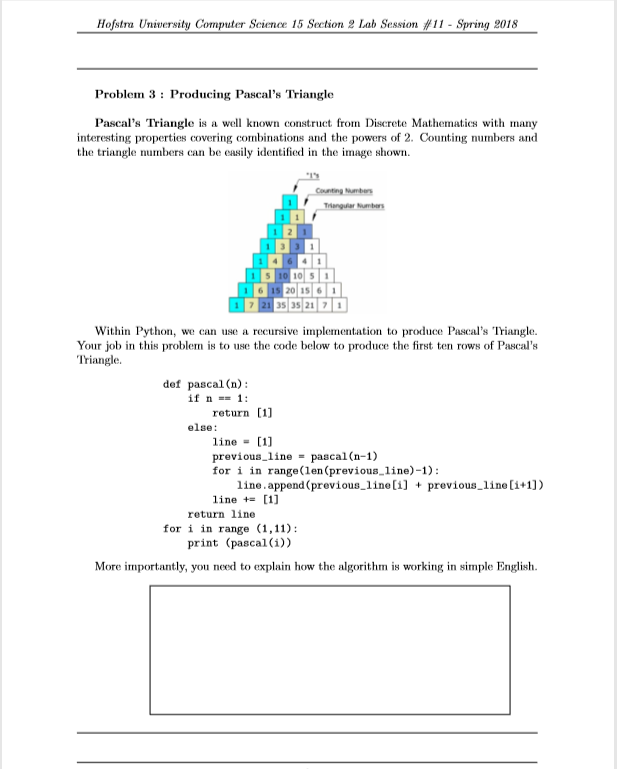
Hofstra Ur Cornputer Science 15 Section 2 Lab Session #11 2018 Problem 3: Producing Pascal's Triangle Pascal's Triangle is a well known construct from Discrete Mathematics with many interesting properties covering combinations and the powers of 2. Counting numbers and the triangle numbers can be easily identified in the image shown 0 15 6 5 35 217 1 Within Python, we can use a recursive implementation to produce Pascal's Triangle Your job in this problem is to use the code below to produce the first ten rows of Pascal's Triangle def pascal (n): if n1: return [1] else: previous_line pascal (n-1) for i in range(len (previous_line)-1) line.append (previous_line[i]previous_line[i+]) line [11 return line for i in range (1,11): print (pascal (i)) More importantly, you need to explain how the algorithm is working in simple English. Hofstra Ur Cornputer Science 15 Section 2 Lab Session #11 2018 Problem 3: Producing Pascal's Triangle Pascal's Triangle is a well known construct from Discrete Mathematics with many interesting properties covering combinations and the powers of 2. Counting numbers and the triangle numbers can be easily identified in the image shown 0 15 6 5 35 217 1 Within Python, we can use a recursive implementation to produce Pascal's Triangle Your job in this problem is to use the code below to produce the first ten rows of Pascal's Triangle def pascal (n): if n1: return [1] else: previous_line pascal (n-1) for i in range(len (previous_line)-1) line.append (previous_line[i]previous_line[i+]) line [11 return line for i in range (1,11): print (pascal (i)) More importantly, you need to explain how the algorithm is working in simple English
Step by Step Solution
There are 3 Steps involved in it

Get step-by-step solutions from verified subject matter experts