Can you help me please?
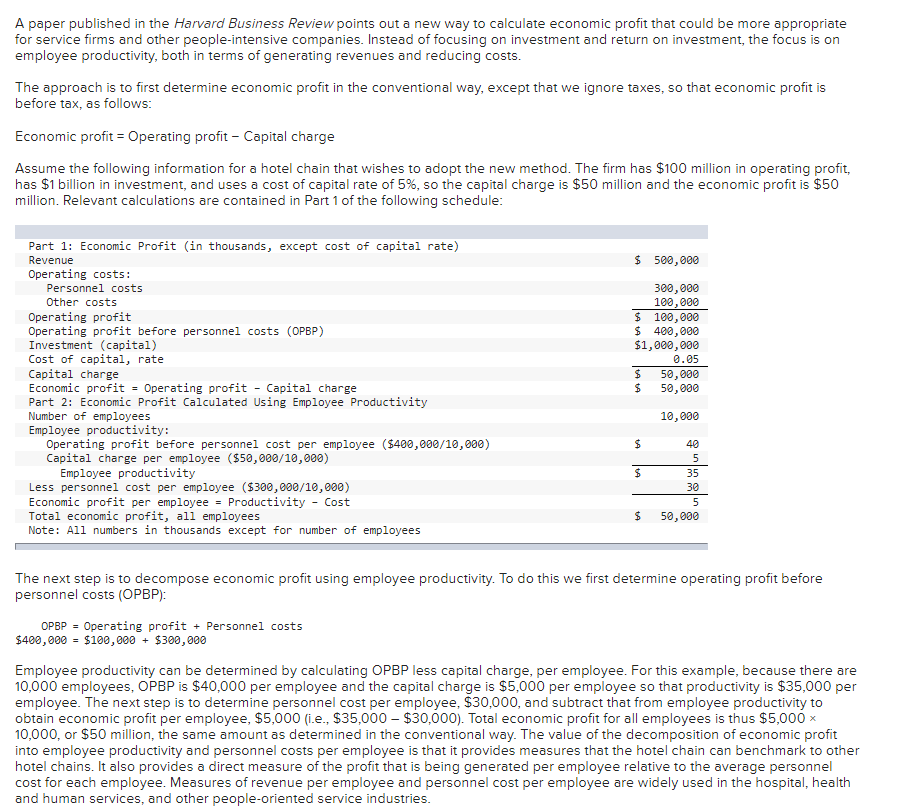
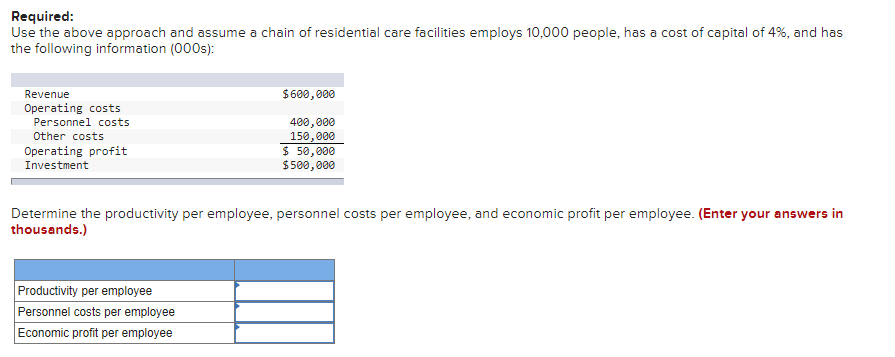
A paper published in the Harvard Business Review points out a new way to calculate economic profit that could be more appropriate for service rms and other people-intensive companies. Instead of focusing on investment and return on investment, the focus is on employee productivity, both in terms of generating revenues and reducing costs. The approach is to rst determine economic prot in the conventional way, except that we ignore taxes, so that economic prot is before tax, as follows: Economic prot = Operating prot Capital charge Assume the following information for a hotel chain that wishes to adopt the new method. The firm has $100 million in operating prot, has $1 billion in investment, and uses a cost of capital rate of 5%, so the capital charge is $50 million and the economic prot is $50 million. Relevant calculations are contained in Part1 ofthe following schedule: Part 1: Economic Pro-Fit (in thousands, except cost of capital rate) Revenue $ 586,636 Operating costs: Personnel costs 386,636 Other costs 166,660 Operating pro-Fit $ 166,660 Operating profit be-Fore personnel costs (OPBP) $ 466,639 Investment (capital) $1,666,666 Cost of capital, rate 3.35 Capital charge $ 56,666 Economic prorFit = Operating pro-Fit Capital charge 3. 56,660 Part 2: Economic Profit Calculated Using Employee Productivity Number of employees 16,660 Employee productivity: Operating profit before personnel cost per employee ($466,366le,668) $ 46 Capital charge per employee ($56,696f16,666) 5 Employee productivity 3 35 Less personnel cost per employee [$368,868r18,968) 38 Economic pro'Fit per employee = Productivity Cost 5 Total economic pro-Fit, all employees $ 56,660 Note: All numbers :in thousands except for number of employees [ The next step is to decompose economic profit using employee productivity. To do this we first determine operating prot before personnel costs [OPBP]: OPBP = Operating pro-Fit + Personnel costs $499,999 = $199,999 + $399,999 Employee productivity can be determined by calculating OPBP less capital charge, per employee. For this example, because there are 10,000 employees, OPBP is $40,000 per employee and the capital charge is $5,000 per employee so that productivity is $35,000 per em ployee. The next step is to determine personnel cost per employee, $30,000, and subtract that from employee productivity to obtain economic profit per employee, $5,000 [i.e., $35,000 $30,000]. Total economic prot for all employees is thus $5,000 x 10,000, or $50 million, the same amount as determined in the conventional way. The value of the decomposition of economic prot into employee productivity and personnel costs per employee is that it provides measures that the hotel chain can benchmark to other hotel chains. it also provides a direct measure ofthe prot that is being generated per employee relative to the average personnel cost for each employee. Measures of revenue per employee and personnel cost per employee are widely used in the hospital, health and human services, and other peopleoriented service industries. Required: Use the above approach and assume a chain of residential care facilities employs 10,000 peopler has a cost of capital of 4%, and has the following information [0005]: Revenue $600,000 Operating costs Personnel costs 400,000 Other costs 150,000 Operating profit 5 50,000 Investment $500,000 ' Determine the productivity per employee, personnel costs per employee, and economic profit per employee. (Enter your answers in thousands.} ProtiuoiiuiiyI per employee Personnel costs per employee Economic prot per employee