







Question: Can you help me with this please. Read the case attached and see questions below CASE STUDY 1.2 Incident on the USS Whitney by Jeff
Can you help me with this please.
Read the case attached and see questions below
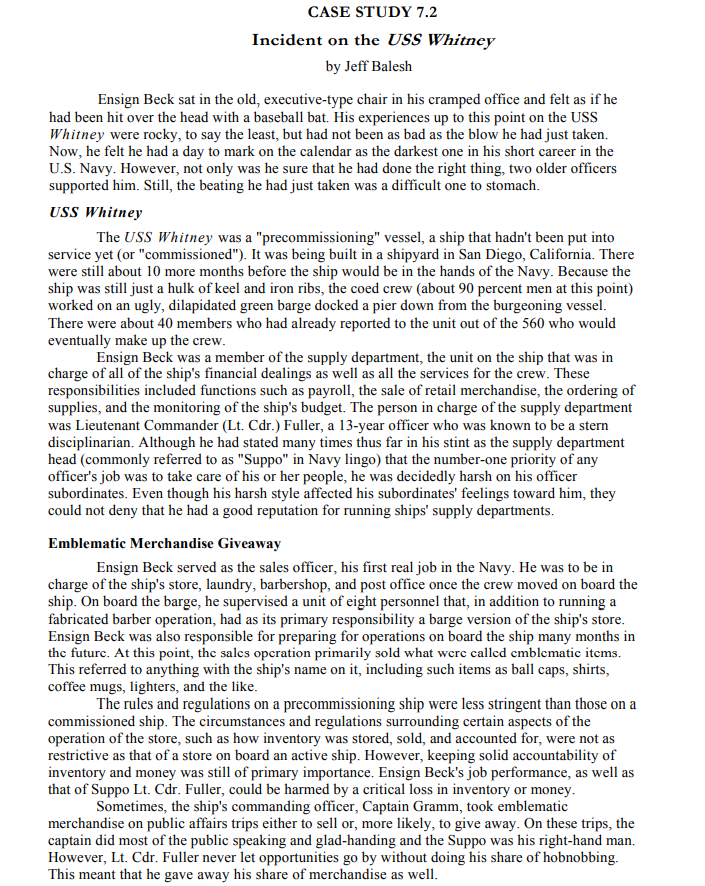
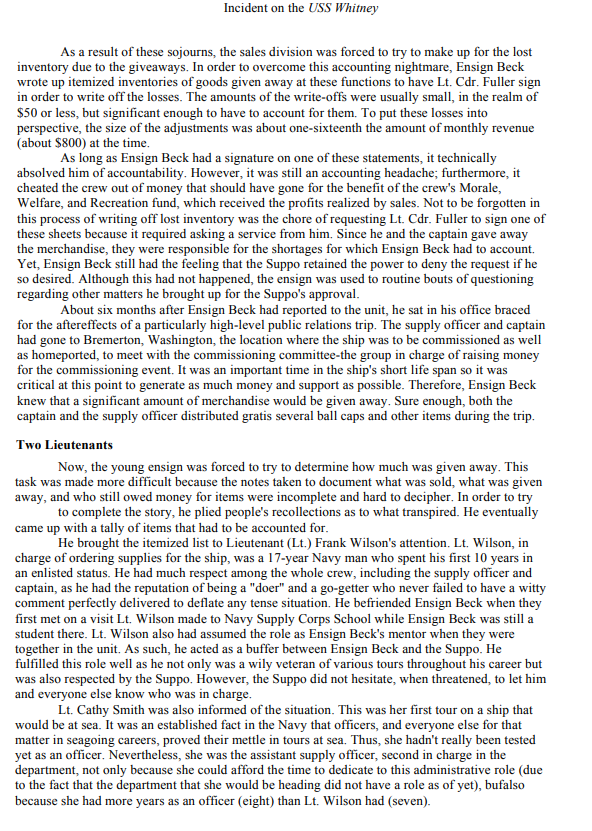
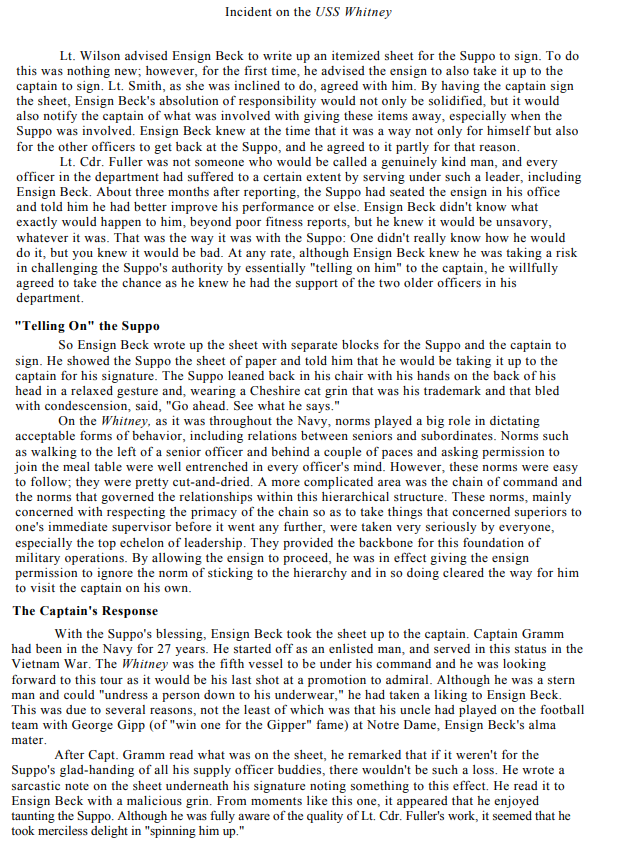
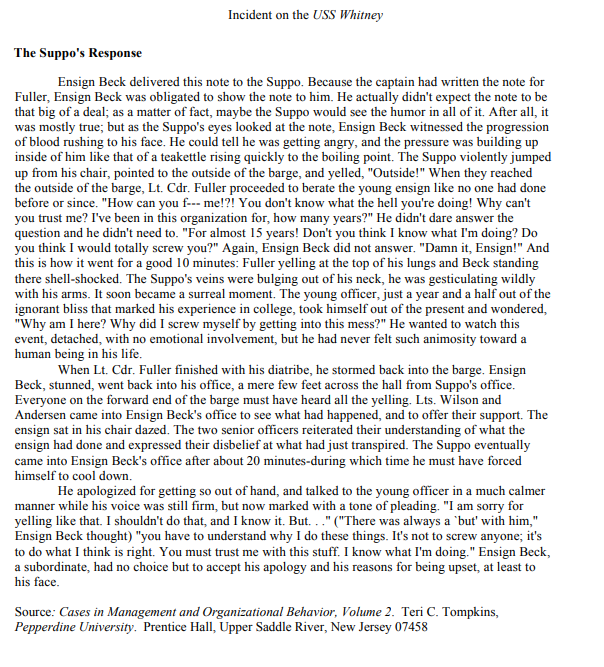
CASE STUDY 1.2 Incident on the USS Whitney by Jeff Balesh Ensign Beck sat in the old, executive-type chair in his cramped ofce and felt as if he had been hit over the head with a baseball bat. His experiences up to this point on the USS Whitney were rocky, to say the least, but had not been as bad as the blow he hadjust taken. Now, he felt he had a day to mark on the calendar as the darkest one in his short career in the US. Navy. However, not only was he sure that he had done the right thing, two older officers supported him. Still, the beating he had just taken was a difcult one to stomach. USS Whitney The USS Whitney was a "precommissioning" vessel, a ship that hadn't been put into service yet {or \"commissioned"). It was being built in a shipyard in San Diego, California. There were still about It] more months before the ship would be in the hands ofthe Navy. Because the ship was still just a hull: of keel and iron ribs, the coed crew [about 90 percent men at this point} worked on an ugly, dilapidated green barge docked a pier down from the burgeoning vessel. There were about 4|] members who had already reported to the unit out of the 560 who would eventually make up the crew. Ensign Beck was a member ofthe supply department, the unit on the ship that was in charge of all ofthe ship's nancial dealings as well as all the services for the crew. These responsibilities included functions such as payroll, the sale of retail merchandise, the ordering of supplies, and the monitoring of the ship's budget. The person in charge of the supply department was Lieutenant Conunander (Lt. Cdr.) Fuller, a 13-year officer who was known to be a stem disciplinarian. Although he had stated many times thus far in his stint as the supply department head [commonly referred to as "Suppo" in Navy lingo} that the number-one priority of any officer's job was to take care ofhis or her people, he was decidedly harsh on his officer subordinates. Even though his harsh style affected his subordinates' feelings toward him, they could not deny that he had a good reputation for running ships' supply departments. Emblemalie Merchandise Giveaway Ensign Beck served as the sales officer, his rst real job in the Navy. He was to be in charge of the ship's store, laundry, barbershop, and post office once the crew moved on board the ship. On board the barge, he supervised a unit of eight personnel that, in addition to running a fabricated barber operation, had as its primary responsibility a barge version of the ship's store. Ensign Beck was also responsible for preparing for operations on board the ship many months in the future. At this point, the sales operation primarily sold what were called emblematic items. This referred to anything with the ship's name on it, including such items as ball caps, shirts, coffee mugs, lighters, and the like. The rules and regulations on a preconunissioning ship were less stringent than those on a commissioned ship. The circumstances and regulations surrounding certain aspects of the operation of the store, such as how inventory was stored, sold, and accounted for, were not as restrictive as that of a store on board an active ship. However, keeping solid accountability of inventory and money was still ofprimary importance. Ensign Beck'sjob performance, as well as that of Suppo Lt. Cdr. Fuller, could be harmed by a critical loss in inventory or money. Sometimes, the ship's commanding ofcer, Captain Grarnm, took emblematic merchandise on public affairs trips either to sell or, more likely, to give away. On these trips, the captain did most of the public speaking and gladwhanding and the Suppo was his right-hand man. However, Lt. Cdr. Fuller never let oppomurities go by without doing his share of hohnobbing. This meant that he gave away his share of merchandise as well. Incident on the USS imsy As a result ofthese sojourns, the sales division was forced to try to make up for the lost inventory due to the giveaways. In order to overcome tllis accounting nightmare, Ensign Beck wrote up itemized inventories ofgoods given away at these functions to have Lt. Cdr. Fuller sign in order to write offtlle losses. The amounts ofthe write-offs were usually small, in the realm of $50 or less, but significant enough to have to account for them. To put these losses into perspective, the size of the adjustments was about one-sixteenth the amount ofmonthly revenue (about SSW) at the time. As long as Ensign Beck had a signature on one ofthese statements, it technically absolved him of accountability. However, it was still an accounting headache; Furthermore, it cheated the crew out of money that should have gone for the benet ofthe crew's Morale, Welfare, and Recreation fund, which received the prots realized by sales. Not to be forgotten in this process ofw'riting offlost inventory was the chore ofrequesting Lt. Cdr. Fullerto sign one of these sheets because it required asking a service from him. Since he and the captain gave away the merchandise, they were responsible for the shortages for which Ensign Beck had to account Yet, Ensign Beck still had the Feeling that the Suppo retained the power to deny the request ifhe so desired. Although this had not happened, the ensign was used to routine bouts ofquestioning regarding other matters he brought up for the Suppo's approval. About six months after Ensign Beck had reported to the unit, he sat in his ofce braced for the aereffects ofa particularly high-level public relations trip. The supply officer and captain had gone to Bremerton, Washington, the location where the ship was to be commissioned as well as homepoited, to meet with the commissioning committee-the group in charge ofraising money for the commissioning event. It was an important time in the ship's short life span so it was critical at this point to generate as much money and support as possible. Therefore, Ensigrl Beck knew that a signicant amount ofmerchandise would be given away. Sure enough, both the captain and the supply ofcer distributed gratis several ball caps and other items during the trip. Two Lieutenant! Now, the young ensign was forced to try to determine how much was given away. This task was made more difficult because the notes taken to document what was sold, what was given away, and who still owed money for items were incomplete and hard to decipher. In order to try to complete the story, he plied people's recollections as to what transpired. He eventually came up with a tally ofitems that had to be accounted for. He brought the itemized list to Lieutenant (LL) Frank Wilson's attention. Lt. Wilson, in charge ofordering supplies for the ship, was a 17-year Navy man who spent his rst It] years in an enlisted status. He had much respect among the whole crew, including the supply oicer and captain, as he had the reputation ofbeing a "doer" and a go-getter who never failed to have a witty comment perfectly delivered to deflate any tense situation. He befriended Ensign Beck when they rst met on a visit Lt Wilson made to Navy Supply Corps School while Ensign Beck was still a student there. Lt. Wilson also had assumed the role as Ensign Beck's mentor when they were together in the unit. As such, he acted as a buffer between Ensign Beck and the Suppo. He fullled this role well as he not only was a wily veteran ofvarious tours throughout his career but was also respected by the Suppo. However, the Suppo did not hesitate, when threatened, to let him and everyone else know who was in charge. Lt. Cathy Smith was also infomled ofthe situation. This was her rst tour on a ship that would be at sea. It was an established fact in the Navy that ofcers, andeveryone else for that matter in seagoing careers, proved their mettle in tours at sea. 'lhus, she hadn't really been tested yet as an ofcer. Nevertlleless, she was the assistant supply ofcer, second in charge in the department, not only because she could afford tlle time to dedicate to this administrative role [due to the fact that the department that she would be heading did not have a role as ofyet), bufalso because she had more years as an ofcer (eight) than Lt. Wilson had (seven). Incident on the USS Whitney Lt. Wilson advised Ensign Beck to write up an itemized sheet for the Suppo to sign. To do this was nothing new, however, for the first time, he advised the ensign to also take it up to the captain to sign. Lt. Smith, as she was inclined to do, agreed with him. By having the captain sign the sheet, Ensign Beck's absolution of responsibility would not only be solidied, but it would also notify the captain of what was involved with giving tllese items away, especially when the Suppo was involved. Ensign Beck knew at the time that it was a way not only for himself but also for the other officers to get back at the Suppo, and he agreed to it partly for that reason. Lt. lCdr. Fuller was not someone who would be called a genuinely kind man, and every ofcer in the department had suffered to a certain extent by serving under such a leader, including Ensign Beck. About three months after reporting, the Suppo had seated the ensign in his office and told him he had better improve his performance or else. Ensign Beck didn't know what exactly would happen to him, beyond poor fitness reports, but he knew it would be unsavory, whatever it was. That was the way it was with the Suppo: Due didn't really know how he would do it, but you knew it would be bad. At any rate, although Ensign Beck knew he was taking a risk in challenging the Suppo's authority by essentially r'telling on him'I to the captain, he willfully agreed to take the chance as he knew he had the support of the two older officers in his department. "Telling On" the Suppu So Ensign Beck wrote up the sheet with separate blocks for the Suppo and the captain to sign. He showed the Suppo the sheet of paper and told him that he would be taking it up to the captain for his signature. The Suppo leaned back in his chair with his hands on the back of his head in a relaxed gesture and, wearing a Cheshire cat grin that was his trademark and that bled with condescension, said, "Go ahead. See what he says.'I On the Whitney, as it was throughout the Navy, norms played a big role in dictating acceptable forms of behavior, including relations between seniors and subordinates. Norms such as walking to the left ofa senior officer and behind a couple of paces and asking permission to join the meal table were well entrenched in every officer's mind. However, these norms were easy to follow, they were pretty cut-and-dried. A more complicated area was the chain of command and the norms that governed the relationships within this hierarchical structure. These norms, mainly concerned with respecting the primacy of the chain so as to take things that concerned superiors to one's immediate supervisor before it went any further, were taken very seriously by everyone, especially the top echelon of leadership. They provided the backbone for this foundation of military operations. By allowing the ensign to proceed, he was in effect giving the ensign permission to ignore the norm of sticking to the hierarchy and in so doing cleared the way for him to visit the captain on his own. The Captain's Response With the Suppo's blessing, Ensign Beck took the sheet up to the captain. Captain lGralnrn had been in the Navy for 27 years. He started off as an enlisted man, and served in this status in the Vietnam War. The Whitney was the lth vessel to be under his command and he was looking forward to this tour as it would be his last shot at a promotion to admiral. Although he was a stern man and could "undress a person down to his underwear," he had taken a liking to Ensign Beck. This was due to several reasons, not the least of which was that his uncle had played on the football team with George Gipp [of"win one for the Gipper" fame] at Notre Dame, Ensign Beck's alma mater. After Capt. Gramm read what was on the sheet, he remarked that if it weren't for the Suppo's glad-handing of all his supply ofcer buddies, there wouldn't be such a loss. He wrote a sarcastic note on the sheet underneath his signature noting something to this effect. He read it to Ensign Beck with a malicious grin. From moments like this one, it appeared that he enjoyed taunting the Suppo. Although he was rlly aware of the quality of Lt. Cdr. Fuller's work, it seemed that he took merciless delight in "spinning him up." Incident on the USS Whitney The Silppn's Response Ensign Beck delivered this note to the Suppo. Because the captain had written the note for Fuller, Ensign Beck was obligated to show the note to him. He actually didn't expect the note to be that big ofa deal; as a matter offact, maybe the Suppo would see the humor in all of it. After all, it was mostly true; but as the Suppo's eyes looked at the note, Ensign Beck witnessed the progression of blood rushing to his face. He could tell he was getting angry, and the pressure was building up inside ofhin'l like that of a teakettle rising quickly to the boiling point. The Suppo violentlyjumped up from his chair, pointed to the outside ofthe barge, and yelled, "Outside!" When they reached the outside of the barge, Lt. lCdr. Fuller proceeded to berate the young ensigrl like no one had done before or since. "How can you f--- me!'?! You don't know what the hell you're doing!I Why can't you bust me? I've been in this organization for, how many years?" He didn't dare answer the question and he didn't needto. "For almost 15 years! Don't you think [know what I'm doing? Do you think I would totally screw you?" Again, Ensign Beck did not answer. "Darrin it, Ensign!'I And this is how it went for a good II] minutes: Fuller yelling at the top of his lungs and Beck standing there shell-shocked. The Suppo's veins were bulging out ofhis neck, he was gesticulating wildly with his arms. It soon became a surreal moment. The young ofcer,just a year anda halfout ofthe ignorant bliss that marked his experience in college, took himself out ofthe present and wondered, "Why am I here? Why did I screw myselfby getting into this megss'i\"r He wanted to watch this event, detached, with no emotional involvement, but he had never felt such animosity toward a human being in his life. When Lt. Cdr. Fuller nished with his diatribe, he stormed back into the barge. Ensign Beck, stunned, went back into his ofce, a mere few feet across the hall from Suppo's office. Everyone on the forward end ofthe barge must have heard all the yelling. Lts. Wilson and Andersen came into Ensign Beck's ofce to see what had happened, and to offer their support. The ensign sat in his chair darned. The two senior ofcers reiterated their understanding ofwhat the ensign had done and expressed their disbeliefat what hadjust transpired. The Suppo eventually came into Ensign Beck's office after about 2!] minutes-during which time he must have Forced himself to cool down. He apologized for getting so out ofhand, and talked to the young officer in a much calmer manner while his voice was still firm, but now marked with a tone of pleading. "I am sorry for yelling like that. I shouldn't do that, and I know it. But. . ." ("There was always a 'but' with hi.m,'r Ensign Beck thought) "you have to understand why I do these things. It's not to screw anyone; it's to do what I think is right. You must trust me with this stuff. I know what I'm doing." Ensign Beck, a subordinate, had no choice but to accept his apology and his reasons for being upset, at least to his face. SDIn'ce: Cases in Management and Organizational Behavior, Volume 2. Teri C. Tompkins, Pepper-dine Universr'gr. Prentice Hall, Upper Saddle River, New Jersey 07458
Step by Step Solution
There are 3 Steps involved in it

Get step-by-step solutions from verified subject matter experts
 Study Help