







Question: Can you help with a abstract for this based on this information for a scientific report. I have most of it done but I need
Can you help with a abstract for this based on this information for a scientific report. I have most of it done but I need help with some conclusions and writing some good points for the abstract and making a good scientific report (information and data below
BACKGROUND INFORMATION FOR LAB REPORT As you have learned in BIOL 1000, biologists make observations about living organisms and ask questions. These questions are then re-phrased into testable hypotheses, which lead to predictions that are used to design experiments that are used to test the proposed hypothesis. For the Lab Report: (a) the test organism is Lemna minor (duckweed) Few plants are suitable for studying continuous population growth because most plants have life cycles with discrete jumps in population size, their reproduction is seasonal and they respond to changes in population density by changing size and shape instead of population number. However, the free-floating aquatic plant called duckweed (Lemna spp.) undergo continuous growth and therefore are an excellent model for measuring growth responses to environmental conditions. It is the smallest of the flowering plants. It is stemless and has one to four leaf-like structures called fronds and one or two roots that hang free in the water. Duckweeds can reproduce by flowering and setting seed (sexual reproduction) but seldom do. More commonly, they reproduce asexually by producing a new frond directly from an old one. When a new frond has grown large enough and has roots, it breaks loose from its parent plant and grows on its own as a separate plant. The growth of Lemna plants can be followed by counting fronds at designated times during a growth experiment and can help to determine the effect of an experimental variable that is being tested. Duckweeds typically have 1 to 2 roots, which grow in response to the environmental conditions available. Therefore, the length of the roots offers a second alternative measurement for assessing growth and the effect of an experimental variable that is being tested. Usefulness of Duckweed in Growth Experiments (Bioassays) Duckweeds make ideal study organisms for this lab: they illustrate the population growth and competition concepts that apply to very many species, they are small enough for you to manipulate easily, and they grow quickly enough for you to observe population growth in a matter of a few days. They are one of the most frequently used organisms in Bioassay Tests for that determine the potential biological harm or toxicity that may result from the release of new chemicals into the natural environment; these bioassay experiments are often required by government regulatory agencies.
(b) the test chemical is the heavy metal, copper (Cu) The test chemical in growth experiments can belong to one of two types of chemicals based on the expected impact on aquatic plant growth. The chemical may be a nutrient (e.g. nitrogen, phosphorus, potassium, etc.), which can be expected to stimulate aquatic plant growth as the concentration increases. The chemical may be a toxicant (e.g. cadmium, copper, nickel, salt, etc.), which can be expected to inhibit aquatic plant growth as the concentration increases. Knowing which type of chemical you are working with will help you to formulate your research hypothesis, state your predictions and design the experiment. In the lab, they will be examining the growth responses of an aquatic plant, Lemna, to one environmental variable, the Test Chemical. For this experiment, the Test Chemical is the heavy metal, copper, that is added at various concentrations to a plant growth solution (Hoagland Culture Solution. The effect of copper on the growth of Lemna is measured at the end of the two-week (14- day) experimental period. Because copper is a heavy metal that is required by organisms in trace amounts for many biological functions, it can affect the growth, reproduction and many other biological processes. However at higher concentrations It can be toxic. For this experiment, growth processes will be monitored in two ways: (1) by counting the number of fronds that form over the 14-day test period and (2) by measuring the length of the roots that develop during the experiment.
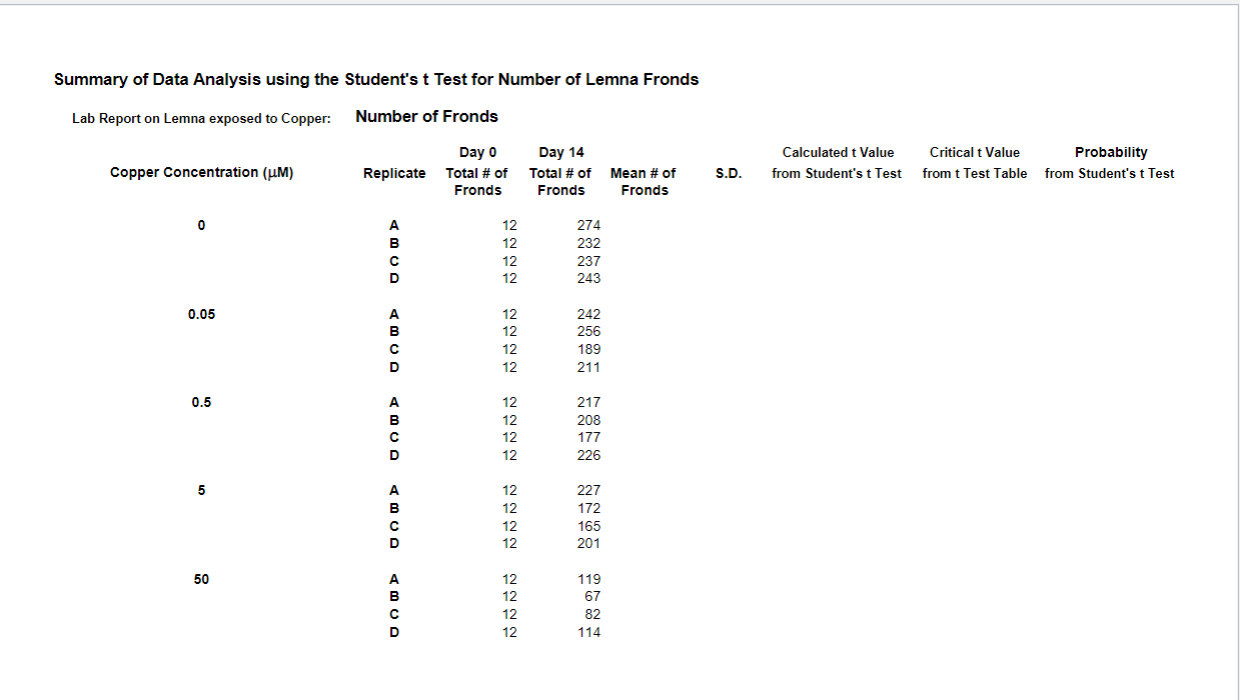
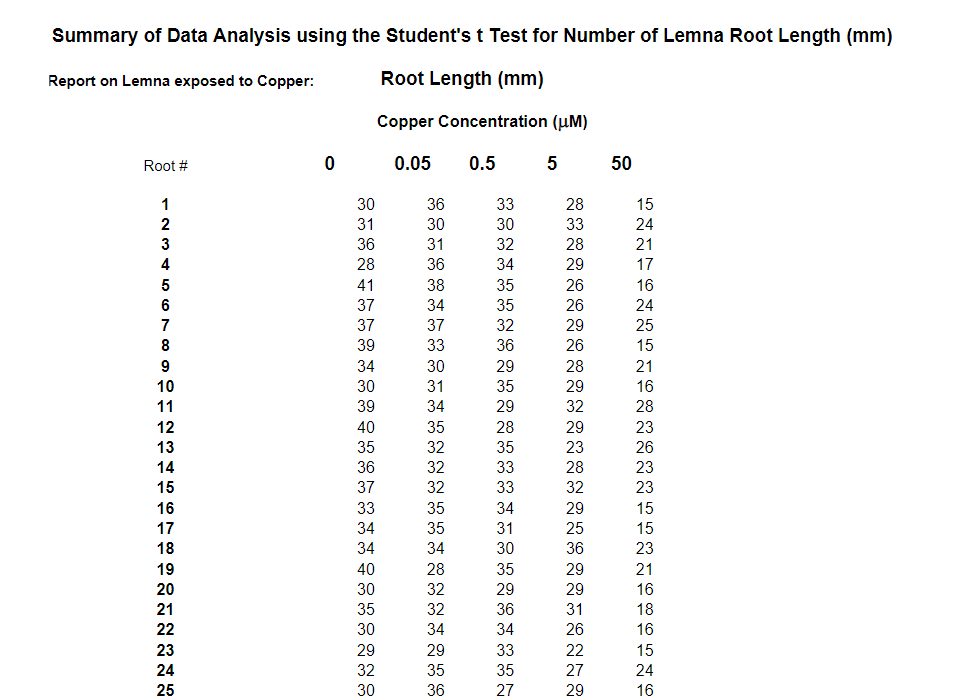
Summary of Data Analysis using the Student's 1 Test for Number of Lemna Fronds Lab Report on Lemna exposed to Copper: Number of Fronds Day [I Day 14 Calculated tValue Critical t Value Probability Copper Concentration {11M} Replicate Total ii of Total # of Mean # of $13. from Student's t Test from 1. Test Table from Student's 1 Test Fronds Fronds Fronds 0 A 12 2M B 12 232 C 12 23? D 12 243 0.05 A 12 242 B 12 256 C 12 189 D 12 211 0.5 A 12 21? B 12 208 C 12 1?? D 12 226 5 A 12 22? B 12 1?2 C 12 165 D 12 201 50 A 12 119 B 12 6? C 12 82 D 12 11;! Summary of Data Analysis using the Student's t Test for Number of Lemna Root Length (mm) Report on Lemna exposed to Copper: R0012 Length (mm) Copper Concentration {uM} Root# 0 0.05 0.5 5 50 1 30 38 33 28 15 2 31 3O 3O 33 24 3 38 31 32 28 21 4 28 38 34 29 17 5 41 38 35 28 18 B 37 34 35 28 24 7 3T 37 32 29 25 B 39 33 38 28 15 9 34 3O 29 28 21 10 30 31 35 29 18 11 39 34 29 32 28 12 4O 35 28 29 23 13 35 32 35 23 28 14 38 32 33 28 23 15 37 32 33 32 23 16 33 35 34 29 15 17 34 35 31 25 15 18 34 34 3O 38 23 19 4O 28 35 29 21 20 30 32 29 29 18 21 35 32 38 31 18 22 3O 34 34 28 18 23 29 29 33 22 15 24 32 35 35 27 24 25 3O 38 2? 29 18
Step by Step Solution
There are 3 Steps involved in it

Get step-by-step solutions from verified subject matter experts
 Study Help