







Question: Can you help with the Statistical thinking, variable classes, and types of sampling?Please, see instructions below. Statistical thinking, variable classes, and types of sampling Instructions:
Can you help with the Statistical thinking, variable classes, and types of sampling?Please, see instructions below.
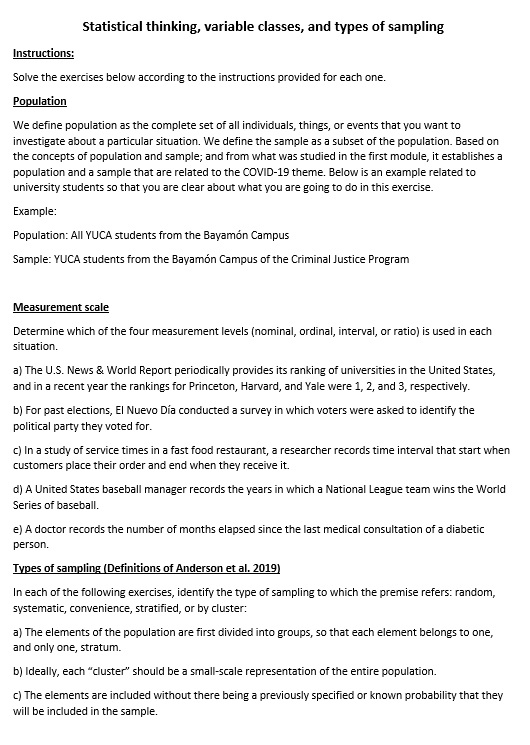
Statistical thinking, variable classes, and types of sampling Instructions: Solve the exercises below according to the instructions provided for each one. Population We define population as the complete set of all individuals, things, or events that you want to investigate about a particular situation. We define the sample as a subset of the population. Based on the concepts of population and sample; and from what was studied in the first module, it establishes a population and a sample that are related to the COVID-19 theme. Below is an example related to university students so that you are clear about what you are going to do in this exercise. Example: Population: All YUCA students from the Bayamon Campus Sample: YUCA students from the Bayamon Campus of the Criminal Justice Program Measurement scale Determine which of the four measurement levels (nominal, ordinal, interval, or ratio) is used in each situation. a) The U.S. News & World Report periodically provides its ranking of universities in the United States, and in a recent year the rankings for Princeton, Harvard, and Yale were 1, 2, and 3, respectively. b) For past elections, El Nuevo Dia conducted a survey in which voters were asked to identify the political party they voted for. c) In a study of service times in a fast food restaurant, a researcher records time interval that start when customers place their order and end when they receive it. d) A United States baseball manager records the years in which a National League team wins the World Series of baseball. e) A doctor records the number of months elapsed since the last medical consultation of a diabetic person. Types of sampling (Definitions of Anderson et al. 2019) In each of the following exercises, identify the type of sampling to which the premise refers: random, systematic, convenience, stratified, or by cluster: a) The elements of the population are first divided into groups, so that each element belongs to one, and only one, stratum. b) Ideally, each "cluster" should be a small-scale representation of the entire population. c) The elements are included without there being a previously specified or known probability that they will be included in the sample
Step by Step Solution
There are 3 Steps involved in it

Get step-by-step solutions from verified subject matter experts
 Study Help