Question: Can you help with this please Mastery Problem: Target Income and Margin of Safety Target Income and Margin of Safety At the break-even point, sales
Can you help with this please
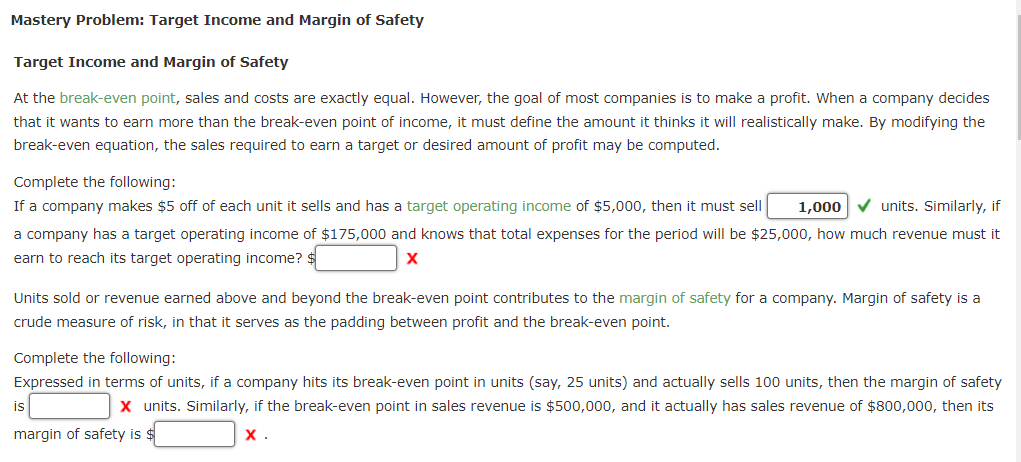
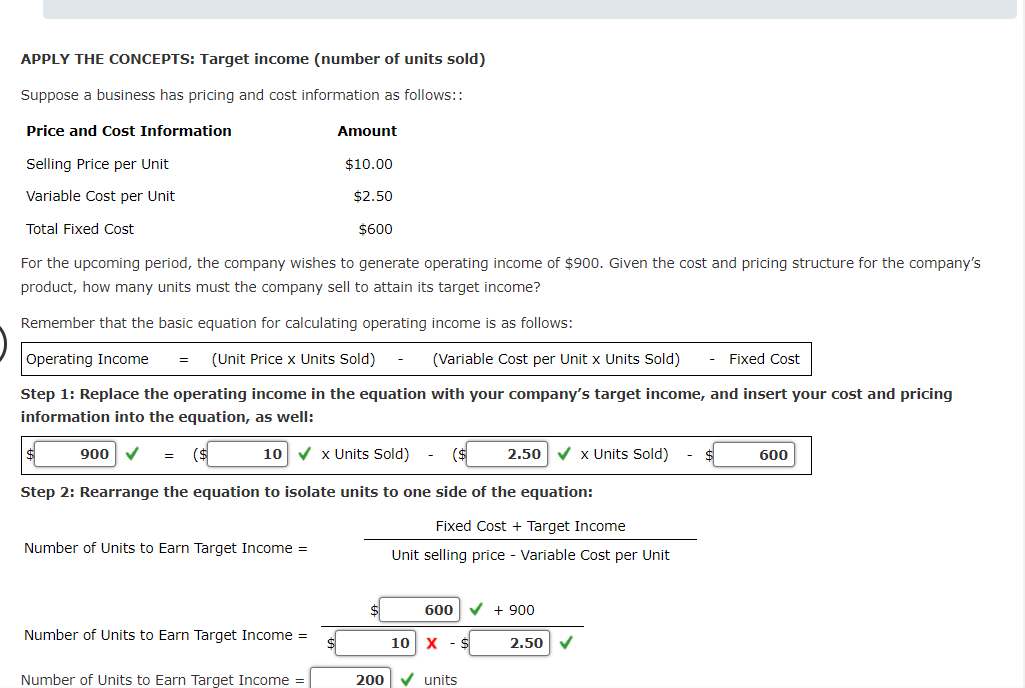
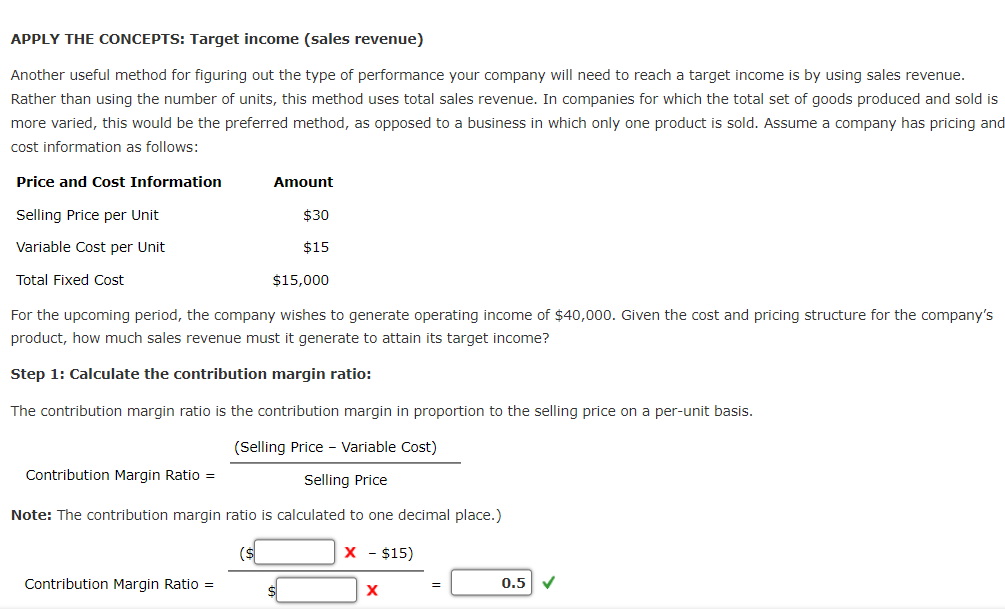
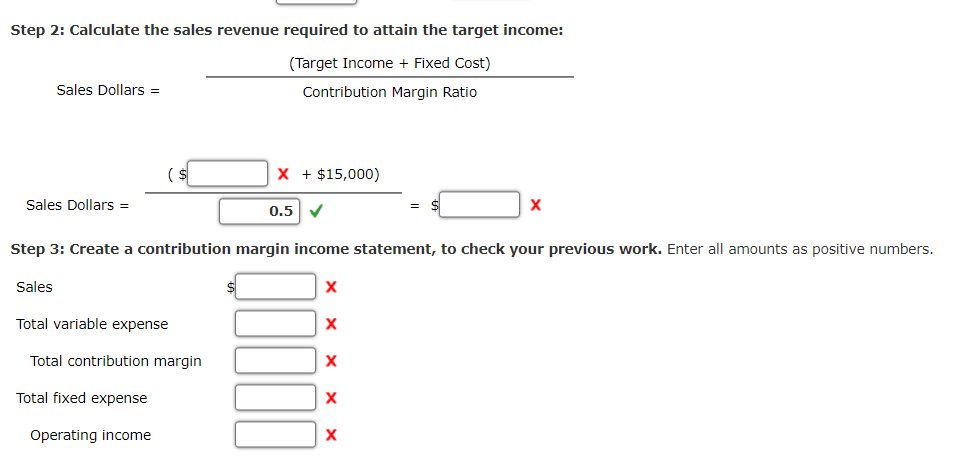
Mastery Problem: Target Income and Margin of Safety Target Income and Margin of Safety At the break-even point, sales and costs are exactly equal. However, the goal of most companies is to make a profit. When a company decides that it wants to earn more than the break-even point of income, it must define the amount it thinks it will realistically make. By modifying the break-even equation, the sales required to earn a target or desired amount of profit may be computed. Complete the following: If a company makes $5 off of each unit it sells and has a target operating income of $5,000, then it must sell 1,000 units. Similarly, if a company has a target operating income of $175,000 and knows that total expenses for the period will be $25,000, how much revenue must it earn to reach its target operating income? $ X Units sold or revenue earned above and beyond the break-even point contributes to the margin of safety for a company. Margin of safety is a crude measure of risk, in that it serves as the padding between profit and the break-even point. Complete the following: Expressed in terms of units, if a company hits its break-even point in units (say, 25 units) and actually sells 100 units, then the margin of safety is X units. Similarly, if the break-even point in sales revenue is $500,000, and it actually has sales revenue of $800,000, then its margin of safety is $ X .APPLY THE CONCEPTS: Target income (number of units sold) Suppose a business has pricing and cost information as follows: : Price and Cost Information Amount Selling Price per Unit $10.00 Variable Cost per Unit $2.50 Total Fixed Cost $600 For the upcoming period, the company wishes to generate operating income of $900. Given the cost and pricing structure for the company's product, how many units must the company sell to attain its target income? Remember that the basic equation for calculating operating income is as follows: Operating Income = (Unit Price x Units Sold) (Variable Cost per Unit x Units Sold) - Fixed Cost Step 1: Replace the operating income in the equation with your company's target income, and insert your cost and pricing information into the equation, as well: 900 V = ($ 10 v x Units Sold) - ($ 2.50 v x Units Sold) - $ 600 Step 2: Rearrange the equation to isolate units to one side of the equation: Fixed Cost + Target Income Number of Units to Earn Target Income = Unit selling price - Variable Cost per Unit 600 V +900 Number of Units to Earn Target Income = 10 X - $ 2.50 Number of Units to Earn Target Income = 200 unitsAPPLY THE CONCEPTS: Target income (sales revenue) Another useful method for figuring out the type of performance your company will need to reach a target income is by using sales revenue. Rather than using the number of units, this method uses total sales revenue. In companies for which the total set of goods produced and sold is more varied, this would be the preferred method, as opposed to a business in which only one product is sold. Assume a company has pricing and cost information as follows: Price and Cost Information Amount Selling Price per Unit $30 Variable Cost per Unit $15 Total Fixed Cost $15,000 For the upcoming period, the company wishes to generate operating income of $40,000. Given the cost and pricing structure for the company's product, how much sales revenue must it generate to attain its target income? Step 1: Calculate the contribution margin ratio: The contribution margin ratio is the contribution margin in proportion to the selling price on a per-unit basis. (Selling Price - Variable Cost) Contribution Margin Ratio = Selling Price Note: The contribution margin ratio is calculated to one decimal place.) ($ X - $15) Contribution Margin Ratio = X 0.5Step 2: Calculate the sales revenue required to attain the target income: (Target Income + Fixed Cost) Sales Dollars = Contribution Margin Ratio ($) X + $15,000) Sales Dollars = 0.5 = X Step 3: Create a contribution margin income statement, to check your previous work. Enter all amounts as positive numbers. Sales X Total variable expense X Total contribution margin X Total fixed expense X Operating income X
Step by Step Solution
There are 3 Steps involved in it
1 Expert Approved Answer
Step: 1 Unlock
Question Has Been Solved by an Expert!
Get step-by-step solutions from verified subject matter experts
Step: 2 Unlock
Step: 3 Unlock
Students Have Also Explored These Related Accounting Questions!









 Study Help