







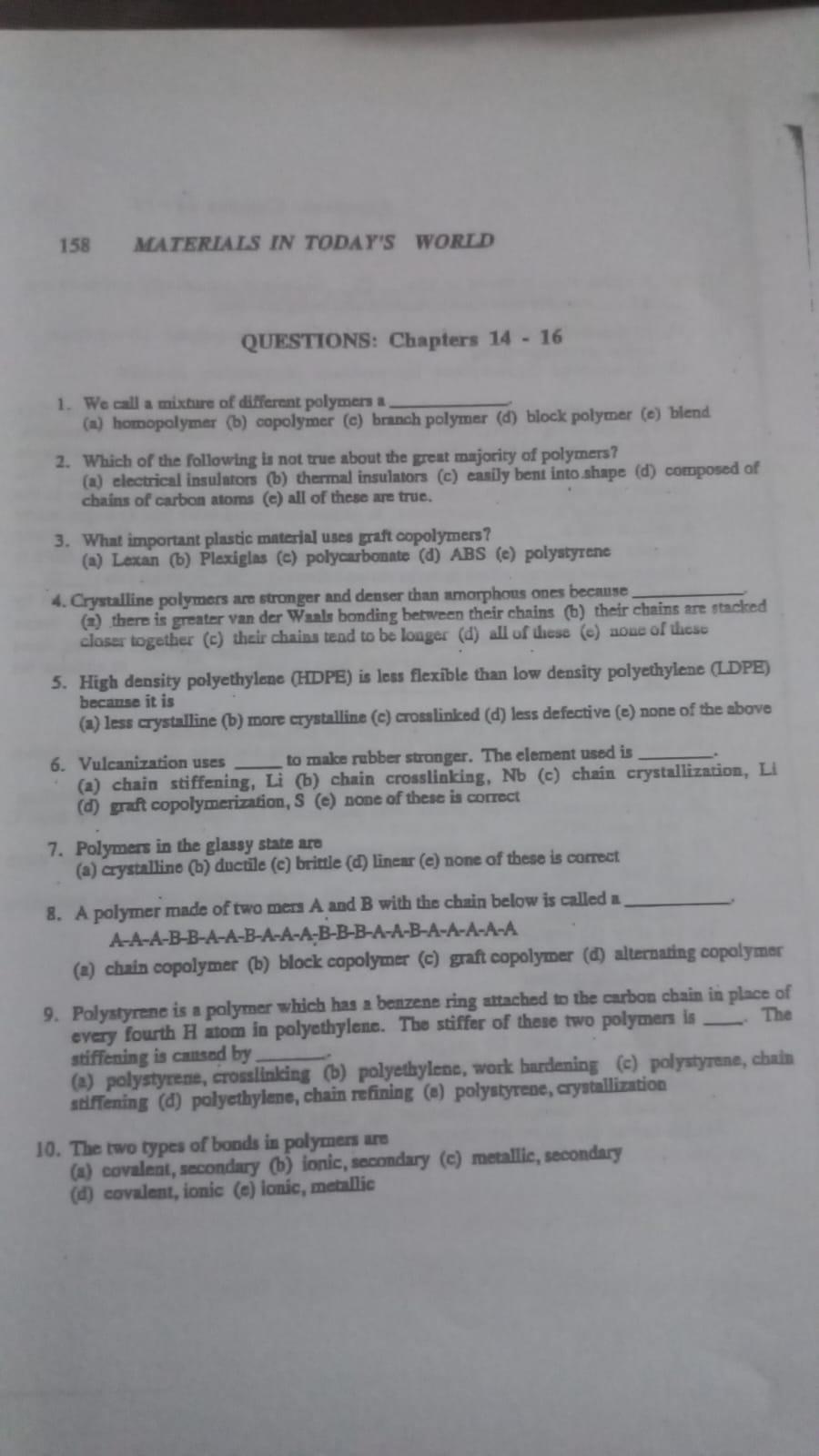
Question: Can you just answer the question without explanation 1. We call a mixture of different polymens a (a) homopolymer (b) copolymer (c) branch polymer (d)
 Can you just answer the question without explanation
1. We call a mixture of different polymens a (a) homopolymer (b) copolymer (c) branch polymer (d) block polymer (e) bend 2. Which of the following is not true about the great majority of polymers? (a) electrical insulators (b) thermal insulators (c) easily bent into shape (d) composed of chains of carbon atoms ( e ) all of these are true. 3. What important plastic material uses graft copolymers? (a) Lexan (b) Plexiglas (c) polycarbonate (d) ABS (c) polystyrene 4. Crystalline polymers are stronger and denser than amorphous ones because (a) there is greater van der Waals bonding between their chains (b) their chains are stacked closer together (c) their chains tend to be longer (d) all of these (c) none of these 5. High density polyethylene (HDPE) is less flexible than low density polyethylene (LDPE) becanse it is (a) less crystalline (b) more crystalline (c) crosalinked (d) less defective (e) none of the above 6. Vulcanization uses to make rubber stronger. The element used is (a) chain stiffening, Li (b) chain crosslinking, Nb (c) chain crystallization, Ll (d) graft copolymerization, S(e) none of these is correct 7. Polymers in the glassy state are (a) crystalline (b) ductile (c) brimic (d) linear (e) none of these is correct 8. A polymer made of two mers A and B with the chain below is called a A-A-A-B-B-A-A-B-A-A-A-B-B-B-A-A-B-A-A-A-A-A (a) chain copolymer (b) block copolymer (c) graft copolymer (d) alternating copolymer 9. Polystyrene is a polymer which has a benzene ring attached to the carbon chain in place of every fourth H atom in polyethylene. The stiffer of these two polymens is . The stiffening is cansed by (a) polystyrene, crosslinking (b) polyethylene, work hardening (c) polystyrene, chain stlfening (d) polyethylene, chain refining (b) polyatyrene, cryatallization 10. The two types of bonds in polymers are (a) covalent, secondary (b) ionic, secondary (c) metallic, secondary (d) covalent, ionic (e) lonic, metallic
Step by Step Solution
There are 3 Steps involved in it

Get step-by-step solutions from verified subject matter experts
 Study Help