



Question: Can you make sure my work is correct? I noticed there are multiple Subnet masks. 1.3.3 Subnetting Challenge #2: In the previous page, you identified
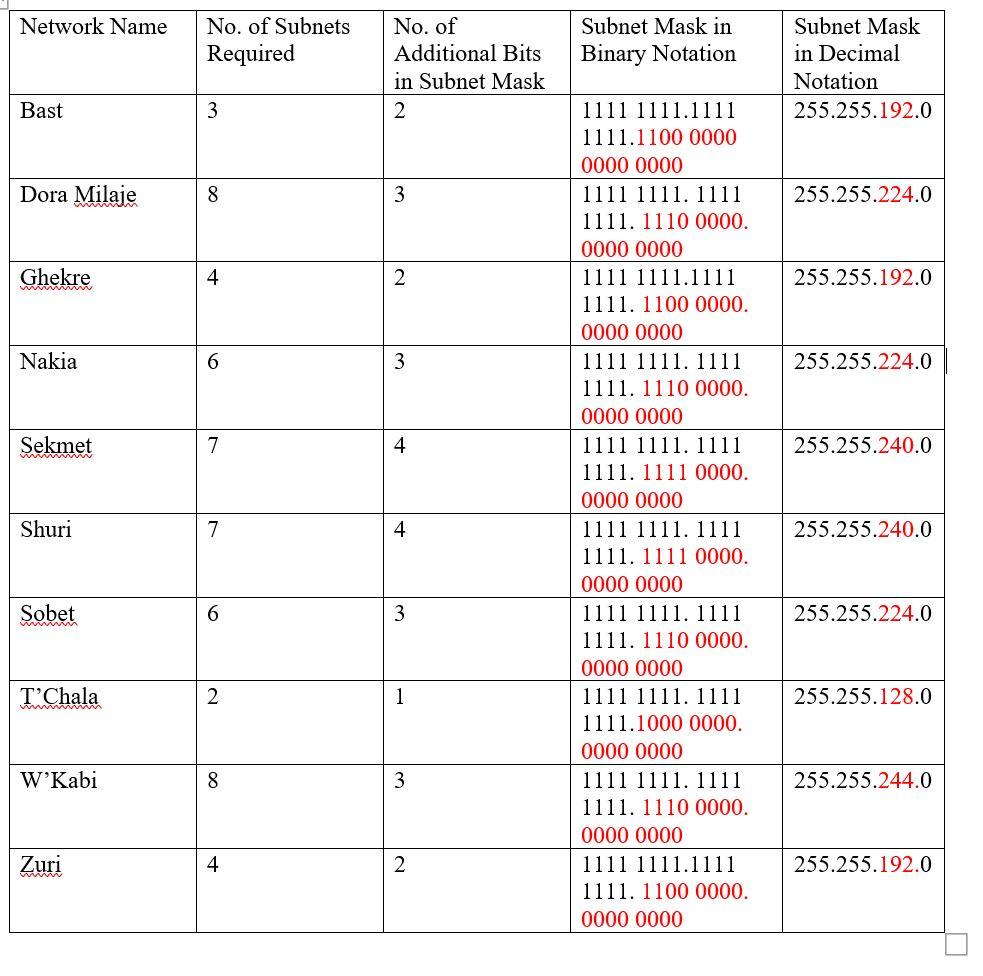
Can you make sure my work is correct? I noticed there are multiple Subnet masks.
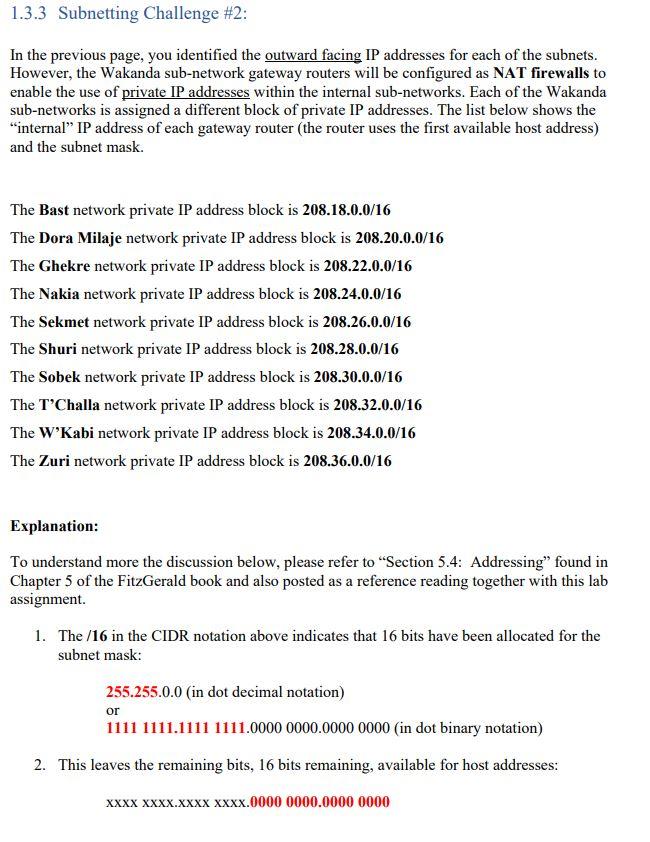
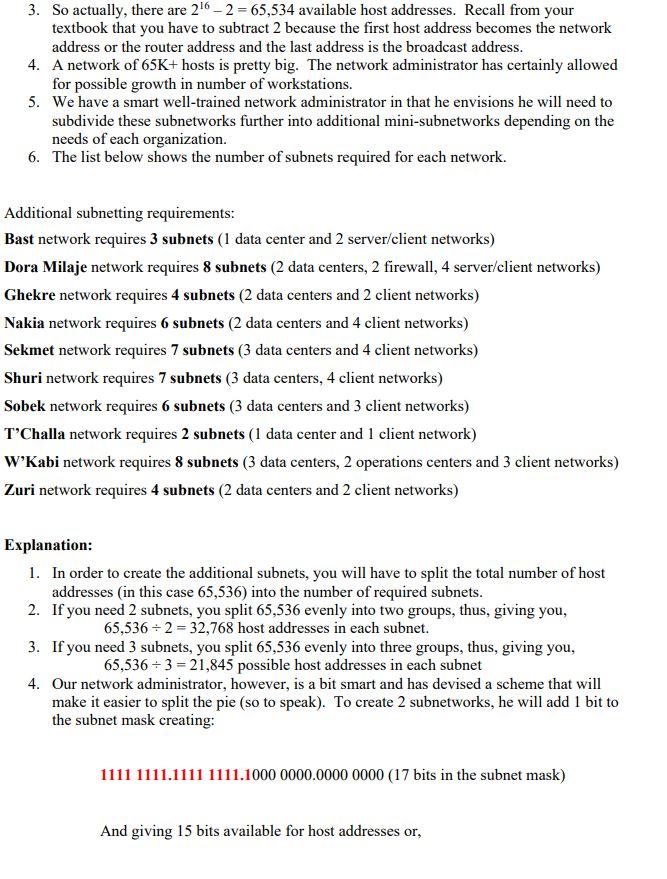
1.3.3 Subnetting Challenge #2: In the previous page, you identified the outward facing IP addresses for each of the subnets. However, the Wakanda sub-network gateway routers will be configured as NAT firewalls to enable the use of private IP addresses within the internal sub-networks. Each of the Wakanda sub-networks is assigned a different block of private IP addresses. The list below shows the "internal" IP address of each gateway router (the router uses the first available host address) and the subnet mask. The Bast network private IP address block is 208.18.0.0/16 The Dora Milaje network private IP address block is 208.20.0.0/16 The Ghekre network private IP address block is 208.22.0.0/16 The Nakia network private IP address block is 208.24.0.0/16 The Sekmet network private IP address block is 208.26.0.0/16 The Shuri network private IP address block is 208.28.0.0/16 The Sobek network private IP address block is 208.30.0.0/16 The T'Challa network private IP address block is 208.32.0.0/16 The WKabi network private IP address block is 208.34.0.0/16 The Zuri network private IP address block is 208.36.0.0/16 Explanation: To understand more the discussion below, please refer to Section 5.4: Addressing found in Chapter 5 of the FitzGerald book and also posted as a reference reading together with this lab assignment. 1. The /16 in the CIDR notation above indicates that 16 bits have been allocated for the subnet mask: 255.255.0.0 (in dot decimal notation) or 1111 1111.1111 1111.0000 0000.0000 0000 (in dot binary notation) 2. This leaves the remaining bits, 16 bits remaining, available for host addresses: XXXX XXXX.XXXX XXXX.0000 0000.0000 0000 3. So actually, there are 26- 2 = 65,534 available host addresses. Recall from your textbook that you have to subtract 2 because the first host address becomes the network address or the router address and the last address is the broadcast address. 4. A network of 65K+ hosts is pretty big. The network administrator has certainly allowed for possible growth in number of workstations. 5. We have a smart well-trained network administrator in that he envisions he will need to subdivide these subnetworks further into additional mini-subnetworks depending on the needs of each organization. 6. The list below shows the number of subnets required for each network. Additional subnetting requirements: Bast network requires 3 subnets (1 data center and 2 server/client networks) Dora Milaje network requires 8 subnets (2 data centers, 2 firewall, 4 server/client networks) Ghekre network requires 4 subnets (2 data centers and 2 client networks) Nakia network requires 6 subnets (2 data centers and 4 client networks) Sekmet network requires 7 subnets (3 data centers and 4 client networks) Shuri network requires 7 subnets (3 data centers, 4 client networks) Sobek network requires 6 subnets (3 data centers and 3 client networks) T'Challa network requires 2 subnets (1 data center and 1 client network) W Kabi network requires 8 subnets (3 data centers, 2 operations centers and 3 client networks) Zuri network requires 4 subnets (2 data centers and 2 client networks) Explanation: 1. In order to create the additional subnets, you will have to split the total number of host addresses in this case 65,536) into the number of required subnets. 2. If you need 2 subnets, you split 65,536 evenly into two groups, thus, giving you, 65,536 +2 = 32,768 host addresses in each subnet. 3. If you need 3 subnets, you split 65,536 evenly into three groups, thus, giving you, 65,536 + 3 = 21,845 possible host addresses in each subnet 4. Our network administrator, however, is a bit smart and has devised a scheme that will make it easier to split the pie (so to speak). To create 2 subnetworks, he will add 1 bit to the subnet mask creating: 1111 1111.1111 1111.1000 0000.0000 0000 (17 bits in the subnet mask) And giving 15 bits available for host addresses or, Network Name No. of Subnets Required No. of Additional Bits in Subnet Mask 2 Subnet Mask in Binary Notation Subnet Mask in Decimal Notation 255.255.192.0 Bast 3 Dora Milaje 8 3 255.255.224.0 Ghekre 4 2 255.255.192.0 Nakia 6 3 255.255.224.0 Sekmet 7 4 255.255.240.0 w 1111 1111.1111 1111.1100 0000 0000 0000 1111 1111. 1111 1111. 1110 0000. 0000 0000 1111 1111.1111 1111. 1100 0000. 0000 0000 1111 1111. 1111 1111. 1110 0000. 0000 0000 1111 1111. 1111 1111. 1111 0000. 0000 0000 1111 1111. 1111 1111. 1111 0000. 0000 0000 1111 1111. 1111 1111. 1110 0000. 0000 0000 1111 1111. 1111 1111.1000 0000. 0000 0000 1111 1111. 1111 1111. 1110 0000. 0000 0000 1111 1111.1111 1111. 1100 0000. 0000 0000 Shuri 7 4 255.255.240.0 Sobet 6 3 255.255.224.0 WMWM T'Chala 2 1 255.255.128.0 Www W'Kabi 8 3 255.255.244.0 2 Zuri 4 2 255.255.192.0 w 1.3.3 Subnetting Challenge #2: In the previous page, you identified the outward facing IP addresses for each of the subnets. However, the Wakanda sub-network gateway routers will be configured as NAT firewalls to enable the use of private IP addresses within the internal sub-networks. Each of the Wakanda sub-networks is assigned a different block of private IP addresses. The list below shows the "internal" IP address of each gateway router (the router uses the first available host address) and the subnet mask. The Bast network private IP address block is 208.18.0.0/16 The Dora Milaje network private IP address block is 208.20.0.0/16 The Ghekre network private IP address block is 208.22.0.0/16 The Nakia network private IP address block is 208.24.0.0/16 The Sekmet network private IP address block is 208.26.0.0/16 The Shuri network private IP address block is 208.28.0.0/16 The Sobek network private IP address block is 208.30.0.0/16 The T'Challa network private IP address block is 208.32.0.0/16 The WKabi network private IP address block is 208.34.0.0/16 The Zuri network private IP address block is 208.36.0.0/16 Explanation: To understand more the discussion below, please refer to Section 5.4: Addressing found in Chapter 5 of the FitzGerald book and also posted as a reference reading together with this lab assignment. 1. The /16 in the CIDR notation above indicates that 16 bits have been allocated for the subnet mask: 255.255.0.0 (in dot decimal notation) or 1111 1111.1111 1111.0000 0000.0000 0000 (in dot binary notation) 2. This leaves the remaining bits, 16 bits remaining, available for host addresses: XXXX XXXX.XXXX XXXX.0000 0000.0000 0000 3. So actually, there are 26- 2 = 65,534 available host addresses. Recall from your textbook that you have to subtract 2 because the first host address becomes the network address or the router address and the last address is the broadcast address. 4. A network of 65K+ hosts is pretty big. The network administrator has certainly allowed for possible growth in number of workstations. 5. We have a smart well-trained network administrator in that he envisions he will need to subdivide these subnetworks further into additional mini-subnetworks depending on the needs of each organization. 6. The list below shows the number of subnets required for each network. Additional subnetting requirements: Bast network requires 3 subnets (1 data center and 2 server/client networks) Dora Milaje network requires 8 subnets (2 data centers, 2 firewall, 4 server/client networks) Ghekre network requires 4 subnets (2 data centers and 2 client networks) Nakia network requires 6 subnets (2 data centers and 4 client networks) Sekmet network requires 7 subnets (3 data centers and 4 client networks) Shuri network requires 7 subnets (3 data centers, 4 client networks) Sobek network requires 6 subnets (3 data centers and 3 client networks) T'Challa network requires 2 subnets (1 data center and 1 client network) W Kabi network requires 8 subnets (3 data centers, 2 operations centers and 3 client networks) Zuri network requires 4 subnets (2 data centers and 2 client networks) Explanation: 1. In order to create the additional subnets, you will have to split the total number of host addresses in this case 65,536) into the number of required subnets. 2. If you need 2 subnets, you split 65,536 evenly into two groups, thus, giving you, 65,536 +2 = 32,768 host addresses in each subnet. 3. If you need 3 subnets, you split 65,536 evenly into three groups, thus, giving you, 65,536 + 3 = 21,845 possible host addresses in each subnet 4. Our network administrator, however, is a bit smart and has devised a scheme that will make it easier to split the pie (so to speak). To create 2 subnetworks, he will add 1 bit to the subnet mask creating: 1111 1111.1111 1111.1000 0000.0000 0000 (17 bits in the subnet mask) And giving 15 bits available for host addresses or, Network Name No. of Subnets Required No. of Additional Bits in Subnet Mask 2 Subnet Mask in Binary Notation Subnet Mask in Decimal Notation 255.255.192.0 Bast 3 Dora Milaje 8 3 255.255.224.0 Ghekre 4 2 255.255.192.0 Nakia 6 3 255.255.224.0 Sekmet 7 4 255.255.240.0 w 1111 1111.1111 1111.1100 0000 0000 0000 1111 1111. 1111 1111. 1110 0000. 0000 0000 1111 1111.1111 1111. 1100 0000. 0000 0000 1111 1111. 1111 1111. 1110 0000. 0000 0000 1111 1111. 1111 1111. 1111 0000. 0000 0000 1111 1111. 1111 1111. 1111 0000. 0000 0000 1111 1111. 1111 1111. 1110 0000. 0000 0000 1111 1111. 1111 1111.1000 0000. 0000 0000 1111 1111. 1111 1111. 1110 0000. 0000 0000 1111 1111.1111 1111. 1100 0000. 0000 0000 Shuri 7 4 255.255.240.0 Sobet 6 3 255.255.224.0 WMWM T'Chala 2 1 255.255.128.0 Www W'Kabi 8 3 255.255.244.0 2 Zuri 4 2 255.255.192.0 w
Step by Step Solution
There are 3 Steps involved in it

Get step-by-step solutions from verified subject matter experts