







Question: Can you please answer and help me understand the problem below? Consider this helper method: void insert (int x, int n, int arr) ( for
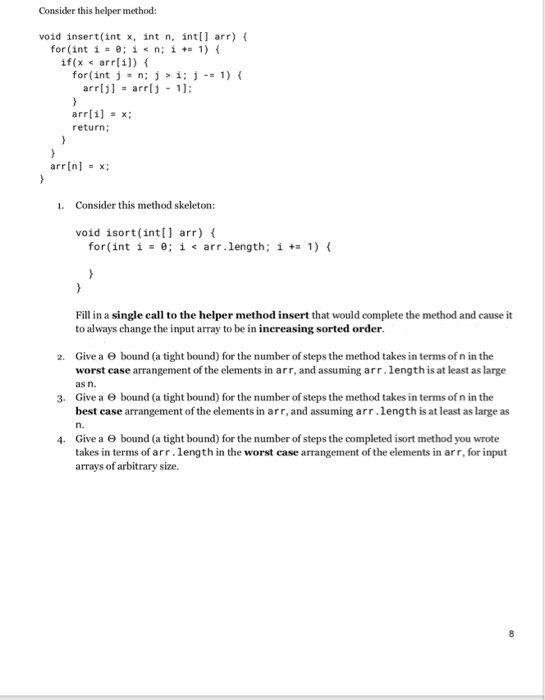
Consider this helper method: void insert (int x, int n, int arr) ( for (int @; n; + 1) { if (xarrlil) for( int j n; j > i; j- 1) { rarrl 11: arr] x; return arr[n] x; 1. Consider this method skeleton void isort(int arr) for(int 0; i arr.length; +. ) { Fill in a single call to the helper method insert that would complete the method and cause it to always change the input array to be in increasing sorted order Give a worst case arrangement of the elements in arr, and assuming arr.length is at least as large as n. Give a best case arrangement of the elements in arr, and assuming arr.length is at least as large as n. 2. bound (a tight bound) for the number of steps the method takes in terms of n in the 3. bound (a tight bound) for the number of steps the method takes in terms of n in the 4. Give a e bound (a tight bound) for the number of steps the completed isort method you wrote takes in terms of arr.length in the worst case arrangement of the elements in arr, for input arrays of arbitrary size
Step by Step Solution
There are 3 Steps involved in it

Get step-by-step solutions from verified subject matter experts
 Study Help