Question: Can you please answer the last 3 question from application of chapter content. do not answer too short Management in Action Difficulties Ati Imagine a
Can you please answer the last 3 question from application of chapter content. do not answer too short
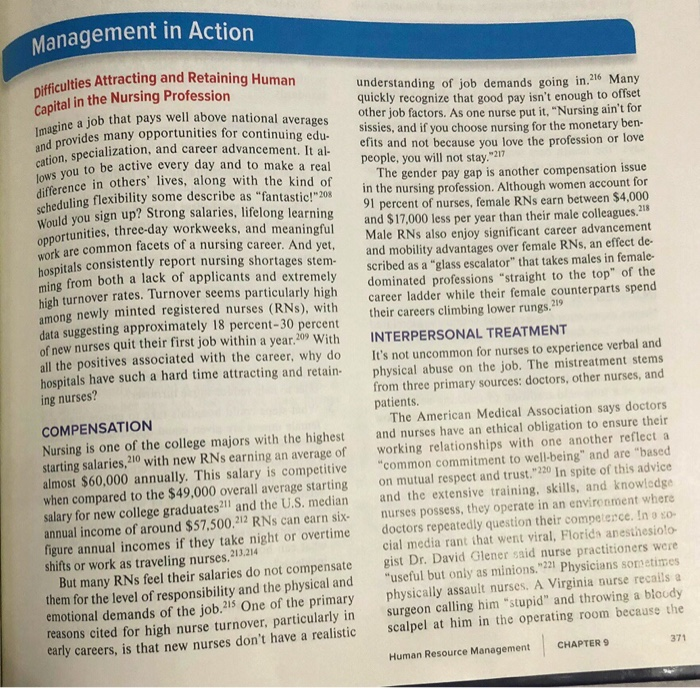
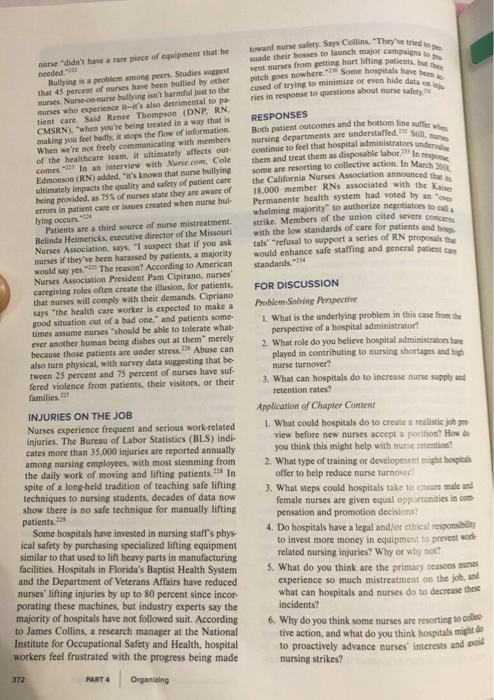
Management in Action Difficulties Ati Imagine a job that p and provides many o cation, specialization, a lows you to be active ever difference in others' live culties Attracting and Retaining Human ital in the Nursing Profession a job that pays well above national averages vides many opportunities for continuing edu- pecialization, and career advancement. It al- to be active every day and to make a real ce in others' lives, along with the kind of ling flexibility some describe as "fantastic!"208 ould you sign up? Strong salaries, lifelong learning portunities, three-day workweeks, and meaningful rk are common facets of a nursing career. And yet, hospitals consistently report nursing shortages stem- ing from both a lack of applicants and extremely high turnover rates. Turnover seems particularly high among newly minted registered nurses (RNS), with data suggesting approximately 18 percent-30 percent of new nurses quit their first job within a year 209 With all the positives associated with the career, why do hospitals have such a hard time attracting and retain. opportunities, three-day understanding of job demands going in.216 Many quickly recognize that good pay isn't enough to offset other job factors. As one nurse put it. "Nursing ain't for sissies, and if you choose nursing for the monetary ben- efits and not because you love the profession or love people, you will not stay."217 The gender pay gap is another compensation issue in the nursing profession. Although women account for 91 percent of nurses, female RNs earn between $4,000 and $17,000 less per year than their male colleagues.218 Male RNs also enjoy significant career advancement and mobility advantages over female RNs, an effect de- scribed as a "glass escalator" that takes males in female- dominated professions "straight to the top of the career ladder while their female counterparts spend their careers climbing lower rungs.21% INTERPERSONAL TREATMENT It's not uncommon for nurses to experience verbal and physical abuse on the job. The mistreatment stems from three primary sources: doctors, other nurses, and patients. The American Medical Association says doctors and nurses have an ethical obligation to ensure their working relationships with one another reflect a "common commitment to well-being" and are "based on mutual respect and trust."220 In spite of this advice and the extensive training, skills, and knowledge nurses possess, they operate in an environment where doctors repeatedly question their competence. In a no cial media rant that went viral, Florida anesthesiolo gist Dr. David Glener said nurse practitioners were "useful but only as minions."221 Physicians sometimes physically assault nurses. A Virginia nurse recalls a surgeon calling him "stupid" and throwing a bloody scalpel at him in the operating room because the Human Resource Management CHAPTER 9 371 ing nurses? COMPENSATION Nursing is one of the college majors with the highest starting salaries, 210 with new RNs earning an average of almost $60,000 annually. This salary is competitive when compared to the $49,000 overall average starting salary for new college graduates2ll and the U.S. median annual income of around $57.500.212 RNs can earn six- figure annual incomes if they take night or overtime shifts or work as traveling nurses.213.214 But many RNs feel their salaries do not compensate them for the level of responsibility and the physical and emotional demands of the job.215 One of the primary reasons cited for high nurse turnover, particularly in early careers, is that new nurses don't have a realistic and nurse safety. Says Collins, "They've tried suade their bosses to launch major campaigns ventures from getting hurt lifting patients pitch goes nowhere. Some hospitals have be cused of trying to minimize or even hide data ries in response to questions about nurse safety nurse "didn't have a rare piece of equipment that he needed Bullying is a problem among peers. Studies suggest that 45 percent of nurses have been bullied by other nurses, Nurse-on-ourse bullying isn't harmful just to the nurses who experience it-it's also detrimental to po tient care. Said Renee Thompson (DNP, RN. CMSRN). "when you're being treated in a way that is making you feel badly, it stops the flow of information When we're not freely communicating with members of the healthcare team, it ultimately affects out comes in an interview with Nurse.com, Cole Edmonson (RN) added, it's known that nurse bullying ultimately impacts the quality and safety of patient care being provided, as 75% of nurses state they are aware of errors in patient care or issues created when nurse bul lying occurs. Patients are a third source of nurse mistreatment. Belinda Heimericks, executive director of the Missouri Nurses Association, says. "I suspect that if you ask nurses if they've been harassed by patients, a majority would say yes. 225 The reason? According to American Nurses Association President Pam Cipirano, nurses' caregiving roles often create the illusion, for patients. that nurses will comply with their demands. Cipriano says "the health care worker is expected to make a good situation out of a bad one, and patients some times assume nurses should be able to tolerate what ever another human being dishes out at them merely because those patients are under stress. 26 Abuse can also turn physical, with survey data suggesting that be- tween 25 percent and 75 percent of nurses have suf- fered violence from patients, their visitors, or their families 22 RESPONSES Rath patient outcomes and the bottom line sur nursing departments are understaffed. continue to feel that hospital administrators und them and treat them as disposable labor. Inte some are resorting to collective action. In March the California Nurses Association announced the 18.000 member RNs associated with the ki Permanente health system had voted by an whelming majority" to authorize negotiators to strike. Members of the union cited severe con with the low standards of care for patients and he tals refusal to support a series of RN proposal would enhance safe staffing and general patient standards. 24 INJURIES ON THE JOB Nurses experience frequent and serious work-related injuries. The Bureau of Labor Statistics (BLS) indi- cates more than 35,000 injuries are reported annually among nursing employees, with most stemming from the daily work of moving and lifting patients. In spite of a long-held tradition of teaching safe lifting techniques to nursing students, decades of data now show there is no safe technique for manually lifting patients 229 Some hospitals have invested in nursing staff's phys- ical safety by purchasing specialized lifting equipment similar to that used to lift heavy parts in manufacturing facilities. Hospitals in Florida's Baptist Health System and the Department of Veterans Affairs have reduced nurses' lifting injuries by up to 80 percent since incor- porating these machines, but industry experts say the majority of hospitals have not followed suit. According to James Collins, a research manager at the National Institute for Occupational Safety and Health, hospital workers feel frustrated with the progress being made PART 4 Organizing FOR DISCUSSION Problem Solving Perspective 1. What is the underlying problem in this case from the perspective of a hospital administrator? 2. What role do you believe hospital administrators are played in contributing to nursing shortages and he nurse turnover? 3. What can hospitals do to increase nurse supply and retention rates? Application of Chapter Content 1. What could hospitals do to create a realistic job pre view before new nurses accept a position? How do you think this might help with nurse retention! 2. What type of training or development might hospitals offer to help reduce nurse turnover 3. What steps could hospitals take to ensure male and female nurses are given equal opportunities in com pensation and promotion decisions! 4. Do hospitals have a legal and/or cthical responsibility to invest more money in equipment to prevent work related nursing injuries? Why or why not? 5. What do you think are the primary reasons nurse experience so much mistreatment on the job, and what can hospitals and nurses do to decrease these incidents? 6. Why do you think some nurses are resorting to cole tive action, and what do you think hospitals might to proactively advance nurses' interests and avoid nursing strikes? 372









 Study Help